Her ex husband was being crowned King of Great Britain. She was still his prisoner. Their son was already Prince of Wales. She was forbidden to see him.
On 20 October 1714, George I was crowned at Westminster Abbey. Sophia Dorothea of Celle, the woman he had divorced in 1694, remained confined at Ahlden in northern Germany, with no place in the ceremony and no title to gain from it. The marriage had ended nearly twenty years earlier. The separation from her children had continued ever since.
She had once been a very desirable bride. Her father, Georg Wilhelm, Duke of Brunswick-Lüneburg, ruled at Celle, and she was his only surviving child. Her mother, Eléonore d'Olbreuse, was a French Huguenot noblewoman whom he loved. In a world where princely marriages were negotiated for the benefit of territories and families, her parents had made an unusually personal choice. Their daughter's marriage would be arranged on more conventional terms.
Georg Wilhelm and his brother Ernst August had an inheritance to settle. Marrying Sophia Dorothea to Ernst August's eldest son would bring the interests of the two branches of the family together. The bridegroom, Georg Ludwig, was her first cousin, the man who would become George I. They married in 1682, when she was sixteen. Whatever the two young people might make of one another, the older men had found a satisfactory arrangement for Celle.
Sophia Dorothea gave birth to a son, George Augustus, in 1683, and a daughter, also named Sophia Dorothea, in 1687. A family portrait painted by Jacques Vaillant around 1690 shows the mother with both children. It preserves the three of them together, before the adults' marriage was dismantled and the children remained with their father's family. The boy would inherit a crown. His mother's right to see him would prove rather less secure than his right to succeed.
The marriage was unhappy. George had a relationship with Melusine von der Schulenburg; Sophia Dorothea became involved with the Swedish count Philipp Christoph von Königsmarck, an officer in Hanoverian service. Their relationship left a substantial trace. About three hundred letters survive, written between two people whose private lives were becoming a matter of public danger at court. By 1694, the lovers were planning to escape.
Königsmarck disappeared that July. He is presumed to have been murdered. What happened to him, and who was responsible, has never been established.
Sophia Dorothea's fate was considerably more public. Her marriage was dissolved in 1694, and she was confined at Ahlden. The affair had helped destroy her position, but the divorce did not give her the freedom to begin again. She could no longer live with her husband. She could not choose to live elsewhere. Her children stayed beyond her reach.
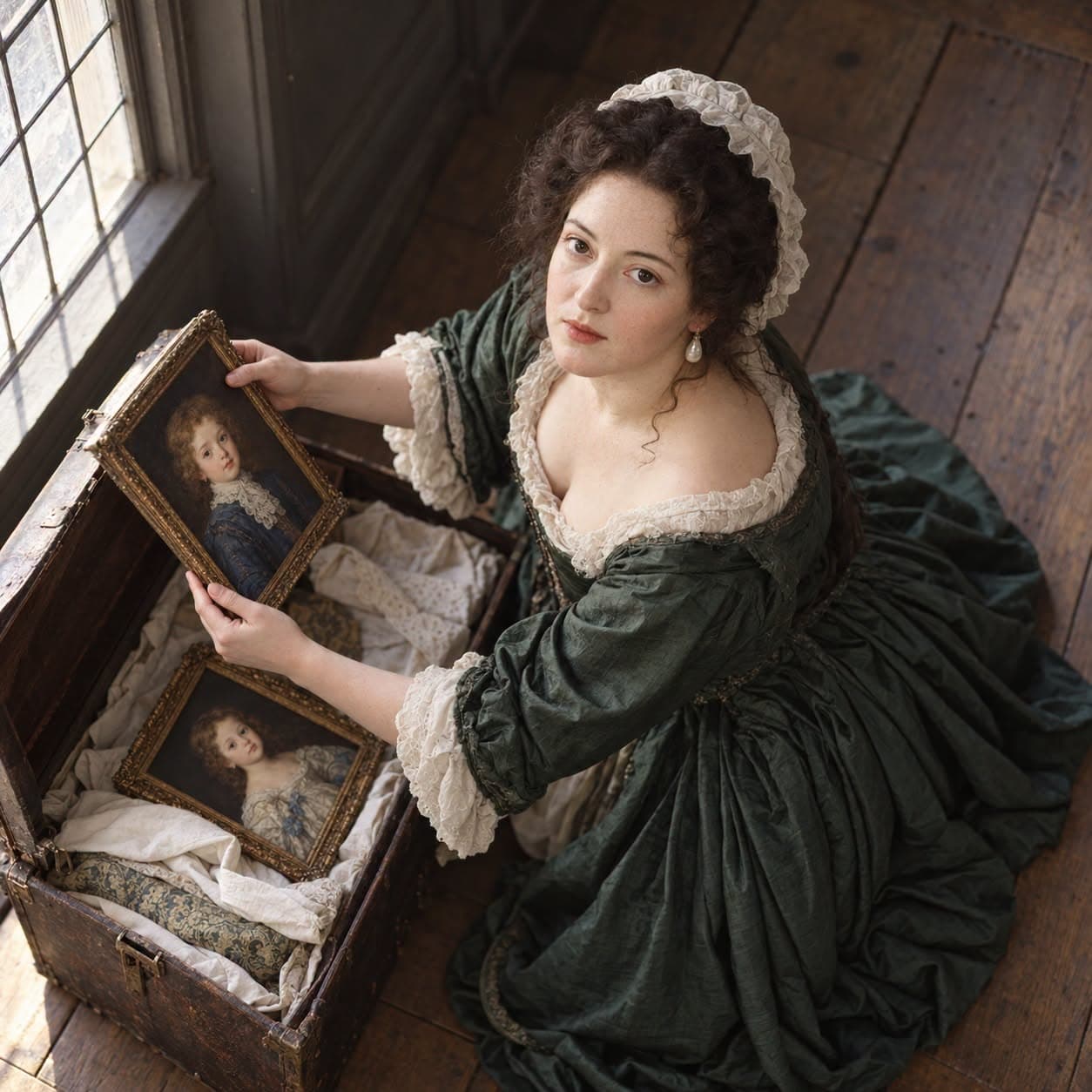
She was allowed to take portraits of them with her.
Ahlden was a guarded residence, with the comforts due to a woman of her rank and restrictions that made those comforts a poor substitute for liberty. Her correspondence was inspected. Outings were limited. Her mother was eventually permitted to visit, but the children were not. It was entirely possible to keep a princess's household in good order while refusing her the ordinary freedom to go and see her family, and both arrangements were maintained for years.
She did ask. After her former husband succeeded his father as Elector of Hanover, she wrote requesting permission to see the children. He did not reply. The portraits could accompany her into confinement; the people they represented could not.
By the autumn of 1714, George Augustus was a grown man. He had travelled to Britain with his father, landing at Greenwich in September, and had been created Prince of Wales before the coronation. The child from the family portrait now had a place in the public ceremonies and expectations of another country. His mother remained at Ahlden, where his childhood had passed without her.
George's British crown came through his own mother, Sophia of Hanover, Sophia Dorothea's former mother-in-law, who had died earlier that year. The arrangement made at Celle had done its work long before Britain entered the picture. The children belonged to the dynasty, and the dynasty had acquired a much larger future.
There was an opportunity to change something for Sophia Dorothea that year. When George went to Britain, it was suggested that he might ease the conditions of her confinement. He refused. A new kingdom required departures, appointments and titles. It required no alteration to her life at Ahlden.
She was forty-eight when he was crowned, with nearly twenty years of separation behind her and a son who was now Prince of Wales in a country she had never seen. She died at Ahlden in November 1726, at the age of sixty. Her son became George II the following June. Twelve years had passed between his father's coronation and her death, and any one of them might have held a meeting. She never saw either of her children again.