She was twenty-two, and both her little girls were already dead. They had died six days apart. Now she had given birth to a son. He would be buried that same day.
On 22 October 1687, Princess Anne, the future Queen Anne, delivered a stillborn boy at Whitehall Palace. His burial was entered in the registers of Westminster Abbey, where his sisters Mary and Anne Sophia had been laid in the royal vault that February. Between their deaths and this new loss lay the months of another pregnancy. There was still no living child.
Anne had married Prince George of Denmark four years earlier, when she was eighteen. It was a marriage arranged between royal families, with the usual business of alliances behind it. The life they made together became something warmer. Charles II, Anne's uncle, gave them the Cockpit, a group of buildings within Whitehall, as their London home. Here was a household of their own inside the palace, and soon there were children.
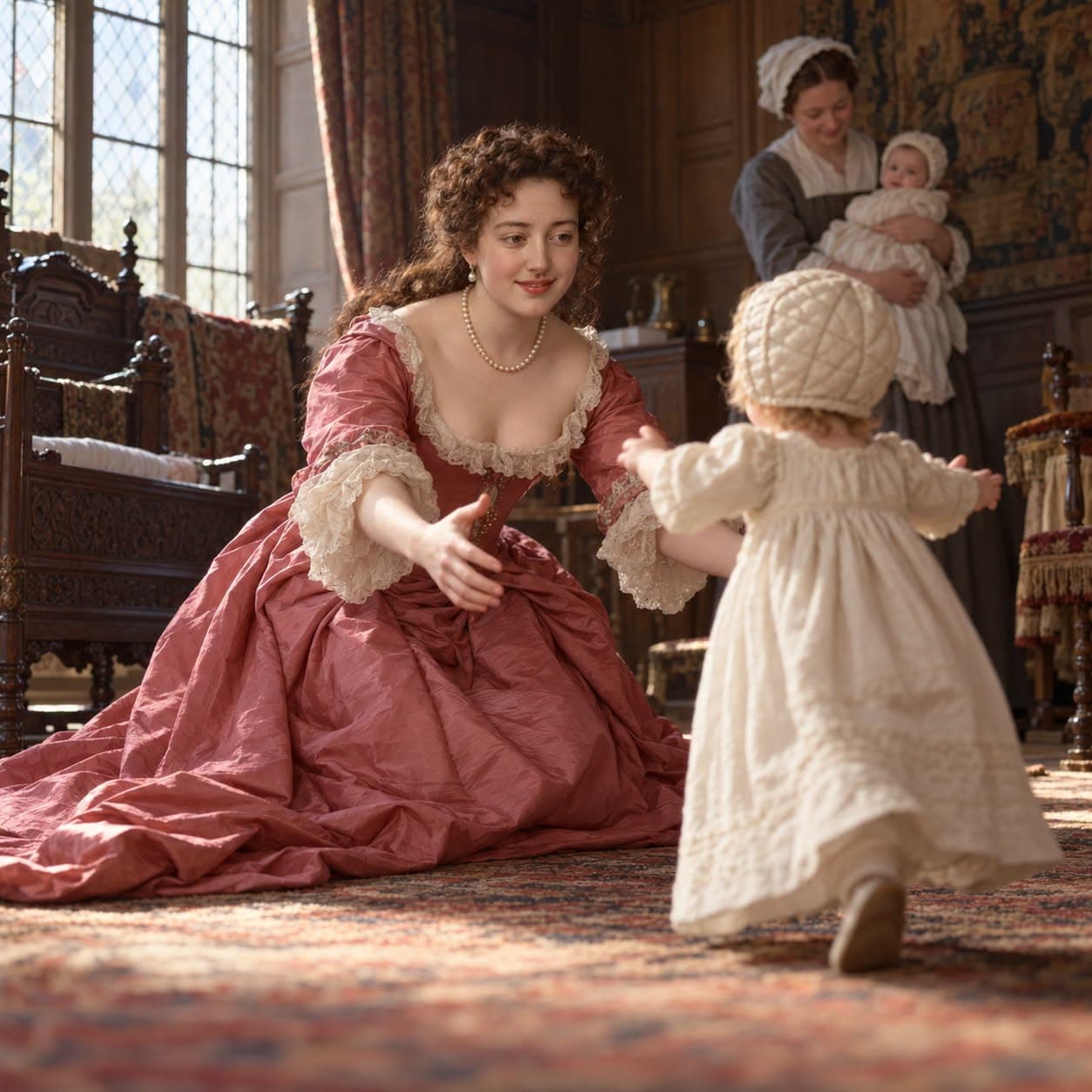
Their first daughter had been stillborn in May 1684. Then Mary was born in June 1685, and Anne Sophia the following May. By the beginning of 1687, Anne and George had two living daughters, neither yet two years old, and Anne was pregnant again. One was a toddler and the other still a baby in arms. The family had survived one loss and kept growing.
Then Anne miscarried in January. In February, smallpox took both girls.
Anne Sophia died first, on 2 February, at eight months old. She was buried in Westminster Abbey two days later. Mary died on 8 February, at twenty months, and was buried there on the tenth. Within a week, the younger sister had been followed by the elder. The register entries gave them their names and their parentage, daughters of Prince George and Princess Anne of Denmark.
George was ill too. The disease that had killed their daughters had reached their father, and Anne, recovering from a miscarriage and grieving for the girls, nursed him. A family that had scarcely begun to bury two children now faced the possibility of a third death.
Sometimes, Lady Rachel Russell was told, they wept. Sometimes they mourned in words. Then they sat silent, hand in hand, George sick in bed and Anne caring for him. The young woman who had lost her daughters was also the one tending their father.
George recovered.
There were no living children now.
Anne's family occupied an awkward place in her father's kingdom. James II was Catholic; she and her elder sister Mary had been brought up as Protestants. Mary lived in the Netherlands with her husband, William of Orange. Anne and George remained in England, a Protestant household within the royal family. Their children belonged to the succession as well as to their parents. Royal births were family events over which other people made calculations.
But the daughters lost that February had been twenty months and eight months old. Before either could become a marriage alliance or a claim upon a throne, there had been the ordinary business of keeping a small child alive. A palace had not been protection enough.
By the spring Anne was expecting again. The father who had survived the winter and the mother who had nursed him through it lost this child too, in October, at Whitehall. The year had begun with two little daughters and a baby on the way. Before it ended there had been a miscarriage, two small funerals and a stillborn son.
There would be a son who lived longer. William, Duke of Gloucester, was born in 1689 and reached eleven before his death in July 1700. His death helped bring about the Act of Settlement the following year, which provided for the Protestant Hanoverian succession if Anne and William III left no eligible descendants. Anne became queen in 1702. None of her children reached adulthood.
All that lay ahead of the twenty-two-year-old princess at Whitehall. In October 1687 the Abbey already held Mary and Anne Sophia, buried six days apart in February. Now their brother went into the same vault, born and buried on the same date. Nearly twenty-seven years later Anne was laid there too, beside George, among the children who had gone before her.