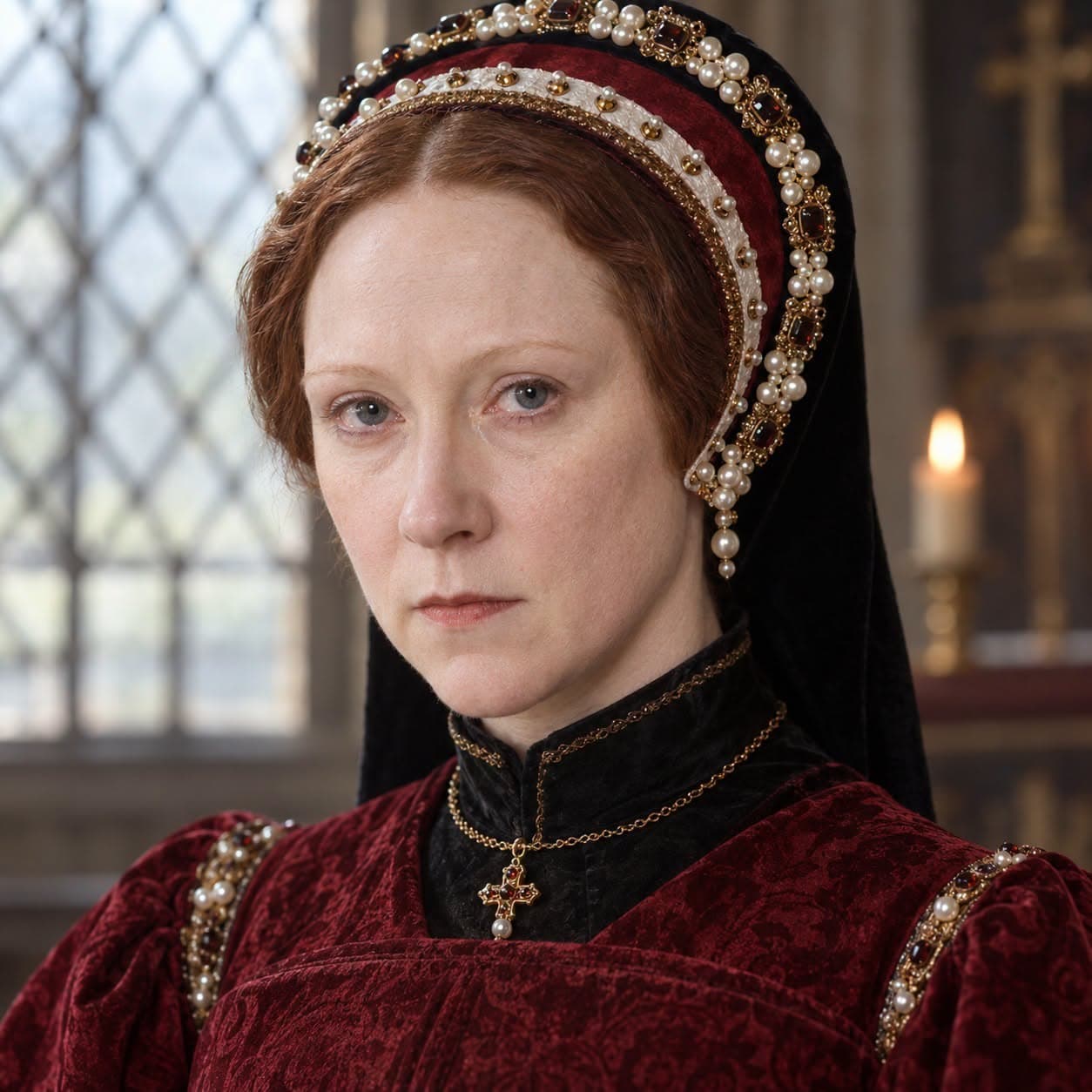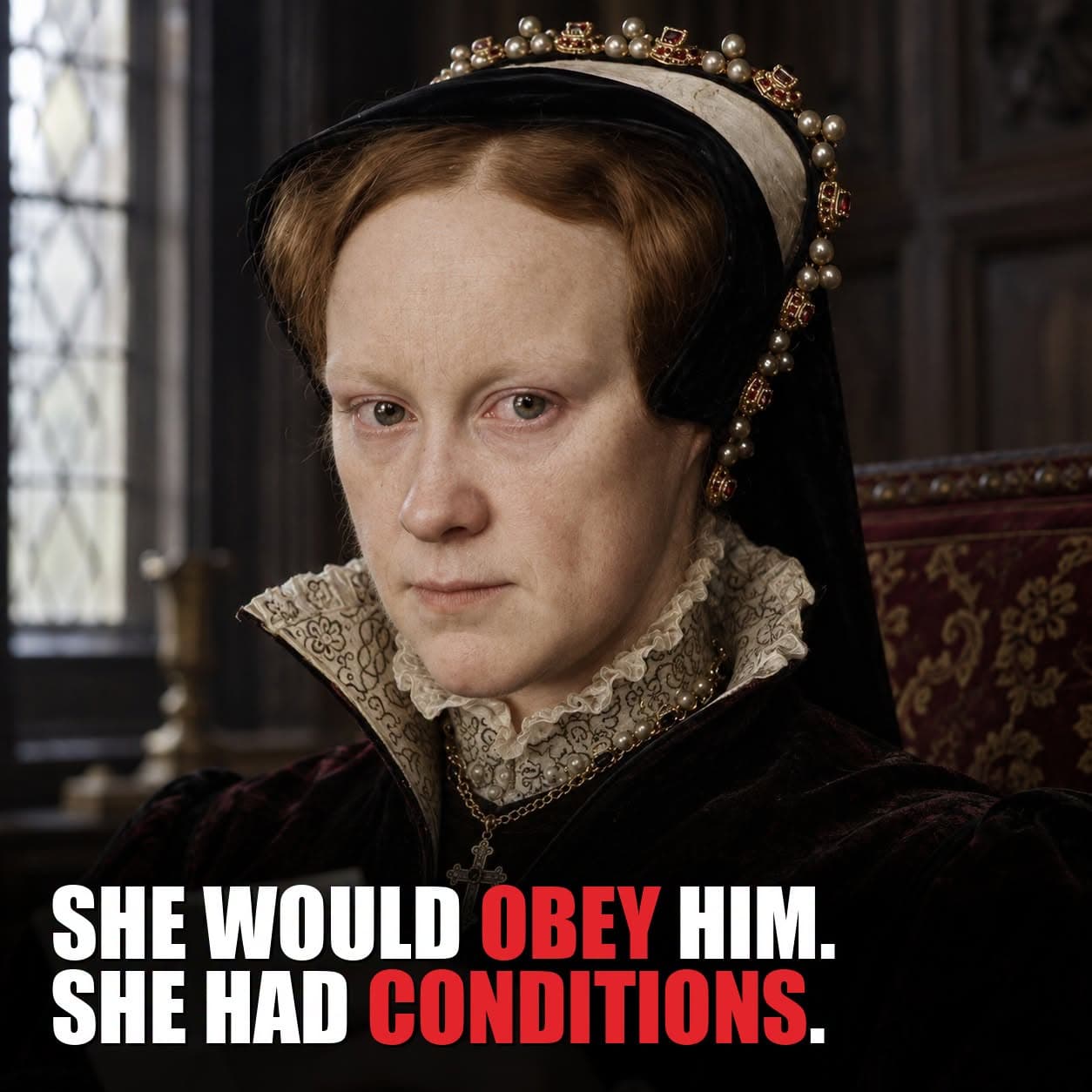
Mary I was thirty-seven, and the husband proposed for her was twenty-six. She intended to obey him as a wife. She had already said she could not let him encroach on her government.
On 27 October 1553, Mary I received Simon Renard, the emperor's ambassador, with four of her councillors present. He brought letters from his master, Charles V, urging her to marry. Mary had already seen a copy in private and read them with ease. She told Renard that she had spent more than two hours that day weeping and praying for guidance. She believed she would agree to the marriage Charles proposed, with his son Philip of Spain.
To her councillors she said that the emperor had written persuading her to marry, and that it was enough for her to have heard his mind. She commanded them to hear Renard's message and consider it carefully. She had indicated where she was leaning. The binding promise was still to come.
Mary had been crowned less than a month earlier. She was the daughter of Henry VIII and Katherine of Aragon, and her parents' marriage had once determined almost everything about her position. When Henry had it annulled, Mary lost her title of princess, was removed from the succession and was forbidden to see her mother. Now she held the crown herself. A marriage and children offered a way to continue the succession through her own family, but a husband brought a difficulty which her father had never needed to solve. Mary expected to submit to him in marriage while continuing to govern the country he would enter.
She had put that difficulty plainly to Renard earlier in October. She would wholly love and obey the man she married, as she believed God commanded. If he tried to encroach on the government of the kingdom, she would be unable to permit it, and the country would not accept its offices being filled with foreigners. She wanted advice from her Council, time to consider, and information about Philip himself. She had heard that he was very young and less wise than his father. The man recommending him was employed by that father. It was an awkward arrangement for obtaining a disinterested opinion of the bridegroom.
Renard supplied reassurance in abundance. Philip was virtuous, prudent and modest, of a stable and settled character. He had already been married and had a son of eight. His youth need not trouble her. He was powerful enough for England to look to him for protection. The emperor, meanwhile, was someone in whose goodwill Mary placed extraordinary confidence. She had said again and again that she would not marry without his knowledge and approval.
Other advice was close at hand. Stephen Gardiner, her Lord Chancellor and Bishop of Winchester, was one of the councillors in the room on 27 October. He favoured Edward Courtenay, Earl of Devon. He and other supporters of an English marriage warned her that the country would never accept a foreign king. Philip would not wish to leave his own dominions. England would find itself dragged into war with France. These were objections to which the queen had to find answers, even if the proposed alternative did nothing to please her.
She had no liking for Courtenay.
She told Renard that her councillors had no authority in matters that touched her so nearly. Yet she also wanted conditions settled before she committed herself, and she was quite specific about them. Foreigners were not to receive English offices. Philip was not to alter the laws or administration, take money out of the kingdom, or draw England into war. He should live in England or the Low Countries, and the Council should govern during his absence. Mary was asking how the marriage would work, down to who would hold its offices and whether its money would stay in the kingdom.
She was ready to promise obedience. She was still asking questions.
On Sunday evening, 29 October, she sent for Renard again. The Holy Sacrament was in the room where she received him. Only he and her attendant, Mrs Clarencieux, were with her. Mary told him that since he had presented the emperor's letters she had not slept, but had wept and prayed for an answer. She knelt and invoked the Holy Spirit with the words Veni, creator spiritus. Renard and Mrs Clarencieux knelt too.
When she rose, Mary explained what she had resolved. She believed what Renard had told her of Philip's qualities. She trusted Charles to observe the conditions protecting her country, to be a good father to her as he had been in the past, and to see that his son became a good husband to her. She felt herself inspired by God. There before the Sacrament, she promised to marry Philip, love him perfectly and never give him cause for jealousy. She said that her mind, once made up, would never change.
The terms still had to be settled. The promise had been given.
Two days later, on All Saints' Eve, Mary wrote to Renard in haste. She had forgotten to ask him one question the other night. Was he quite sure that there had never been any contract of marriage between Philip and the daughter of Portugal? There had been much talk to that effect. She asked him to write her the truth, on his faith and conscience. She also asked his advice on how to broach the matter to her Council. She had not yet raised it with a single councillor.
Four days after she had told her councillors to consider the emperor's letters, the queen was asking how to tell them what she had done. There was nothing else in the world, she wrote, that could make her break the promise she had made. She had sworn before the Sacrament to love Philip perfectly. She was still asking whether he was free to marry her.