She was twenty-five when she arrived to join her nineteen-year-old husband. She had already sung and danced at an emperor's court. Her new court would soon be arguing about who was allowed to dance with whom.
By 27 October 1708, Maria Anna of Austria had arrived in Lisbon amid the celebrations of her marriage to John V. This was Maria Anna, Queen of Portugal, 1683-1754, a daughter of the Habsburg emperor Leopold I. She was already John's wife by proxy, married in Vienna that summer with her brother, Emperor Joseph I, standing in for the bridegroom. The marriage had been performed. Now came the business of living in it.
John had turned nineteen only five days earlier. His father had died in December 1706, leaving him a kingdom before he was eighteen. Less than two years into his reign, the young king was receiving an emperor's daughter, and Lisbon was arranging a welcome to match. Royal marriages were public affairs long before the couple sat down to dinner.
Maria Anna's preparation for this one had included considerably more than a family name. Like her father, she was deeply musical, and at the Viennese court she had received a thorough musical training and sung and danced in its opera productions. She had learned Latin, Italian, French and Spanish. In that family a princess's singing and dancing belonged to the life of the court, and she had been part of it rather than merely watching. When she came to Portugal, she brought the experience of making a performance happen from inside it.
Lisbon's welcome had a performance of its own. A temporary bridge had been prepared to bring her ashore at the Terreiro do Paço. Bells rang and the surrounding fortresses fired salutes as she crossed. An English fleet had escorted her to Portugal; now the sounds of the city and its guns marked her passage from the water to the court. There was nothing private about a queen arriving to meet her husband.
Even dinner belonged to the occasion. The royal couple ate in public, with Portuguese singing and instrumental music accompanying the meal. Here was her new country's music, played for a woman accustomed to the Italian music cultivated at Vienna. Before she began arranging entertainments of her own, she was being entertained in the Portuguese manner.
The larger celebrations took longer. Preparations could not be hurried simply because the bride had arrived, and the major festivities were delayed until December. Meanwhile, Maria Anna wanted to go out into the city, which caused difficulty: custom required a royal bride to receive the cathedral blessing before making such outings. An imperial daughter could cross Europe to become a queen and still find her movements waiting upon the arrangements for her welcome.
Inside the palace, however, a new routine was already beginning. The king and queen wanted evening gatherings every Sunday and Thursday. The nobility was summoned, and the gatherings began. The welcome was becoming something repeated, with people returning to the palace twice a week rather than merely appearing for a wedding ceremony.
This was enough to produce an argument.
Some gentlemen favoured ladies coming into the antechambers to talk, play games and dance with men. Others insisted upon retirement, silence and modest reserve. Even an evening's amusement could become a dispute about the proper conduct of women, and about whether a shared dance offended the dignity of the court. A royal marriage had brought fresh company into the palace. Agreeing what that company should do together was another matter.
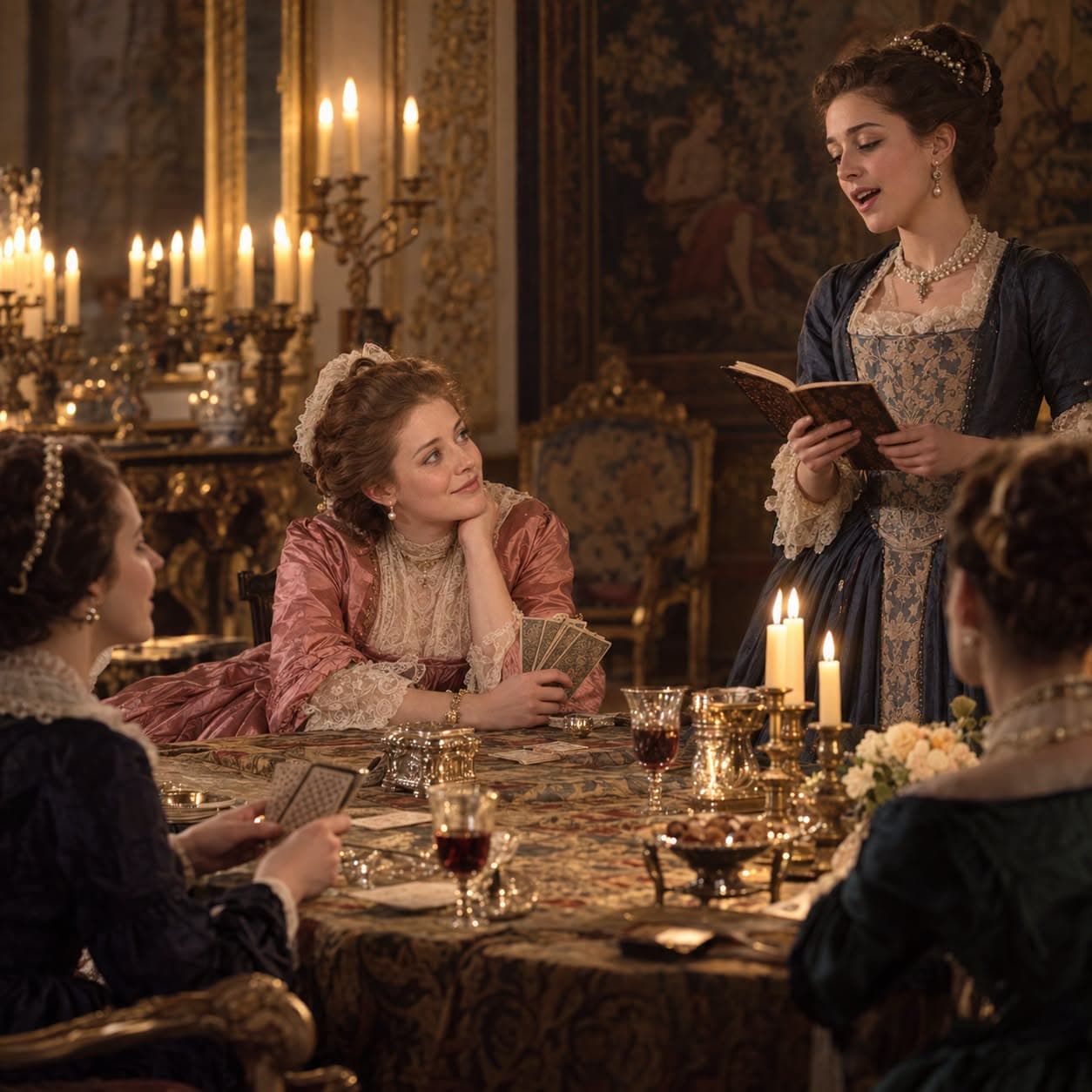
Maria Anna's own household contained Portuguese and German ladies. In December she was spending evenings playing games with the Portuguese women, sometimes listening to them sing and watching them dance in their own manner. These were smaller occasions than the public welcome, but they gave the women around her something to contribute. The queen who had performed at Vienna was now an audience for them. Her own accomplishments did not require everyone else's to disappear.
Nor was John merely looking on while his wife supplied the entertainment. He had wanted Italian musical theatre among the wedding festivities himself. The king and queen came from different musical worlds, and their early marriage drew on both, with the queen's household giving her rooms in which to arrange occasions of her own.
By Carnival in 1709 she had a German theatrical entertainment performed for him. John was particularly taken with its gestures and dancing, which were new to him. The twenty-five-year-old bride had arrived to a welcome prepared around her; now the nineteen-year-old king was watching a performance she had arranged. He had it performed again.