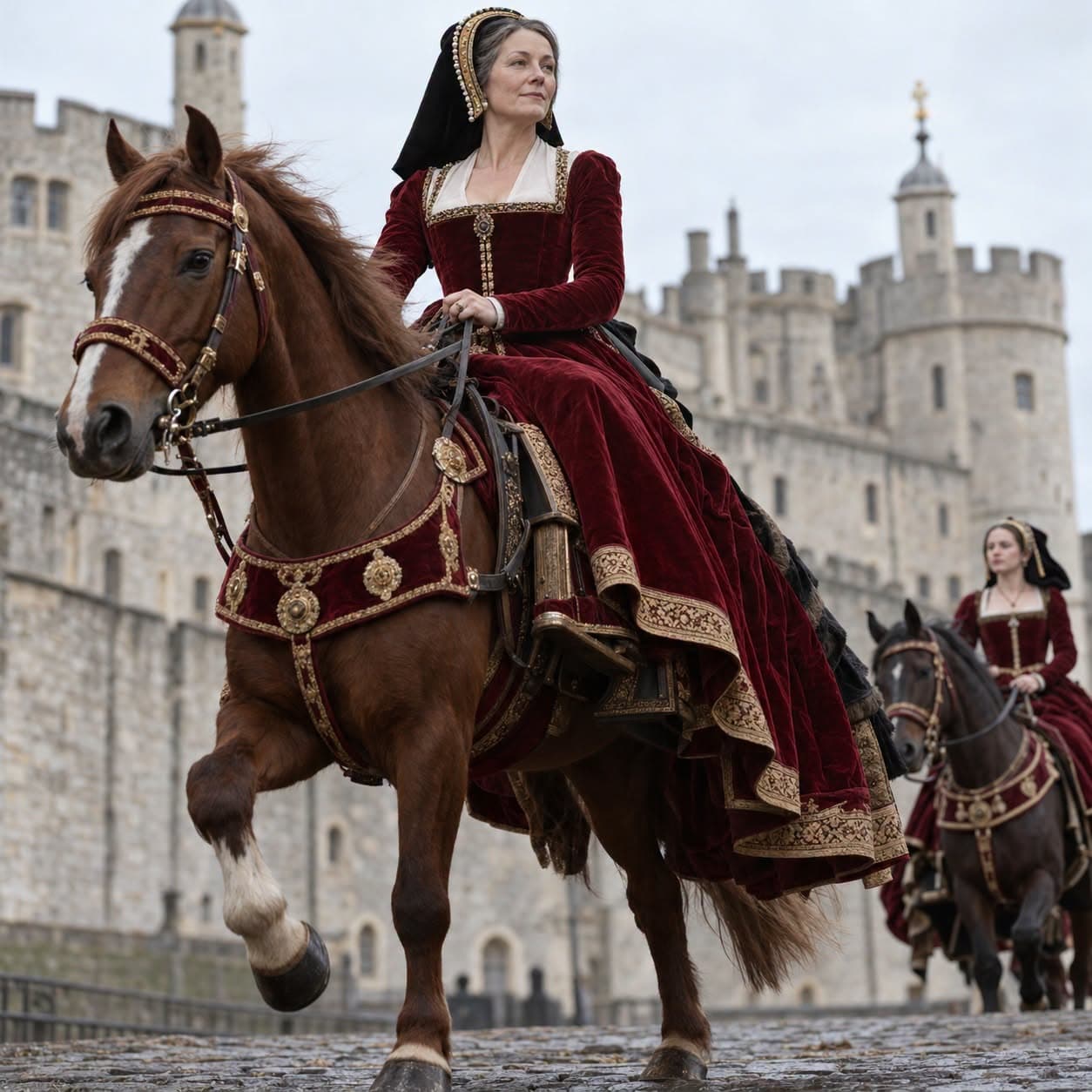
Gertrude rode out of the Tower in crimson velvet, still among the ladies of the queen's coronation procession. Her husband had been beheaded on Tower Hill. Her son had spent nearly fifteen years behind its walls.
Three weeks later, on 21 October 1553, royal assent was given to the private act restoring Gertrude Courtenay, Marchioness of Exeter, in blood. A separate act restored her son Edward the same day. Both were already free. What Parliament was repairing now was the legal damage left by attainder, the condemnation that had reached beyond a prisoner's life into property and inheritance.
Gertrude had once belonged comfortably to the court that destroyed her family. Born a Blount, the daughter of Lord Mountjoy, she married Henry Courtenay, Earl of Devon, in 1519. He was Henry VIII's first cousin. Their mothers were sisters, daughters of Edward IV, and the king rewarded his cousin with land and advancement. The next summer Gertrude made her first appearance as a countess at the Field of Cloth of Gold, attending Queen Catherine. Five years later her husband became Marquess of Exeter, and she became a marchioness.
Their son Edward was born into that closeness to the throne. He would spend most of his growing up confined by it.
When Henry sought to put Catherine of Aragon aside, Gertrude remained sympathetic to her cause and to her daughter Mary. There were practical dangers in staying attached to people the king wanted others to abandon. Gertrude went further. She travelled in disguise to consult Elizabeth Barton, the nun whose prophecies warned against Henry's repudiation of Catherine, and brought her to the Courtenay house at West Horsley in Surrey.
Barton went into a trance there. Prophecy had entered a household already connected by blood to the royal succession, which made it something the king's ministers could scarcely be expected to overlook. Gertrude was caught up in the investigation and in November 1533 wrote to the king for his forgiveness, calling the nun a "most unworthy, subtle and deceivable woman". She kept her freedom. Barton was executed for treason in April 1534. By November 1535 she was sending warning to the imperial ambassador that Catherine and Mary were in grave danger.
In November 1538, Gertrude, her husband and their son were imprisoned in the Tower. Her husband was convicted of treason with Henry Pole, Lord Montague, and on 9 December both men were beheaded on Tower Hill. The Crown took the family's estates. Gertrude remained a prisoner and was herself attainted in 1539.
The countess of the Field of Cloth of Gold now had no change of clothes. One of her keepers in the Tower, Thomas Philips, wrote that the Lady Marchioness "wanteth raiment, and hath no change". Her gentlewoman had no change either, and what she wore was badly worn. Another attendant had served Gertrude for more than a year, and Gertrude had no money to pay her wages.
Even in the Tower, there were wages owing. A household could be brought down with its mistress and still have to find something to wear in the morning.
Gertrude was pardoned and released on 21 December 1539, a little over a year after her imprisonment began. The family estates stayed with the Crown, and so did her son.
She had her freedom. He did not.
Henry VIII died in 1547 with Edward still in the Tower. Edward VI reigned for six years and left him there. He had entered it as a boy. By the time Catherine of Aragon's daughter became queen in 1553, he was a grown man whose adolescence and early adulthood had passed in confinement.
Mary had him released on 3 August. On 3 September she created him Earl of Devon. A month after leaving the Tower he had a title again, and there was talk that he might marry the queen. His descent, which had made him dangerous under one sovereign, made him a possible husband for another. Royal blood had become an advantage again with remarkable speed.
Gertrude returned to court too. The daughter of the queen she had supported now had the power to receive her, and her place in the coronation procession made that favour public. On 30 September she rode from the Tower towards Westminster among the four ladies of estate, dressed in crimson velvet, her horse trapped in the same. The Duchess of Norfolk, the Marchioness of Winchester and the Countess of Arundel were the other three. Gertrude was back in the company her rank had once made ordinary.
The following day Mary was crowned. Edward bore the sword at the coronation celebrations. Mother and son had their separate places in the ceremonies surrounding the new queen, after years in which one had been free and the other had remained a prisoner.
The acts of 21 October followed those public honours. Release had opened the prison and favour had brought them back to court, but neither had undone an attainder. Restitution in blood removed the disabilities that a pardon alone had left in place, the bar on inheriting and passing on what a family held. It did not, simply by its name, hand back every forfeited estate or title. Even a grateful queen had to work through Parliament, and Parliament dealt with mother and son one act at a time.
Gertrude had ridden away from the Tower with Mary's coronation company, and Edward had carried the sword before the new queen. In October their names appeared in separate acts of restoration. His named him Earl of Devon. Hers still identified her through the husband executed nearly fifteen years before: the "late wife of Henry Courtney, late lord marquis of Exeter".