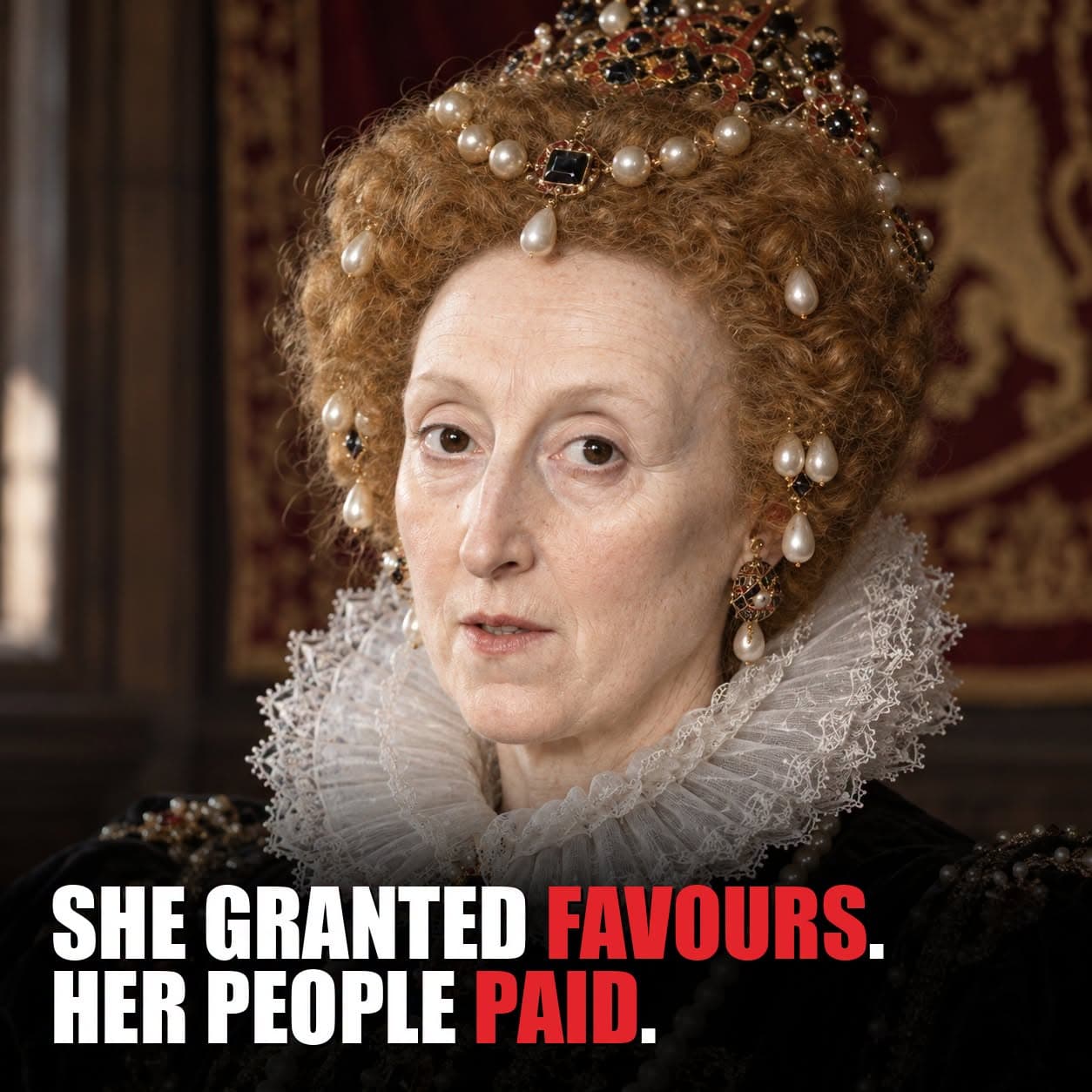
Elizabeth I was sixty-eight, riding to Parliament in an open chariot. She needed money for war. Before the session was over, she would have to answer for what her own royal favours had cost her people.
On 27 October 1601, Elizabeth I opened her final Parliament. She set out from Whitehall at about three in the afternoon, in an open chariot under a canopy of cloth of silver, with lords and bishops in their robes around her. She went first to Westminster Abbey to hear a sermon, then on to the Upper House. There was still a whole machinery for putting Elizabeth at the centre of England, and that afternoon it was at work.
A few weeks earlier, Spanish troops had landed at Kinsale in Ireland. The Lord Keeper, Thomas Egerton, explained the business beneath the ceremony. England was at war with Spain. War required money, and Parliament had been assembled to help provide it. Many of the Commons never heard him say so. Many members were kept out of the chamber, and a good number went away discontented. A crown could command a procession. Paying for an army required rather more than everyone knowing where to stand.
For Elizabeth, rewarding service had its own expense. One way of meeting it was to grant a courtier the exclusive right to trade in a particular commodity. A royal patent could turn an article bought and sold by many people into a source of profit controlled by a few. The queen had something valuable to give without finding the equivalent in ready money. The recipient had a favour that other people would pay for.
Salt, leather, coal. These were things people needed, and an exclusive right to supply them gave its holder an uncomfortable amount of power over the price. The advantage of the arrangement was much easier to appreciate at court than at the point of purchase. Royal generosity could be expensive for people who had received none of it.
The Commons had already complained in the Parliament of 1597 to 1598, and Elizabeth had promised that the grants would be examined. By the time the members returned in 1601, the grievance remained. Respect for her authority had not made the monopolies easier to live with, and another assurance that matters would be considered was a poor return for another parliamentary complaint.
In November, the argument sharpened. A bill against abuses of letters patent came before the Commons, and in the third week of the month a list of the privileges was read out in the House. William Hakewill asked whether bread was there. It was not, and he said so: his warning was that, unless something was done, it would be on the list before the next Parliament. Nobody held a patent for bread. He did not need one to make himself understood.
Inside the complaints about goods and prices sat a harder question. Elizabeth claimed the right to choose whom she rewarded. A law restricting monopolies would carry the dispute into the exercise of royal power itself. The queen's freedom to grant a favour and her subjects' freedom to earn a living had become uncomfortably entangled.
Elizabeth yielded, and she did it by her own proclamation rather than by statute. On 28 November she issued a proclamation reforming abuses of the patents. Certain monopolies were revoked, and subjects were given a means of challenging grievances through the law. The whole system had not disappeared. There had, however, been action substantial enough for the Commons to seek an audience to thank her. By the time she received them, there was something besides a promise to be grateful for.
On 30 November, a delegation came to the Council Chamber at Whitehall. Elizabeth sat beneath the cloth of state. The Speaker and the members made their reverences, and the Speaker presented their thanks. Then they knelt, and she answered them herself.
She told them that she had cause to thank them in return. Had she not received knowledge from them, she said, she might have fallen into "the lapse of an error". She placed the blame on those who had misused her grants and oppressed her subjects. It was a defence of her own conduct, and it was also an acknowledgement that the men in front of her had done her a service by telling her something unwelcome.
She spoke too about the crown itself. "To be a king and wear a crown," she told them, "is a thing more glorious to them that see it than it is pleasant to them that bear it." A month earlier she had been carried through Westminster under a canopy of cloth of silver. God had raised her high, she said, "yet this I count the glory of my crown, that I have reigned with your loves." The men who heard it had spent November challenging her government. She was thanking them for the challenge.
This was the speech that would later be called golden. Elizabeth was still seated above them, the woman of sixty-eight around whom the October procession had been arranged. When she began, the members were still on their knees. She broke off to tell them that she would wish them to stand up, for she would yet trouble them with longer speech. They got up, and she went on.