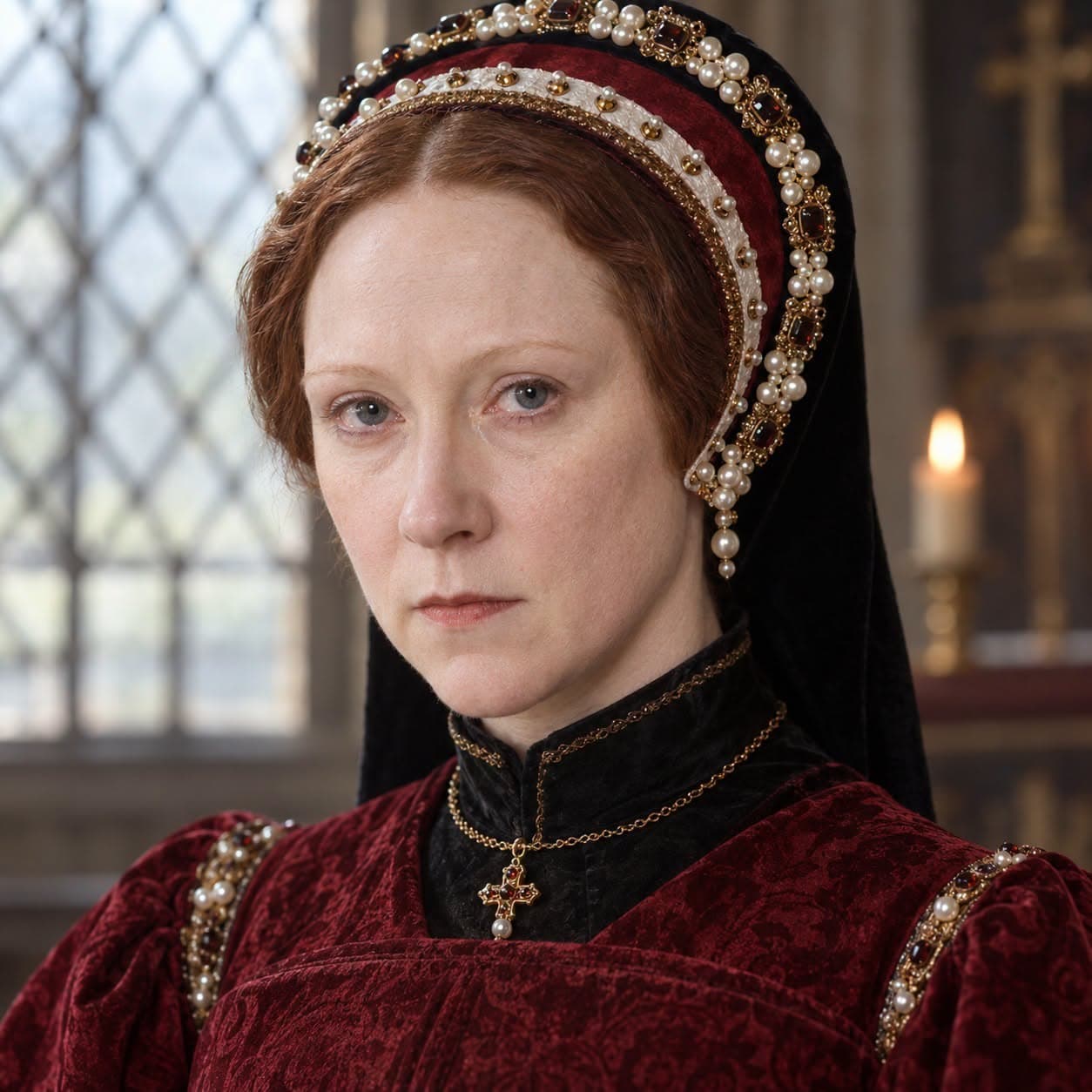
Dorothea was still under twenty, and already a queen, a widow and a bride for the second time. Her first husband was dead. The rights he had left her were expensive enough to matter to his successor.
On 28 October 1449, Dorothea of Brandenburg and Christian of Oldenburg were crowned in Copenhagen's Church of Our Lady, and the wedding celebrations were joined to the coronation. Christian was the new King of Denmark, chosen after the death of her first husband, Christopher of Bavaria. For the Danish council arranging the succession, the marriage solved an awkward financial problem.
The kingdom could have its new king without paying off its old queen.
Dorothea had come to Copenhagen in 1445, aged about fourteen, a daughter of the Hohenzollern house; her father was John, Margrave of Brandenburg. The marriage brought Christopher allies among the princes of northern Germany. He ruled Denmark, Norway and Sweden, three kingdoms joined under one monarch, and shortly after the wedding she was crowned as their queen. While still in her mid-teens she travelled through Sweden to receive the homage of its aristocracy. A medieval queen's authority was built partly on the road, in front of the men whose loyalty kept the crown standing.
Then, in January 1448, Christopher died. Their marriage had lasted little more than two years, and there were no children. The three kingdoms were left to settle who would rule them next, while Dorothea remained a young widow with a title, a financial settlement and a considerable interest in the answer.
Her provision for widowhood had been arranged during the marriage. In Denmark it included the revenues of Haraldsborg, with the town of Roskilde, and Skjoldenæs. This was her livgeding, the landed provision intended to maintain her after the king's death. Those Danish lands were handed over to her when Christopher died. The marriage had ended; the obligations attached to it had not.
There were Swedish claims too, and those were harder to enforce. Sweden's new king, Karl Knutsson, refused to recognise the lands she had been promised there. A grant could be written down rather more easily than it could be collected from men who no longer accepted the authority behind it. Dorothea would spend decades defending her rights in Sweden. Widowhood had left her with resources, but also with the work of making other people recognise what she was owed.
The Danish throne was offered to Duke Adolf of Schleswig, who declined it and put forward his nephew Christian of Oldenburg. Christian was unmarried and willing to marry Dorothea, which helped make him an attractive candidate: without that marriage, the council would have owed her a substantial settlement. He was chosen in 1448. By the coronation the following autumn, Dorothea was entering a second royal partnership in the country to which her first marriage had brought her.
The ceremony in Copenhagen did not settle everything beyond Denmark. Sweden had its own king in Karl Knutsson, and Norway was contested. Christian's Norwegian coronation followed in 1450. The territories Christopher had ruled could not simply be passed from one husband to another along with the bride. Dorothea's second husband had a crown, but much of the authority once attached to her first husband's position still had to be recovered.
The marriage that began in a widow's settlement soon filled a nursery. Their first child, a son named Oluf, was born in 1450. He died as a small boy, and a second son, Knud, did not survive childhood either. Hans, born in 1455, did, and so did a daughter, Margaret, born the following year. The childless widow of 1448 became the mother of a future king.
Within the new government, her presence was recorded in the king's business. In the early years of the reign, royal letters were explicitly issued in Dorothea's presence. Christian was often away, and when he was, she took a firm hand in running the government. The young woman whose upkeep had figured in the succession calculations had become part of the machinery of government itself.
In 1453, the Norwegian council swore a separate oath of allegiance to her. Its members were making a commitment to Dorothea herself, as their gracious lady. That promise reached beyond her husband's lifetime, into the possibility that she might once again be left a widow.
Her financial independence also gave the partnership a practical shape. In the years that followed, Dorothea lent Christian money, and he assigned her further lands as security. Around 1459 she received Ravnsborg on Lolland in this way. Lending to a king could turn a queen's income into a claim on still more royal revenues. The crown increasingly owed her money as well as respect.
She was quite capable of pursuing payment. In 1466, after German merchants at Falsterbo refused to pay a toll that had been demanded of them, the Lübeck official there wrote home that the queen was in nearby Malmö, and that he feared she meant to come to Falsterbo. He did not need to explain why. The prospect of Dorothea arriving was enough to trouble a man whose merchants had declined to pay.
That formidable queen had been the young widow crowned beside Christian in Copenhagen. At the beginning of their marriage, the kingdom had worked out what it owed her. Within four years, Norway's councillors had sworn that if this husband died too, their loyalty to Dorothea would stand. Kings could end. What was owed to her did not.