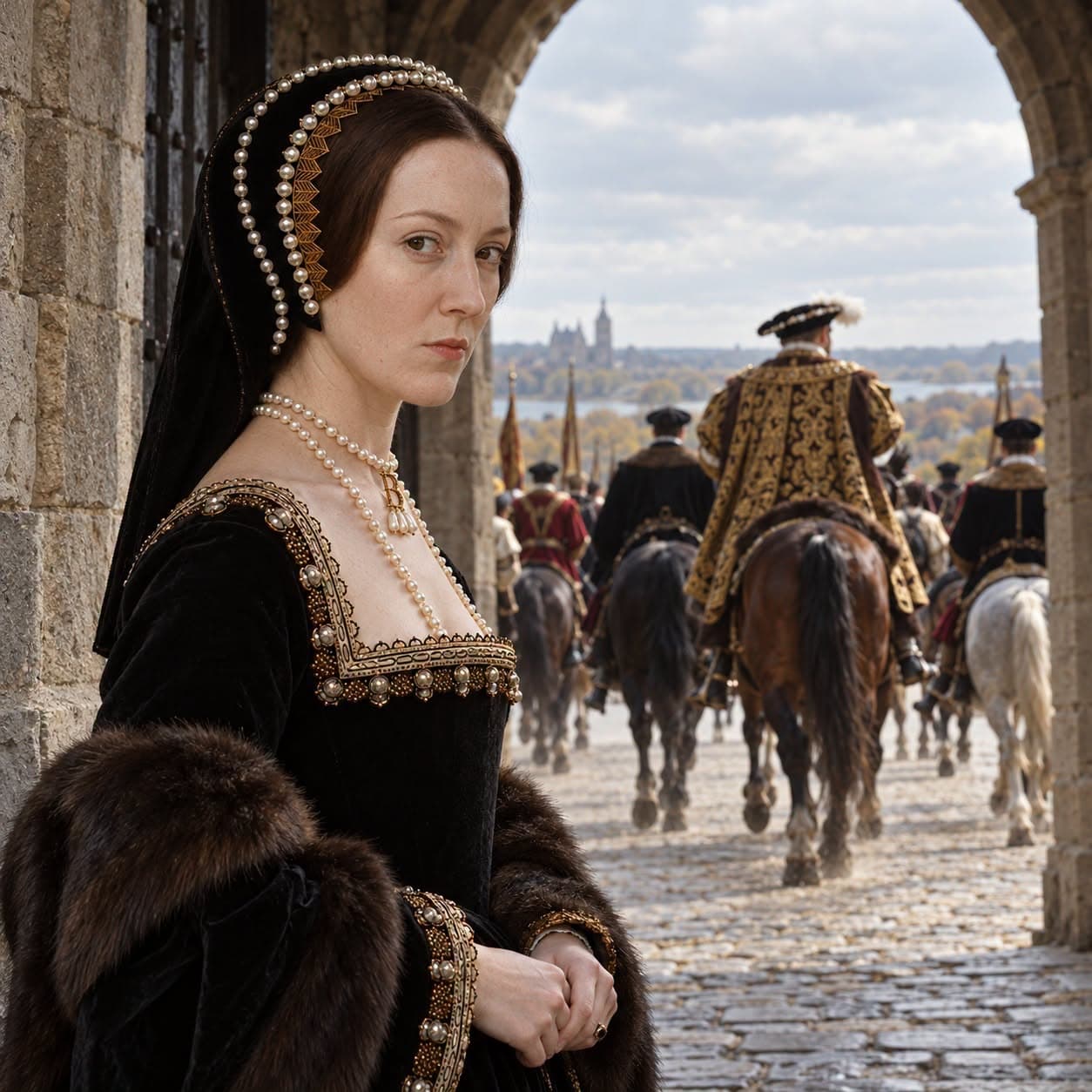
Anne knelt before Henry as he invested her with a mantle and coronet. He could give her a title in a single ceremony. Making her his wife was taking years.
On 21 October 1532, seven weeks after that ceremony at Windsor, Anne Boleyn remained in Calais while Henry rode away to meet Francis I of France. The two kings would spend the next four days at Boulogne. Henry wanted French support for the marriage he intended to make, and for the ending of the one he already had. Anne had crossed the Channel with him, and the future under discussion was hers. Now she had to wait while the kings discussed it elsewhere.
She had arrived as Marquess of Pembroke. Catherine of Aragon was still Queen of England.
The preparations for this journey had given Anne something substantial to carry with her. On 1 September, the Countesses of Rutland and Sussex had led her before Henry at Windsor Castle, with the officers of arms going before them. She wore a crimson velvet surcoat trimmed with ermine, her hair loose. Garter King of Arms carried her patent of creation. Lady Mary Howard, the Duke of Norfolk's daughter, carried the mantle and coronet with which Henry would invest her. The French ambassador was there to witness it.
Anne knelt while Stephen Gardiner, Bishop of Winchester, read the patent. Henry gave her the mantle, the coronet and the documents establishing her new dignity and income. She thanked him and returned to her chamber. What she took away was a title in her own right and lands worth £1,000 a year. These were honours she could possess before any wedding, with revenues behind them. The woman Henry proposed to present abroad had been given a place among the English nobility that required no husband to explain it.
The ambassador had seen what Henry could bestow.
France itself needed little introduction to Anne. She had spent years in the household of Queen Claude, Francis's first wife, before returning to England by 1522. The manners, music and fashions of the French court had been part of her education. She had once served a queen there. On this journey, Henry was preparing to make her one. The distinction between those two positions was the business of the visit, however splendidly she was dressed for it.
For the occasion, Henry had also arranged for Anne to have royal jewels taken from Catherine. Catherine had initially resisted the demand to give them up. Her jewels were being requisitioned for the woman who was to replace her, while she was still defending the marriage that made them a queen's possessions. Henry could have the jewels fetched. He could not have their former wearer cease to be his wife by the same convenient procedure.
Anne had served Catherine too. After her return from France she had become one of the queen's ladies, and the household she had entered was the one her own advancement was now helping to displace. By the autumn of 1532, Henry had already dismissed Catherine from court. Removing her from his company had proved easier than removing her from his marriage.
Catherine refused to accept that the marriage was invalid. She had taken her case to Rome, and her nephew, the Emperor Charles V, stood behind her. Henry needed an annulment, a ruling that the marriage had never been valid, if he was to marry again with the Church's sanction. Pope Clement VII had not given him one. French friendship offered support against the opposition his plans had aroused, and a king who might speak on his behalf in Rome. It could help Anne towards the wedding. It could not perform it.
Henry and Anne had landed at Calais on 11 October. The town was an English possession, across the water but still under Henry's authority. She had travelled with him openly, bearing her new title, towards a meeting whose purpose concerned her as directly as anyone in the royal company. There was nothing modest about the place Henry was preparing for her. The jewels and the ceremony had made that plain enough.
Yet on the 21st, he went on without her.
Henry met Francis at Sandingfield, and the kings embraced on horseback before riding on towards Boulogne. Anne remained in Calais through their days together. The woman whose marriage was one of the reasons for the journey was absent from this part of it. Every honour of the preceding weeks had been gathered for this journey, and the part of it that mattered most was taking place in another king's town.
On 25 October, Henry returned to Calais with Francis. Anne's opportunity to meet the French king followed; the supper and masque at which she danced belonged to 27 October. Those later festivities would give her a place in the celebrations, but they did not end the marriage crisis. For the woman Henry had left waiting, the distance between the ceremony at Windsor and the wedding she sought remained. He had placed a marquess's coronet on her head. Catherine was still his wife.