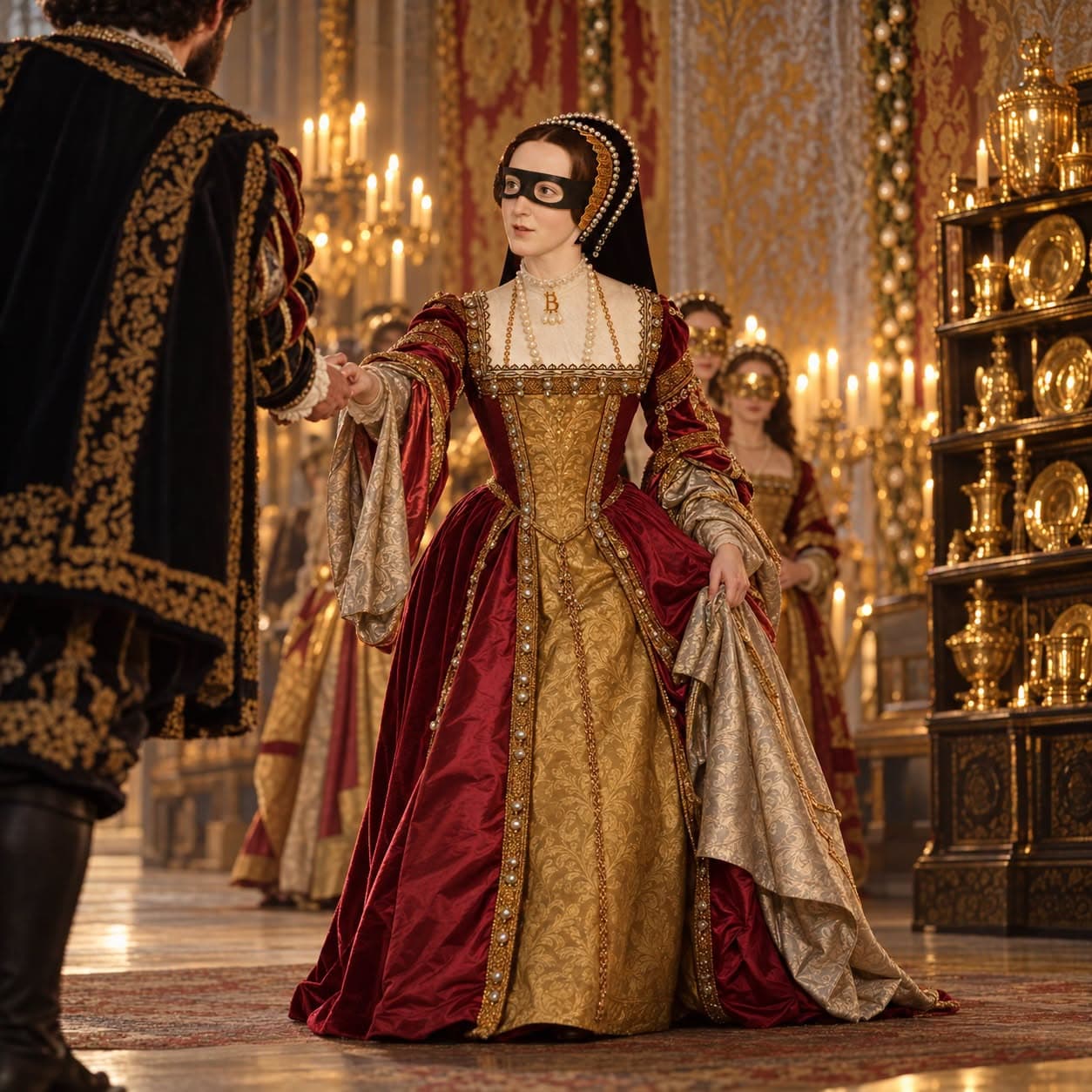
Anne Boleyn took the King of France by the hand with a mask still covering her face. The King of England was there to watch. He meant to make her his queen. He already had one.
On Sunday 27 October 1532, Anne Boleyn and her ladies entered a chamber at Calais after Henry VIII had given supper for Francis I. The walls were hung with rich fabrics worked in gold and silver, with wreaths of goldsmiths' work set with stones and pearls covering the seams. A cupboard rose through seven stages, displaying gold plate. Henry had carried the wealth of his court across the Channel to show his guest. Anne was part of what he meant him to see.
She had a new name for the occasion. Less than two months earlier, on 1 September, she had knelt before Henry at Windsor Castle in crimson velvet trimmed with ermine. The French ambassador had been there too. A patent was read aloud, and Henry invested her with a mantle and coronet. She rose as Marquess of Pembroke, with a title in her own right and a grant of income to support it. He could give her land, money and precedence. Making her his wife had proved considerably more troublesome.
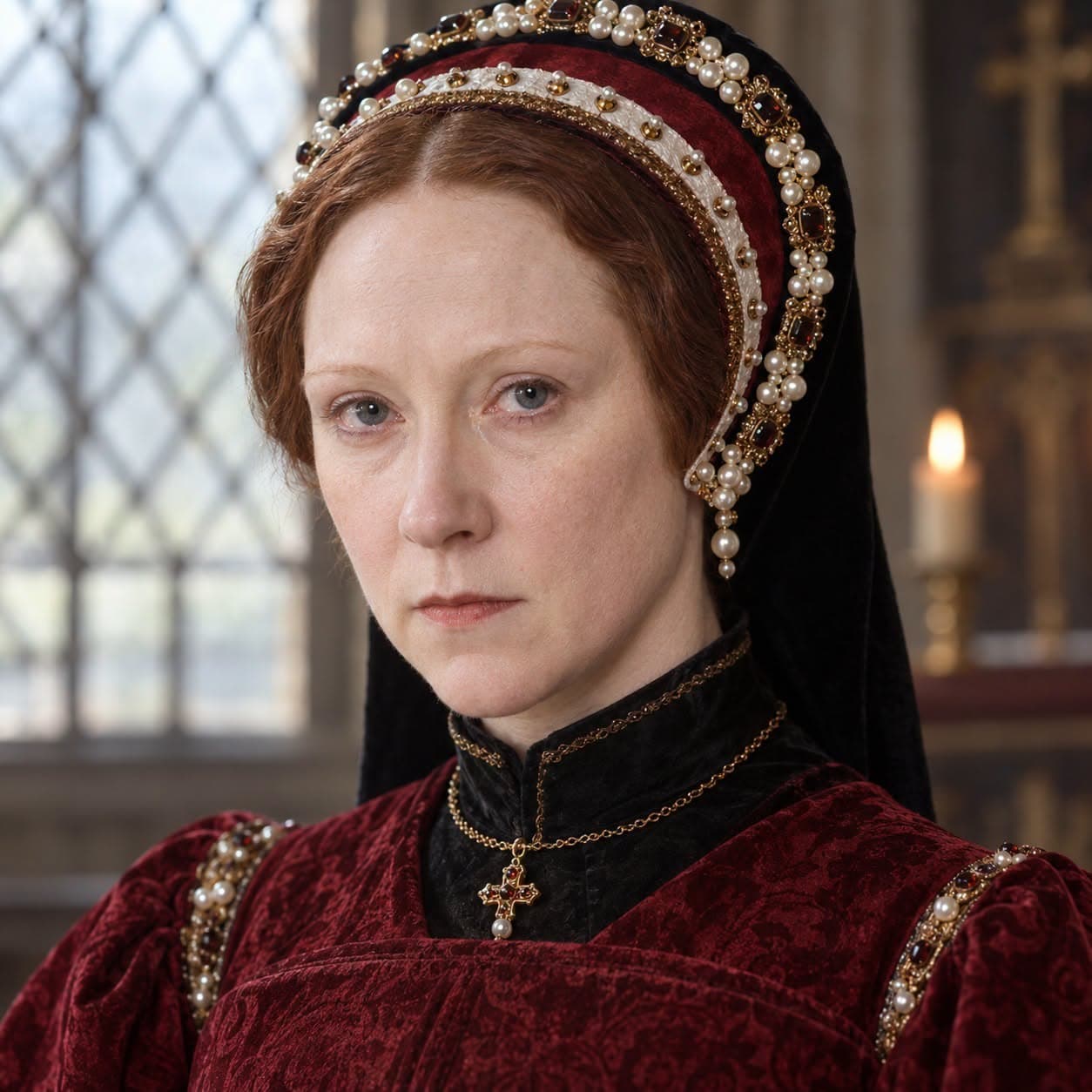
Catherine of Aragon was still Queen of England. Henry had removed her from court the previous year, but removing a woman from his household had not removed her from his marriage. He had been seeking its annulment since 1527, arguing that it should never have been valid because Catherine had first married his brother. Catherine maintained that she was his lawful wife. Their daughter Mary was their only surviving child, and Henry wanted a legitimate son. The marriage he wished to put behind him involved a queen, a princess and the authority of the Pope. None could be disposed of with a new patent.
So Anne came to Calais as Lady Marquess.
Henry wanted Francis's support for the marriage he intended to make. Calais was English territory, although it lay across the sea, and here Henry could receive his fellow king as host. Earlier in the visit he had gone to Boulogne to be entertained by Francis. Anne had remained at Calais. Now the French king was Henry's guest, and the woman Henry intended to marry was taking her place in the evening's entertainment.
Francis's court was a world Anne had known from the other side of royal service. As a girl she had been an attendant to his first wife, Queen Claude, and she had lived in France for years before she was called home to England around the turn of 1522. She had learned how a French court moved long before Henry's attention had settled on her. The title was two months old. Her knowledge of a French court was not.
She did not enter alone. Among the masked women were a 'Lady Mary', perhaps her sister Mary Carey, and Jane, Lady Rochford, the wife of her brother George. The Countess of Derby was there, with Ladies Fitzwater, Lisle and Wallop. Around the woman whose marriage had become a matter for kings stood women whose own places at court were already expressed in the names of husbands and families.
Their costumes were cloth of gold with crimson satin, overlaid with cloth of silver that hung loose and was caught up with laces of gold. Four damsels in crimson satin came with them. Anne took Francis as her partner. The Countess of Derby took the King of Navarre, and each of the other ladies took a lord. They danced with their faces covered, and then Henry himself took away the women's visors. She had stayed at Calais when he went to Boulogne. Here he uncovered her face himself, in front of his guest.
The women went on dancing with the gentlemen of France for another hour, and Francis talked with Anne before taking his leave. The former attendant of his late wife's household now held his conversation as Marquess of Pembroke. Henry could not yet give her a crown, but he could give her a king for a partner and an hour in which to be seen.
At the end, Henry accompanied Francis back to his lodging. The mask had come away, and the French king had spoken with her openly, but the name she carried out of the chamber was still the one she had been given at Windsor. The hand she had taken belonged to Francis. Henry remained Catherine's husband.