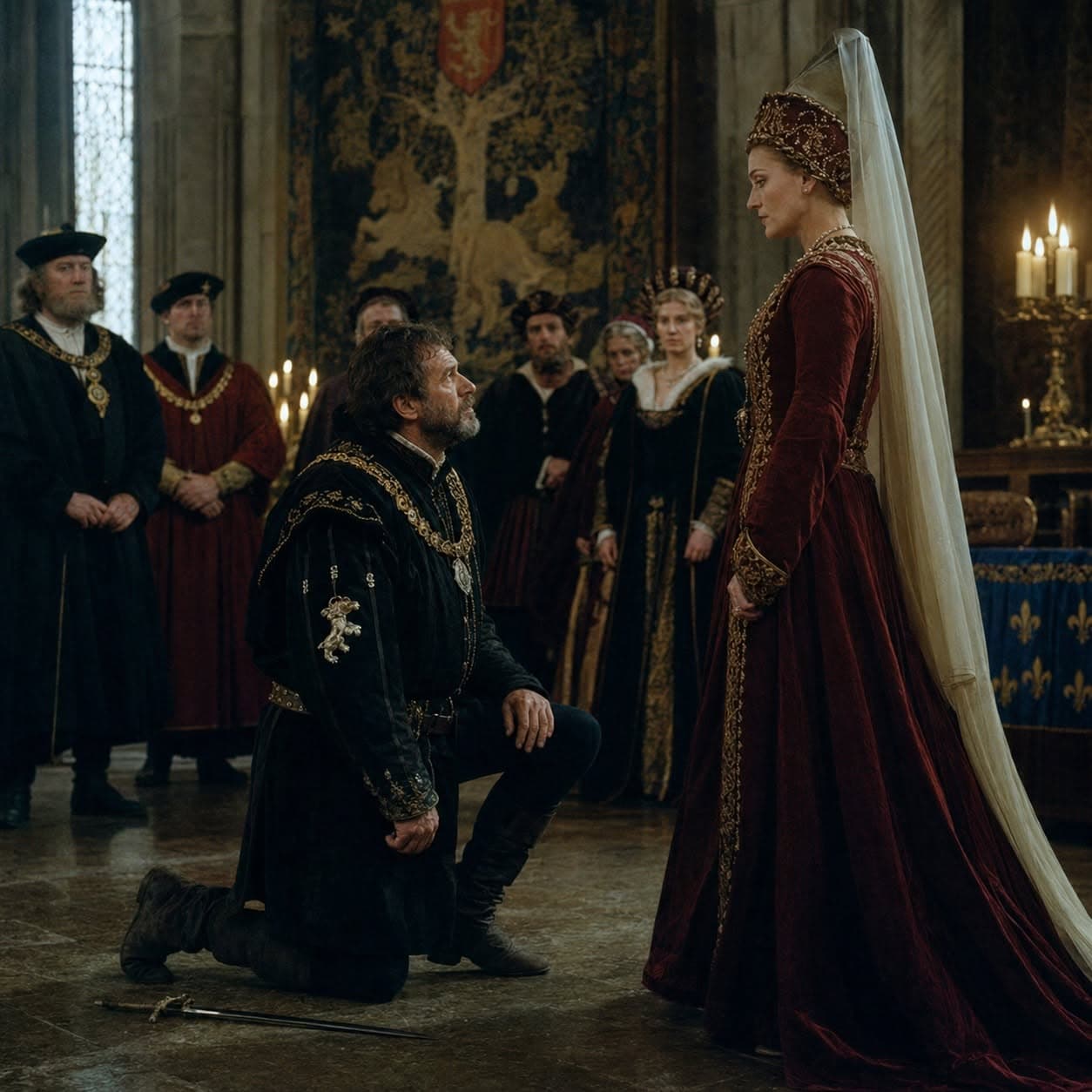
In the summer of 1470 Richard Neville, Earl of Warwick, knelt before Margaret of Anjou in a French court and asked for her help. She had been waiting nine years for someone with an army. He was the man who had made that wait necessary. They both understood what the meeting was. They did it anyway.
Richard Neville was born in November 1428, the eldest son of Richard Neville, Earl of Salisbury, and he inherited a position that was already considerable and made it larger. The Neville family was one of the great northern dynasties, rich in land and military capability, experienced in the management of the Scottish border, and embedded in the network of obligation and loyalty that held the English nobility together in the years before it stopped holding. What Richard inherited from his father was a foundation. What he built on it was something the period had not seen before and would not see again.
The Beauchamp inheritance was the making of him. In 1449 he became Earl of Warwick through his wife Anne Beauchamp, acquiring in a single inheritance estates spread across England that generated an income no private subject could match. He had not been born to that wealth. He had married into it. He understood that the accumulation of power required the right marriages at the right moment, and he applied that understanding to his daughters with the same calculation he had benefited from himself.
The captaincy of Calais came in 1455 and was the second foundation of everything that followed. Calais was England's military outpost on the continent, garrisoned and funded separately from the domestic revenue, and commanding it gave Warwick something no purely English magnate possessed: a base outside the reach of whichever faction held London, an income independent of royal favour, and a reputation built on the most visible stage available to an English nobleman of the period. He fed the garrison. He kept the crossing open. He was seen to be competent at the moment when competence in royal government was becoming difficult to find. The commons noticed. That noticing was deliberate.
He cultivated popularity with a consistency nobody in the period matched. His London household fed hundreds daily, the open-handed generosity of a man who understood that reputation was a tool of power and that the commons were an audience worth performing for. He was the most visible nobleman in England by the late 1450s, not because visibility had found him but because he had arranged it. He was building something the nobility around him did not have a name for and would not have recognised as a threat until it was too late.
The Yorkist cause gave him the instrument his position required. When the conflict between Henry VI's court and Richard Duke of York hardened into open warfare, Warwick chose York, managed the Yorkist military operations from Calais with considerable skill, and was present at the sequence of battles: St Albans, Northampton, and Mortimer's Cross, which ended with Edward IV on the throne at Towton in March 1461. He had done more than any other single figure to put Edward there. He returned from Towton expecting a partnership. Edward IV had watched everything Warwick did and drawn different conclusions entirely.
The four years between Towton and the Woodville marriage in 1464 were the years in which the misreading that would destroy Warwick became visible, though not yet to him. He managed English foreign policy as though it were his own. He negotiated European marriages on Edward's behalf, built diplomatic relationships with the French court, conducted himself at every continental court as the man whose word carried the weight of the English crown. He was not wrong that he was powerful. He was wrong about what that power rested on. Edward permitted the diplomacy, used the results, and watched Warwick extend himself further and further into commitments that assumed Edward's compliance as their foundation.
In May 1464 Edward married Elizabeth Woodville in secret at Grafton Regis and told his council four months later. The conventional account of what followed focuses on Warwick's humiliation, and the humiliation was real and complete, he had been negotiating a French marriage on Edward's behalf across every court in Europe and the ground had been removed from under him in a Northamptonshire manor house at dawn. But the humiliation was the surface of something worse. What the Woodville marriage revealed to Warwick was that Edward had always understood their relationship differently than he did. Warwick had believed he was governing alongside a king he had made. Edward had been waiting for the moment to demonstrate that made kings govern themselves.
What followed was a sequence of moves that each made sense as a response to the last and collectively produced a catastrophe. The marriage of Isabel to George of Clarence in 1469, conducted at Calais without Edward's permission, was designed to bind a royal duke to the Neville interest and give Warwick a candidate who could replace Edward if replacement became necessary. The rebellion that followed captured Edward at Warwick Castle and held him for several weeks before the practical reality asserted itself: only Edward could hold the Yorkist army together, only Edward could govern the country, and a king in Warwick's custody was a problem rather than an asset unless Warwick was prepared to take the throne himself, which required a legitimacy he did not possess. He released Edward. Edward forgave him, publicly and without apparent reservation, and neither of them believed the reconciliation for a moment.
The second rebellion in 1470 failed faster than the first. Warwick and George fled to France. Warwick had run out of moves within the system he had spent thirty years building, and what he did next was the most remarkable decision of his career and the one that made everything else legible in retrospect. He went to Louis XI's court and asked for an introduction to Margaret of Anjou. He had spent a decade destroying the Lancastrian cause. He had fought at every significant battle on the Yorkist side. He had placed the man who deposed her husband on the throne of England. She had been in exile for nine years. Her son was eighteen years old and had never set foot in the country he was heir to.
She made him kneel before she acknowledged him. The sources record the waiting. Whether it was theatre or genuine fury or both, it was the only honest moment in a negotiation conducted entirely between people who needed each other and trusted each other not at all. The terms were these: Warwick's daughter Anne would marry her son Edward of Lancaster, binding the Neville inheritance to the Lancastrian succession. Warwick would invade England, restore Henry VI, and rule as lieutenant until Margaret felt the position was secure enough to cross. She would wait in France. He would do the work.
He invaded in September 1470, Edward IV fled to Burgundy, and Henry VI was taken from the Tower, dusted off, and reinstated as king of England. Warwick governed for six months as the effective ruler of a country whose restored king was by this point barely capable of coherent speech and whose legitimate heir was still in France waiting for his mother's signal. The Lancastrian restoration was a performance of legitimacy built on a foundation that everyone involved could see clearly. Louis XI watched from France. The Yorkist exiles watched from Burgundy. Margaret watched and waited and did not cross.
Edward IV landed in Yorkshire in March 1471 with a Burgundian-funded force and began moving south. The Yorkist support that Warwick had expected to have dissolved came back. The men who had eaten at Warwick's table made their calculations about which direction power was moving and moved with it. Warwick met Edward at Barnet on the fourteenth of April 1471, in a fog so thick that parts of his own army engaged each other by mistake and broke before the fighting had properly begun. He died on the field. His body was stripped of its armour and displayed at St Paul's for two days so that no one could claim he had survived. Edward IV had observed what happened when you left your enemies breathing.
He had made two kings and unmade two kings and placed his daughters into the machinery of both attempts. Isabel had made the crossing to France pregnant and delivered a dead child at sea while he negotiated. Anne was now bound by the agreement at the French court to a Lancastrian prince who would die at Tewkesbury three weeks after Barnet, on the same day his mother finally landed in England and found that everything was already over. The Kingmaker's instruments. He had deployed them as precisely as he had deployed everything else and with the same result: they had served the plan and the plan had failed.
Anne Neville would eventually become queen of England. She would watch her only son die in 1484 and follow him in March 1485, worn out at twenty-eight, her husband's regime collapsing around her, the Neville inheritance that her father had built dispersed and absorbed into the crown. What Richard Neville had spent thirty years accumulating, the estates, the income, the military reach, the reputation, and the public that knew his name, passed through his daughters into the hands of the men who married them, and from there into the Tudor settlement that made his entire project irrelevant.
He had not been making a dynasty. He had been making other men's dynasties. By the time that became visible to him there was a fog at Barnet and his own troops in front of him and nowhere left to go.