At eighteen she married a duke of fifty-two. The marriage made her a sovereign duchess. Within four years she was a widow, and the duchy was gone from her husband's hands.
By 1710, Suzanne-Henriette of Lorraine was living in Paris, still Duchess of Mantua, with no Gonzaga court in Mantua to return to. She would die that year at twenty-four. Between her wedding and her death lay six years in which an impressive title had proved considerably easier to acquire than the security it appeared to promise.
She was the daughter of Charles, Duke of Elbeuf, and Françoise de Montaut de Navailles. The Elbeufs belonged to the French branch of the House of Lorraine, a family whose foreign princely standing gave it a particular place at the French court. Suzanne-Henriette had been known as Mademoiselle d'Elbeuf. Marriage would make her the wife of a ruling prince, a distinction that mattered in a world where rank determined who approached whom, who gave way, and who sat down.
Ferdinand Charles Gonzaga had been married before. His first wife had died without leaving him a legitimate heir, and the second marriage offered another chance to continue the ruling line. Suzanne-Henriette's youth belonged to that calculation. She married him at Tortona on 8 November 1704, becoming Duchess of Mantua and Montferrat. The Gonzaga name carried centuries of rule in northern Italy. Its future now depended on rather more than the bride.
There were portraits to mark the union. In Paris, Ferdinand Charles commissioned Hyacinthe Rigaud to paint both himself and Suzanne-Henriette. The pictures belonged to the public business of being a prince and princess: two large canvases to represent a marriage, a household and a ruling house, meant to follow the couple to Italy. They were also slow work. In 1705 the duke's envoy in Paris reported them still unfinished in the painter's studio, while the people they represented had already begun their married life on the other side of the Alps.
Suzanne-Henriette entered Mantua on 4 March 1706, welcomed with celebrations. She was twenty. A little over a year later, she would leave it.
The War of the Spanish Succession had made her husband's allegiance to France dangerous. Mantua was an imperial fief, and the emperor could treat its duke's support for the French as disloyalty. When the French were defeated at Turin in September 1706, Ferdinand Charles lost the military protection on which his position depended. His marriage could provide a bride. It could not provide another army.
In January 1707 he left Mantua for Venice. Suzanne-Henriette remained behind for a time, departing on 1 April with a passport issued by Prince Eugene of Savoy, the imperial commander. The man commanding the forces that had broken her husband's position was now the man whose passport helped her leave it.
Mantua passed to imperial control, while Montferrat went to Savoy. In June 1708 the imperial diet formally declared Ferdinand Charles deprived of his rights and states. He died at Padua on 5 July. Suzanne-Henriette was twenty-two, and their marriage had produced no children. There would be no son to succeed him in Mantua, and no restoration of the Gonzaga court there for his widow.
She kept the title.
For a time she lived in a convent at Pont-à-Mousson, in Lorraine. The court memoirist Saint-Simon, no admirer of the Elbeuf women, says she grew bored there and resolved to return to court. Her mother then pressed for the recognition a sovereign duchess might expect, above all a chair with a back in the presence of the young duchesse de Bourgogne. In his telling, she was refused four separate times. Such distinctions could look absurd from a distance. In the room itself, they told everyone exactly where a woman stood.
He describes two visits to Madame de Maintenon's rooms at Versailles. At the first, Suzanne-Henriette stayed only briefly and did not sit, and the king did not kiss her, an omission Saint-Simon thought extraordinary. Her mother negotiated a second visit. This time the king sat down, and mother and daughter were left standing. No folding stools were brought. He spoke to her a few times and dismissed her. The sovereign title had brought her into the room. It had not brought her a chair.
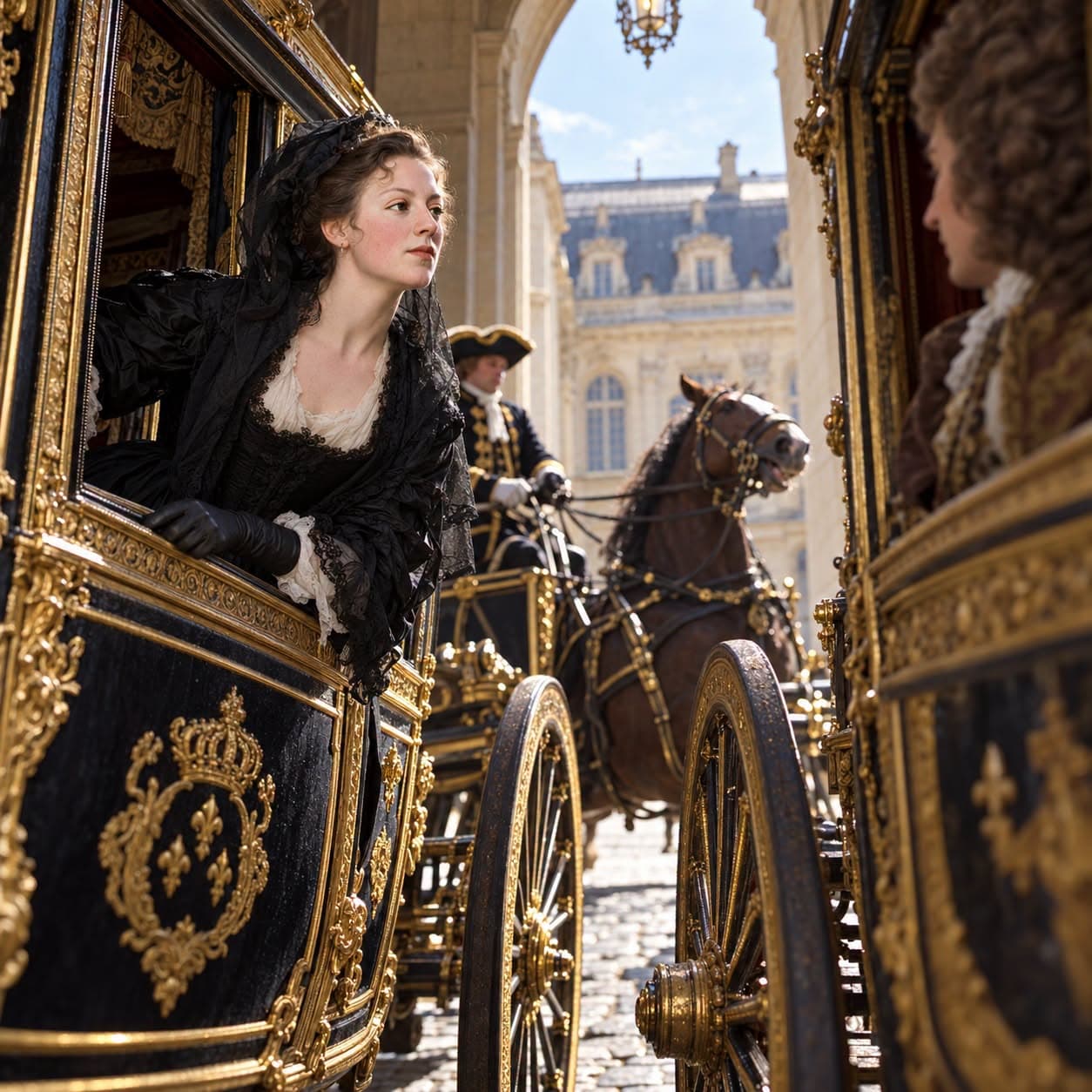
Mother and daughter did not simply accept the place allotted to them. At a gateway of the Palais-Royal, her carriage tried to force the Montbazons' carriage to back out of the way. The Montbazons refused, and the two carriages scraped past each other. In another house she tried to take precedence over the Grand Duchess of Tuscany and was ordered to apologise. The demands kept coming, and so did the refusals. A title acquired abroad still had to be made to work at home.
In Paris, Suzanne-Henriette fell ill, and the illness was long. Saint-Simon wrote that she died in the flower of her age, with a beauty that had seemed to promise great health, and that her life since that strange marriage had been very sad. She had no children, and she had received nothing from her husband. She died in 1710, six years after the wedding. Louis XIV wore black for her for five or six days.
She had been eighteen when she became Duchess of Mantua, and twenty-four when she died still bearing the name. Rigaud had painted her for the marriage that carried her to Italy. When both she and her husband were dead, the paired portraits that were meant to follow them there were still in his studio in Paris.