Sophia got her name into the university register. Getting a medical degree was another matter. Edinburgh admitted her as a student, then refused to let her graduate.
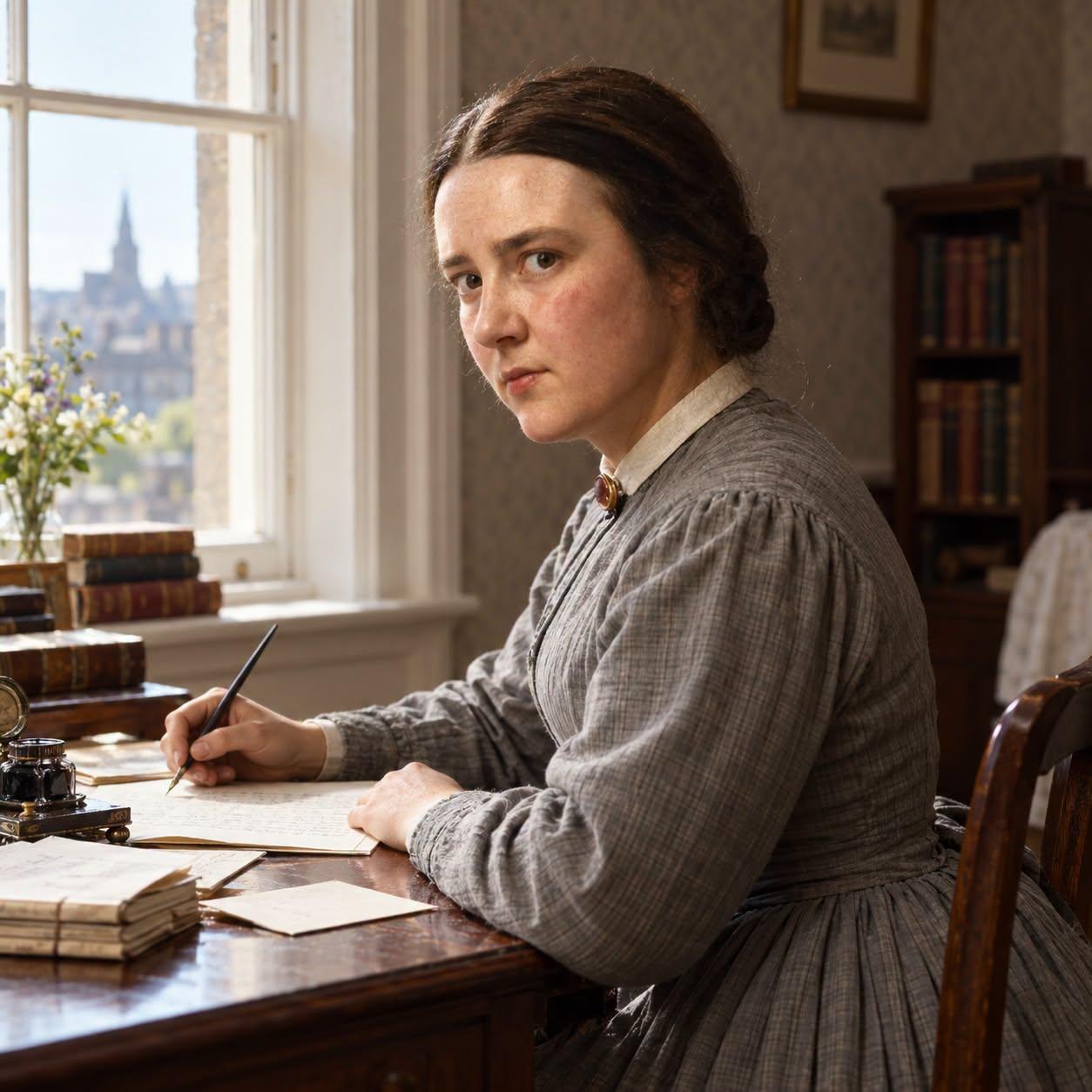
On 2 November 1869, by the date usually given, Sophia Jex-Blake signed the University of Edinburgh's matriculation roll. She was twenty-nine, entering a profession for which her sex was still widely treated as a disqualification. Among her first companions were Isabel Thorne, Edith Pechey, Matilda Chaplin and Helen Evans. They had won the right to begin.
Sophia came from a prosperous family in Hastings, where earning money was hardly the future expected of a daughter. She had taught mathematics, travelled and seen women practising medicine in America. In Boston, Dr Lucy Sewall gave her something arguments about women's abilities could not: the daily example of a woman doing the work. When Sophia later dedicated a book to Lucy, she called her a noble and pure-minded woman, and a thoroughly scientific physician.
There were patients as well as students in Sophia's argument. A woman might prefer to consult another woman about an illness, yet have no qualified woman available to consult. Sophia wanted women properly trained, examined and able to practise. That required access to the education by which competence was established. Refusing the education, then pointing to the shortage of qualified women, made a remarkably durable arrangement.
Her first Edinburgh application, in the spring of 1869, was modest. She asked to attend the botany and natural history classes over the summer, and offered to set aside matriculation for the time being. There were professors willing to support her, and the university's academic senate voted in her favour. But opponents appealed to the University Court, which overturned the decision in April. Separate teaching for a single woman presented difficulties. The Court was unwilling to make a temporary arrangement "in the interest of one lady".
Other ladies came forward.
Sophia helped make the case public and gathered women who wanted the same opportunity. The original practical objection could now be answered with an application from a group. She wrote again in June, asking whether the university would withdraw its veto if separate classes could be arranged. She asked to matriculate in the usual way, to sit the ordinary examinations and, in due course, to obtain a medical degree. The degree was in the request from the start.
She also offered, on behalf of herself and her fellow students, to guarantee whatever minimum fee the medical faculty required for those classes. This was a campaign conducted through letters, applications, examinations and money. Before the women could learn medicine, they had to help arrange the business of being taught it.
By the autumn, the group had passed the preliminary examination required of entrants. The new arrangements allowed women to study medicine in classes kept separate from men. The women paid the usual fee and signed the university album. Each received a matriculation ticket declaring her one of the Cives Academiae Edinensis, a citizen of the University of Edinburgh. After months spent asking for permission, they had something more substantial than a sympathetic answer.
But the conditions mattered. Professors were permitted to teach women in separate classes; they were not compelled to do so. The formal regulations set a fee of four guineas for a course of instruction, with provision for a higher charge if the class was too small to pay the professor adequately. The expense of keeping women apart from men could be passed on to the women.
Admission had been obtained. Teaching still had to be secured.
As the campaign grew, Mary Anderson and Emily Bovell joined the women remembered as the Edinburgh Seven. Sophia and Edith shared lodgings at 15 Buccleuch Place, which became a centre for organising their efforts. Their studies proceeded alongside the work of finding instruction and fighting for access to clinical training. A place on the register did not settle what would happen in the lecture room or the hospital.
Hostility became physical. On 18 November 1870, more than a year after Sophia's matriculation, a crowd confronted the women as they arrived for an anatomy examination at Surgeons' Hall. They were shouted at and pelted with mud and refuse. With help, they got inside and sat the examination. The publicity brought supporters to their cause, but public sympathy could not confer a degree.
The legal struggle ended against them in 1873. The Court of Session ruled that the university had lacked the power to admit the women under the arrangements it had made. Years of study had not failed an academic test. The permission on which they had begun had failed a legal one.
Sophia continued elsewhere. She helped establish the London School of Medicine for Women in 1874, obtained her MD at Bern in 1877 and secured an Irish medical licentiate that same year, enabling her to register as a doctor. In 1878 she returned to Edinburgh to practise and opened a dispensary for women and children, including women who could not afford expensive treatment. The patients whose need she had argued for could now consult her.
The Edinburgh School of Medicine for Women followed in 1886, with Sophia at its head. The citizen of the university had never been allowed to finish there. The woman who had once offered to guarantee the fees for separate classes was now admitting students to a medical school of her own.