Two names scratched into the windows at Fredensborg Palace belonged to a couple who never married. Dagmar had been engaged to the Russian heir. When she finally married the heir, he was a different man.
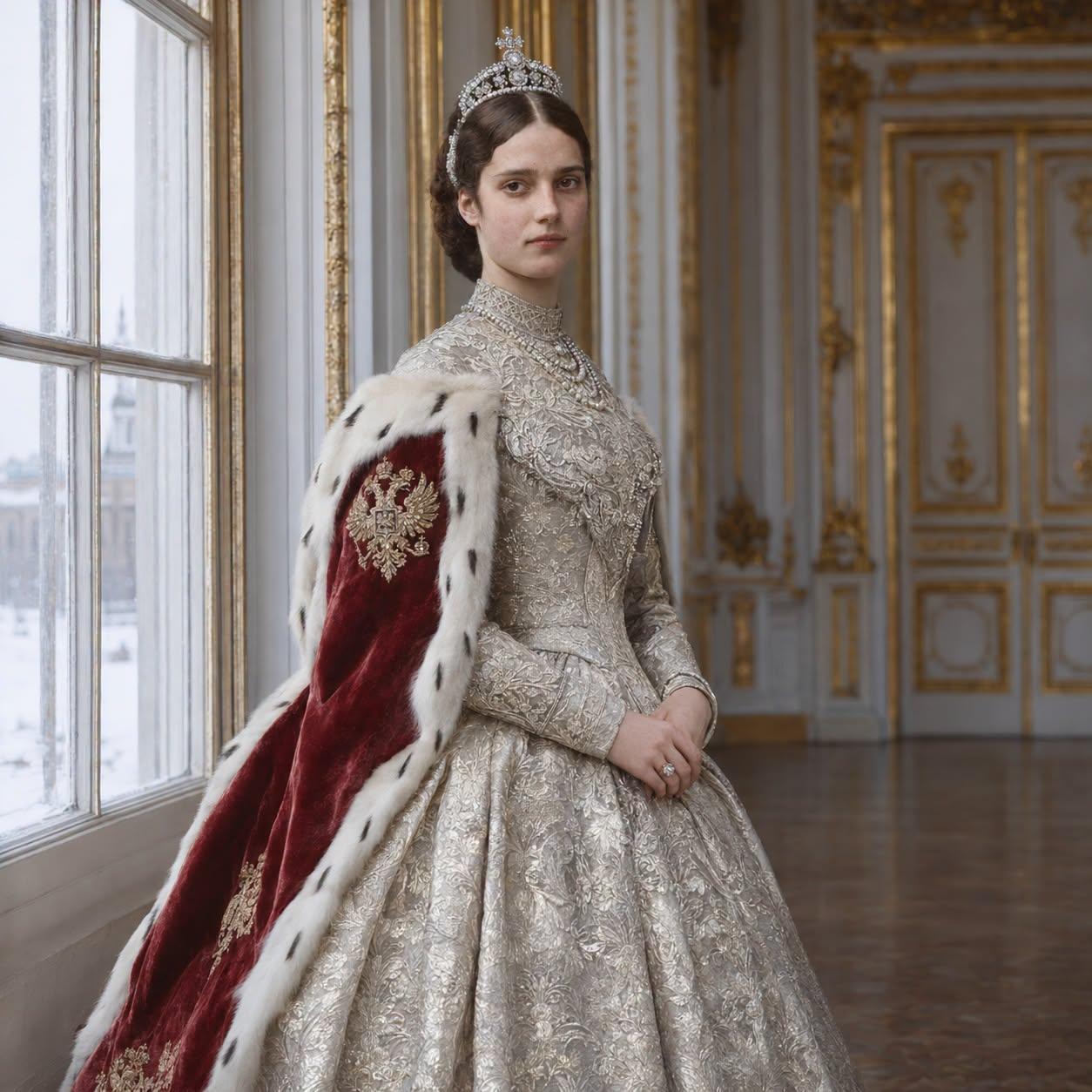
On 9 November 1866, eighteen-year-old Dagmar of Denmark married Grand Duke Alexander Alexandrovich, heir to the Russian throne, in the Imperial Chapel of the Winter Palace in St Petersburg. He was twenty-one, the younger brother of her dead fiancé, Nicholas. The marriage still joined the same two royal families. Within those families, a son and a brother had been buried, and a young woman had lost the man she had expected to marry.
Two years earlier, Nicholas had come to Denmark as the eldest son of Emperor Alexander II. Dagmar's father, Christian IX, had only recently become king. Her elder sister Alexandra had already married Britain's Prince of Wales. Another grand marriage would place a second Danish daughter beside the heir to a great European throne. For a family whose children were marrying across the continent, it was an excellent match.
Dagmar was sixteen when she and Nicholas became engaged at Fredensborg in September 1864. Royal visitors and members of the family had long scratched their signatures into the palace windows, and the oldest dated one belonged to her mother, Louise, who had added her name in 1841, the year before her own wedding. There were names, dates and little traces of visits scattered through the palace, an informal family record written on something that could so easily have broken. Nicholas and Dagmar added theirs on 9 October, and again on 29 October.
By the following April, he was dead.
Nicholas died at Nice, aged twenty-one, and there would be no wedding to the eldest son. Alexander became the Russian heir in his brother's place, and with the title came the question of Dagmar. Both sets of parents wanted the connection between Denmark and Russia to survive. A younger brother was available, and the princess was still unmarried. On paper, the arrangement could be made to work.
Off paper, Alexander had lost his elder brother and Dagmar had lost her fiancé. By June 1866 he was in Denmark, and a small detail from that visit places Dagmar back among her own people. On the day he proposed, she and her younger sister Thyra had a drawing lesson at Fredensborg with Heinrich Buntzen, who taught the royal children two days a week and followed the family from one residence to the next. Even a proposal from the Russian heir had to share a day with an existing timetable.
Buntzen was not a teacher to let things slide. When he felt the children put less effort into their homework than into their lessons, he gave them small reprimands. He had taught their mother before them, and before he was done he had taught three generations of the family. Their drawings survive in the royal collections. Behind the princess being prepared for Russia was a young woman still taking lessons beside her sister.
The new engagement was announced that June. In September, Dagmar left Copenhagen for Russia. There were changes to make before she could marry. Raised in Lutheran Denmark, she was received into the Russian Orthodox Church a little over a fortnight before the wedding and took the name Maria Feodorovna. Within five months of that drawing lesson, she had a new church, a new name and a new country.
The wedding joined her to the heir, not yet to an emperor. Alexander II was still on the throne, and Dagmar and her husband would wait until 1881 to become Russia's reigning imperial couple. For the moment they were a newly married grand duke and grand duchess, with the future laid out before them in titles, expectations and the prospect of children.
That future had already been laid out once.
This time it held. Alexander proved a loving and considerate husband, and they had six children, four sons and two daughters. A wedding that could so easily be reduced to the replacement of one brother by another became a marriage in its own right, and a family large enough to fill a palace.
Her married life took her far from the Danish palace where the first engagement had begun, but she kept coming back. As empress, Dagmar made frequent, long stays at Fredensborg with her family. The windows there still carried the names she and Nicholas had left in October 1864, before either of them had reached a wedding day. The names in the glass are still Dagmar and Nicholas.