Rose de Beauharnais had not shared a home with her husband in nine years. She was locked in the same prison as him anyway, and she was still there when they killed him.
Alexandre and Rose had married in 1779, when he was nineteen and she was sixteen, a match arranged by his father with no real acquaintance behind it. The marriage soured quickly. By 1785 they were living apart, Alexandre pursuing his own career and his own women, Rose settled with their two children at Pentemont Abbey, a convent that had become a fashionable refuge for aristocratic wives who no longer lived with their husbands. Nine years passed in that arrangement. Then the Revolution, which had already reorganised everything else in France, reorganised their marriage too, by putting them both behind the same set of walls.
Alexandre had served as a general in the revolutionary army and briefly commanded the Army of the Rhine. When the fortress city of Mainz fell to allied forces in 1793, the Convention went looking for someone to blame, and Alexandre's earlier command in that theatre made him a convenient target. He was arrested in March 1794 on suspicion of aristocratic sympathies and military failure, the standard charge sheet of the Terror, vague enough to fit almost anyone the Committee of Public Safety wanted removed. Rose was arrested a month later, on 21 April 1794, on no clearer grounds than being his wife and a woman of noble birth. The couple who had avoided each other's company for nearly a decade were now confined within the same institution, the former Carmelite convent on the Rue de Vaugirard that Parisians called Les Carmes.
Carmes was not an ordinary prison. It held its overflow of aristocratic and political prisoners in cells converted from a convent's cellars and outbuildings, and the conditions were closer to a slow-acting punishment than a holding facility. Air reached some of the underground rooms through only three small holes cut into the walls. There were no lavatories. Each prisoner was allotted a single bottle of water a day, for drinking, washing, and everything else the body required. Executions were carried out on a schedule, and everyone inside knew, roughly, how the schedule worked. One exception existed in the law: a pregnant woman could not be sent to the guillotine until after she had given birth. Historian Andrew Roberts has noted the consequence of that single clause, that prisoners at Carmes were reported to have sex with their guards at night, pregnancy pursued deliberately as a form of postponement, perhaps the only form of postponement the prison allowed. Roberts has also raised the possibility that Rose herself survived, in part, because she had become too ill by the summer to be worth guillotining before her case could be resolved another way.
Inside that building, estranged husband and wife apparently found their way to other people. Rumour inside and outside the prison held that Rose had begun a relationship with General Lazare Hoche, another prisoner at Carmes, and that Alexandre had been separately involved with Delphine de Custine before his arrest and, by some accounts, during his imprisonment as well. None of this is documented with the certainty of a court record, and it should be read as what it was: contemporary gossip about two people who had stopped being married to each other in any meaningful sense years before the Terror put them in adjoining cells. It is nonetheless a detail that changes the shape of what happened next. Whatever went through Rose's mind when Alexandre was taken from Carmes, it was not the grief of a woman losing the great love of her life. It was something stranger: watching a man she barely knew anymore be marched out to die, for a war he had already lost the argument over before either of them were arrested.
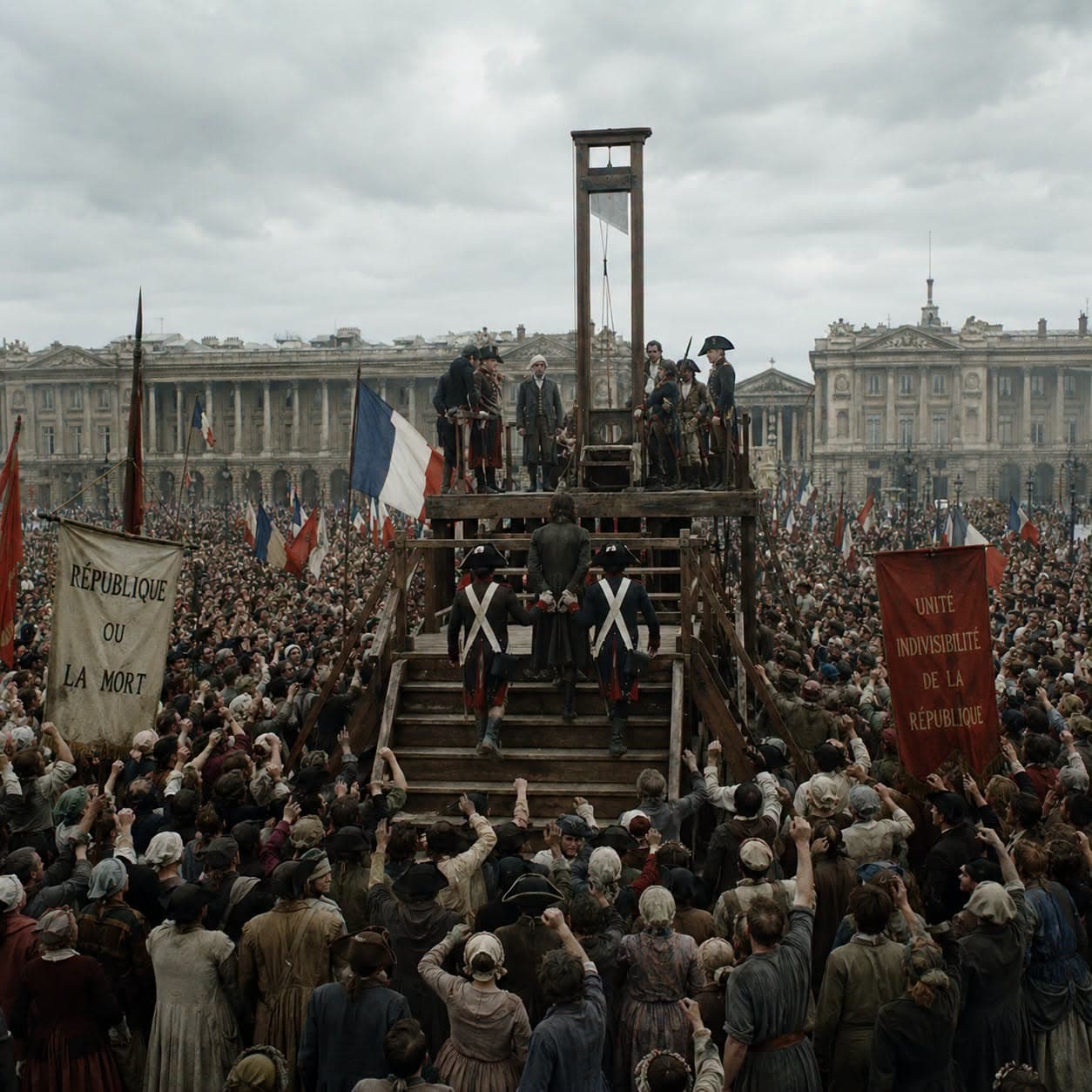
Alexandre was tried before the Revolutionary Tribunal and condemned along with his cousin, Augustin, on the charge of conspiring against the Republic. He was guillotined in Paris on 23 July 1794. Rose was not present at the execution. She was still in her cell at Carmes, with no way of knowing whether her own trial, whenever it came, would end the same way.
Four days later, the machinery that had killed her husband began, unexpectedly, to consume itself. On 27 July, the National Convention turned on Maximilien Robespierre, the man most responsible for the Terror's pace and its logic, and had him arrested that same night. He was guillotined the following afternoon, 28 July 1794, at the same site where he had sent so many others.
The Terror did not end instantly with his death, and Rose did not walk free the next morning. She remained in Carmes for another ten days, while the Convention worked out, deputy by deputy, how far the reaction against Robespierre's system would actually go, and whether the prisoners still held under his laws would be released or simply forgotten in the confusion.
She was finally freed on 6 August 1794, roughly two weeks after her husband's death and more than a week after the man who might have ordered hers was already gone.
She had entered Les Carmes a wife in name only, uncertain whether either she or the estranged husband she still shared a surname with would leave alive. She left it a widow, thirty-one years old, with two children and a title she had inherited rather than earned through affection. Less than two years later she would marry a young general named Napoleon Bonaparte. In 1804 she would be crowned Empress of the French.
None of it could have been imagined possible from inside a cell with three holes for air and one bottle of water a day.