He was the brother who never switched sides.
While George watched for his opportunity and Edward IV watched George, Richard of Gloucester was given the north of England and told to govern it, and he did. For a decade he rode the Pennines and administered the law and fought when Edward needed fighting done and came home to Middleham Castle and asked for nothing beyond what he had been given. In a dynasty that had been built on the contest for the crown, through the deaths of fathers and brothers and cousins on frozen Yorkshire fields, Richard was the one who did not contest it. He served. He was very good at serving.
Richard was born on the second of October 1452 at Fotheringhay Castle in Northamptonshire, the eleventh child of Richard Duke of York and Cecily Neville, called Proud Cis by the court because she was, and proud was the neutral description. He was the youngest surviving son of the most dangerous house in England, born into a family that was circling the crown with the specific patience of men who had calculated that they had a better claim than the man currently wearing it and were waiting for events to confirm their calculation.
He was two years old when his father's patience ran out and the Yorkist challenge became open warfare. He was eight when his father died at the Battle of Wakefield on the thirtieth of December 1460, an overconfident sortie from a castle he should not have left, and his brother Edmund with him, both killed on the same afternoon. Richard was eight years old, the youngest of the surviving children, and the family's position had collapsed overnight from the most serious rival to the crown to a widow and her children with attainders filed against their estates and Lancastrian armies between them and safety.
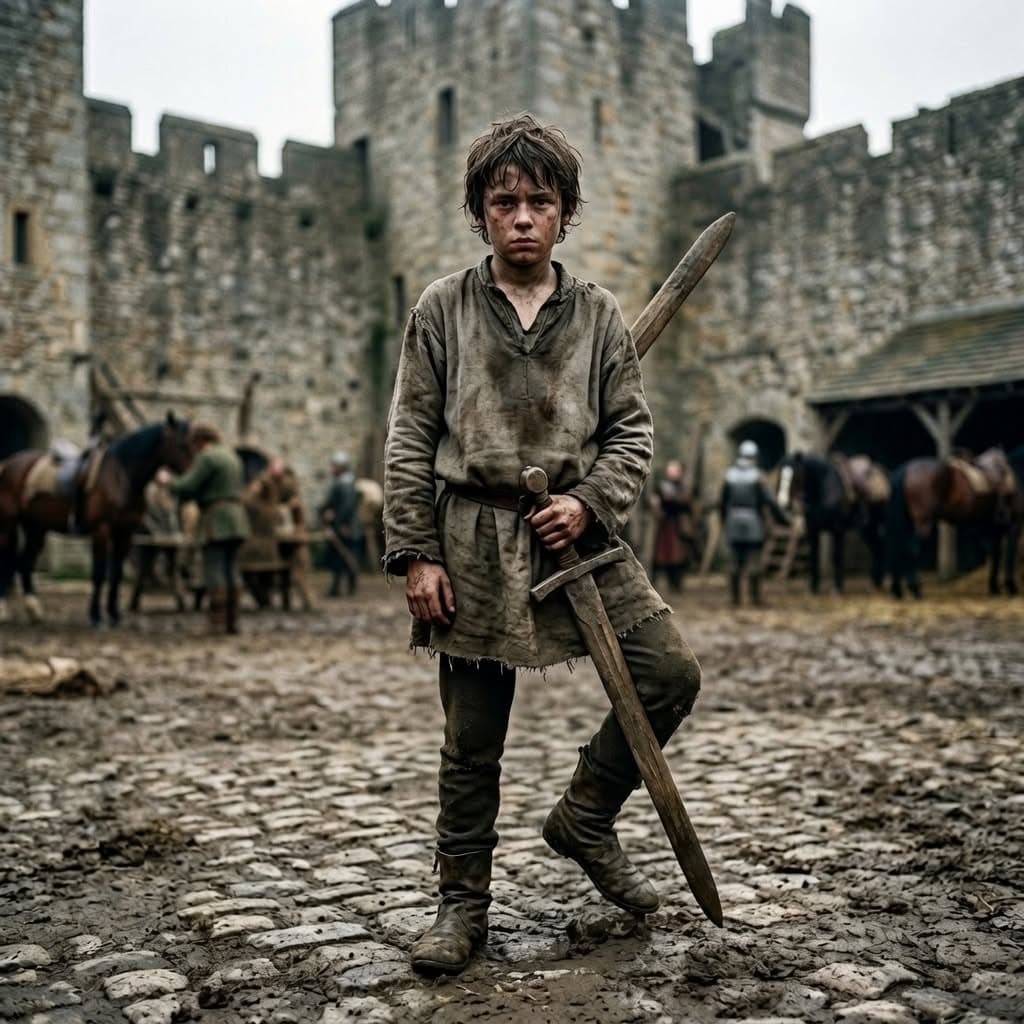
Cecily sent Richard and George to Burgundy. The decision was practical. They were the youngest, the most vulnerable, and the court of Philip the Good was sufficiently distant from the fighting and sufficiently well-disposed toward the Yorkist cause to keep them alive while their brother Edward consolidated his position. Richard was eight years old when he crossed to the continent. He was eight years old, in a foreign court where everyone spoke French, when the news arrived that Edward had won at Towton in a snowstorm in March 1461 and was king.
He returned to an England that was entirely reorganised. The family that had spent a decade watching the crown from the edge of legitimate reach now wore it. Edward IV was king. Richard was the king's youngest brother, and his childhood, such as it was, would now be shaped entirely by what that meant.
The titles came quickly, as they always did for royal brothers. Richard was created Duke of Gloucester in November 1461 when he was nine years old. He was appointed Constable of England at nine, made a Knight of the Garter in 1465. The appointments were largely ceremonial at that age, the formal machinery of a dynasty establishing its architecture, but they named the space Richard would occupy. Youngest brother. Most loyal. Given the difficult title (Gloucester had been the dukedom of Humphrey, the good duke killed by court politics; of Thomas of Woodstock, murdered by Richard II), and he wore it without apparent concern.
The skeleton confirmed by the University of Leicester's 2012 excavation showed a significant spinal curvature: idiopathic adolescent-onset scoliosis, meaning it developed after the age of ten, with a curve measured in the range of seventy to ninety degrees. His right shoulder would have sat a little higher than the left, his torso short relative to his limbs. Custom-made armour and a competent tailor could minimise the visual difference, and the condition would not have impaired his capacity to ride or fight. The withered arm, the pronounced hunch, the grotesque physical corruption of Tudor chronicle and Shakespearean stage, those are elaborations, and the Leicester skeleton distinguishes them cleanly from the documented fact.
The more significant event of his early formation was his placement in the household of Richard Neville, Earl of Warwick, sometime around 1465, when Richard was approximately twelve years old. This was standard practice for the sons of great families. Boys were placed in great households to be educated in the martial and administrative arts, to learn how power worked by watching it exercised at close range. It was not unusual. What was unusual was the household.
Warwick was the most powerful subject in England. He had made Edward king, or believed he had, which in Warwick's internal accounting amounted to the same thing. His household at Middleham Castle in Yorkshire was the largest private establishment in the country, his income exceeded that of many continental princes, and his political reach was so extensive that his contemporaries had already begun using the word that would follow his name into posterity: kingmaker. Richard spent several years inside this household. He was educated alongside Warwick's daughters, Isabel and Anne, children who would later become entangled with his family in ways that none of them, in those early years at Middleham, could have anticipated. He watched how Warwick operated. He watched the specific style of a man who understood power as something managed through personal presence, through the cultivation of obligation, through the maintenance of a network so dense that the network itself became a form of governance. He learned it from the inside.
He also watched Warwick's relationship with Edward curdle.
Edward had married Elizabeth Woodville in secret in 1464. The marriage had produced the Woodville ascent, the displacement of Warwick's influence, the gathering fury of a man who had expected gratitude and received a displacement instead. Warwick began looking for instruments. He had two daughters and a plan, and the plan required a prince of the blood. He settled on George, Duke of Clarence, the middle brother, unstable and ambitious and constitutionally unable to be satisfied with what he had. Richard watched all of this from inside Warwick's household and made his calculation with the quiet efficiency of a boy who had grown up understanding that the wrong calculation could be fatal.
He chose Edward. He was, at the time, somewhere between fifteen and seventeen years old, and choosing Edward meant choosing against the man who had educated him, in whose house he had spent his most formative years, whose daughters he had grown up alongside. He chose anyway. It is the first clear signal the record preserves of the thread that would run through everything that followed.
What happened between 1469 and 1471 unmade the world Richard had grown up in and remade it in a form that required a different kind of man. Warwick's break with Edward was total. He allied with the Lancastrian cause he had spent a decade fighting, negotiated with Margaret of Anjou through the mechanism of Anne Neville's betrothal to the Lancastrian Prince of Wales, and launched the invasion that temporarily put Henry VI back on the throne in 1470. Edward fled to Burgundy. Richard, now seventeen, was with him.
Edward returned in March 1471, landing at Ravenspur in Yorkshire, and Richard was at his side. The campaign that followed was fast, decisive, and violent, and Richard was not a spectator in it. He commanded a division of the Yorkist army at the Battle of Barnet on the fourteenth of April 1471. He was eighteen years old, and the field at Barnet on that morning was foggy and confused, and Warwick died in it, and George of Clarence had arrived with his forces to stand beside Edward rather than against him, because George always arrived eventually on whatever side had the better prospects, and Richard held his position and fought on the right of the Yorkist line while the Kingmaker died somewhere in the murk on the other side.
Tewkesbury followed three weeks later. The Lancastrian army was broken on the fourth of May 1471. The Lancastrian Prince of Wales, Edward of Westminster, died in the battle or immediately after it. The precise circumstances have never been resolved in five hundred years of historical argument. What is not in dispute is that Richard was there. He was eighteen years old and he had fought in two decisive battles in three weeks and the House of Lancaster was finished.
What these two battles gave Richard, beyond the military experience itself, was a reputation. He had not played at war. He had not carried a ceremonial sword at a safe distance from the danger. He had commanded men in the field at an age when many young nobles were still learning which end of a lance to hold, and the men of the north who would later follow him to Middleham and beyond knew this about him because the north valued the military record above most other currencies. He had earned his position in the way they understood. This mattered more than any appointment Edward could have given him.
He married Anne Neville in 1472 and established himself at Middleham. What the north meant to Richard and what the Neville connection gave him was not only a wife but a base, a legitimacy, and an inheritance of loyalty that Warwick had built over decades and that Richard was now positioned to inherit alongside the estates. He was not merely the king's representative in the north. He was, over time, something closer to its governor, a figure whose authority was personal as well as royal, whose presence in the region was understood as a commitment rather than a delegation.
He built. He was genuinely popular in Yorkshire in a way that is documented and not merely later Ricardian sentiment, and the popularity rested on specific things. He dispensed justice efficiently. He resolved local disputes with a consistency that established his credibility as an administrator. He established the Council of the North, the administrative instrument that would outlast him by more than a century, a functioning body that gave the north a mechanism for governance that the south had long possessed and the north had long been denied. These are not the actions of a man who understood the north as a staging ground for something larger. They are the actions of a man who had found his place and was building it.
Anne bore him a son in 1473. They named him Edward. He was their only child to survive infancy, created Prince of Wales in 1483, and the family at Middleham was as close to a settled life as any York brother achieved in those years. George Duke of Clarence was attainted and executed in the Tower in February 1478. He was the only York brother left now. Edward's brother. The most trusted man in Edward's kingdom, and the trust was real and the record supports it, and none of it prepared him for the morning in April 1483 when a rider came north from London carrying news that Edward IV was dead.
Edward IV died on the ninth of April 1483. He was forty years old. He had not arranged his affairs with the care of a man who expected to die soon, and the council he left behind was a fractured thing, divided between the Woodville faction around Elizabeth Woodville and her family and the older nobility who had never been comfortable with the Woodville ascendancy and saw Edward's death as the moment to correct it. He left a twelve-year-old heir. He left a council that could not agree on what came next. He left a Protectorship for Richard of Gloucester that the council had not yet formalised. He left the most powerful non-Woodville instrument in England sitting at Middleham Castle, four days' hard ride from London, reading a letter that told him the world had changed.
Richard had been given the north because Edward trusted him with it. He had been trusted with it because he was loyal, because he asked for nothing beyond what he was given, because he was the brother who never switched sides. The trust was real. The north was real. The reputation was built from real work across real years.
He read the letter. He began to make arrangements. He gave orders for mourning. He wrote to the council and to the young king expressing his grief and his loyalty. He called for the men of the north to assemble.
Then he turned his horse south.