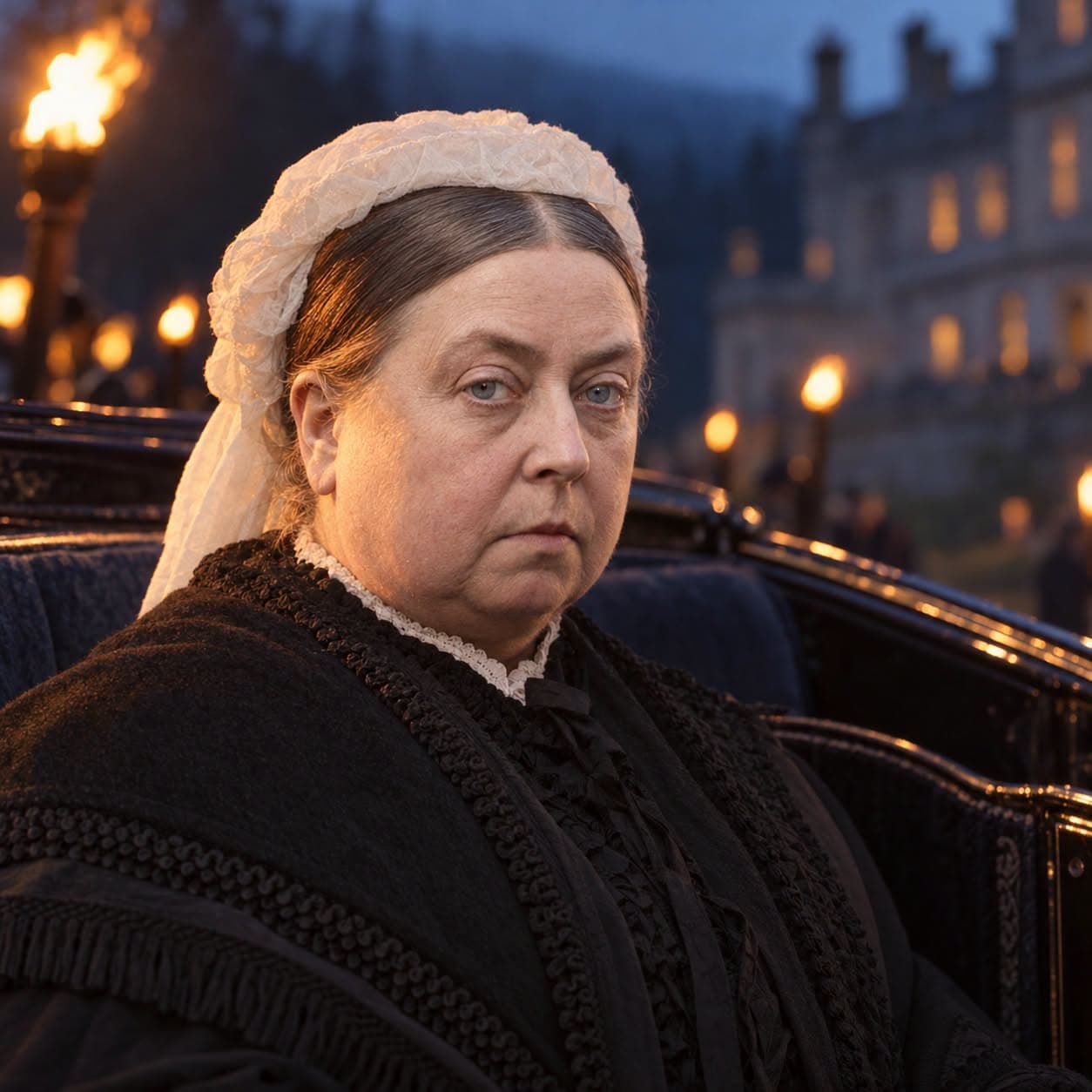
Queen Victoria got out of her carriage and joined the torchlight procession. Her youngest daughter walked with her. Her son had been moved into her dressing room so he could watch.
It was 31 October 1873, and Halloween was being kept at Balmoral. Victoria was fifty-four, still wearing the black she had adopted after Albert's death nearly twelve years earlier. Beatrice, the youngest of their nine children, was sixteen. Leopold, their youngest son, was twenty. For this evening, the family's Scottish home had become the meeting place for a procession of servants, tenants and members of the royal household, carrying flames towards the castle.
Balmoral belonged to Victoria's married life as well as her widowhood. Albert had bought the estate in 1852, when their children were still growing up. It was one of the homes they had made for their family, away from the demands of London and the formal rooms in which so much of royal life had to be conducted. After his death, Victoria continued to return to it. The place remained full of people whose lives went on around hers.
Albert had died at Windsor on 14 December 1861, aged forty-two. Victoria had lost her husband and the man on whom she depended in public business as well as private life. Her withdrawal attracted criticism, and her mourning clothes became almost as recognisable as her face. They could make the woman inside them seem fixed in a single moment. At Balmoral, however, there were horses to ride, people to visit and children who were no longer children. Beatrice had been four when her father died. She was now carrying a torch behind her mother's carriage.
She had grown up close to Victoria, the youngest daughter in a family whose older daughters married and established households of their own. Companionship with her mother became a central part of Beatrice's life. That put her beside a queen, and beside a mother who had been widowed when Beatrice was barely out of the nursery. On this particular day, it took the two of them out across the estate twice before the procession began.
The morning had been dull, with mist coming down over the hills. Late in the morning Victoria rode with Beatrice, going by the quarry and through the woods before returning home. Rain began after luncheon. Victoria spent time with Leopold, and at a quarter to five she drove out again with Beatrice and Lady Erroll to take tea with Mrs Grant. The day had the familiar rhythm of a family staying in the country, with the weather entering into most of the arrangements.
Then the maids of honour joined them, and Beatrice went with them into the Halloween procession behind the queen's carriage, carrying a torch like everyone else. The pipers walked in front. The rain had stopped, and Victoria estimated that there were about 150 torches. She had never seen so many. The number was large enough to catch the attention of a woman who was seldom short of people to accompany her anywhere.
At the castle, Victoria got out. She walked round it with Beatrice and the ladies and gentlemen of the household, while the servants and tenants followed with their lights. The daughter who had walked behind the carriage was now walking with her mother, and a queen much criticised for keeping out of sight was on foot among her household and tenants, in the open, by torchlight.
The torches were piled on the ground. Pieces of wood and old packing cases were added until the fire became enormous. A royal household's discarded boxes had found a useful final appointment. The pipers, the procession and the people walking round the castle gave way to dancing in front of the blaze.
Leopold's place was different. He had haemophilia, and much of his young life had been spent indoors, recovering. On this evening he had been rolled into his mother's dressing room so that he could see the celebration. Victoria had spent part of the afternoon with him. Now his sister was outside among the torches, and he watched from indoors.
Victoria watched the dancing for a little while. It went on until nearly half past seven, and afterwards only the three ladies dined with her. The day had begun with a ride beside Beatrice and ended with every torch gathered into a single fire. Her daughter had walked round the castle with her. Her son, she wrote, had been rolled into her dressing room, from where he could see quite well.