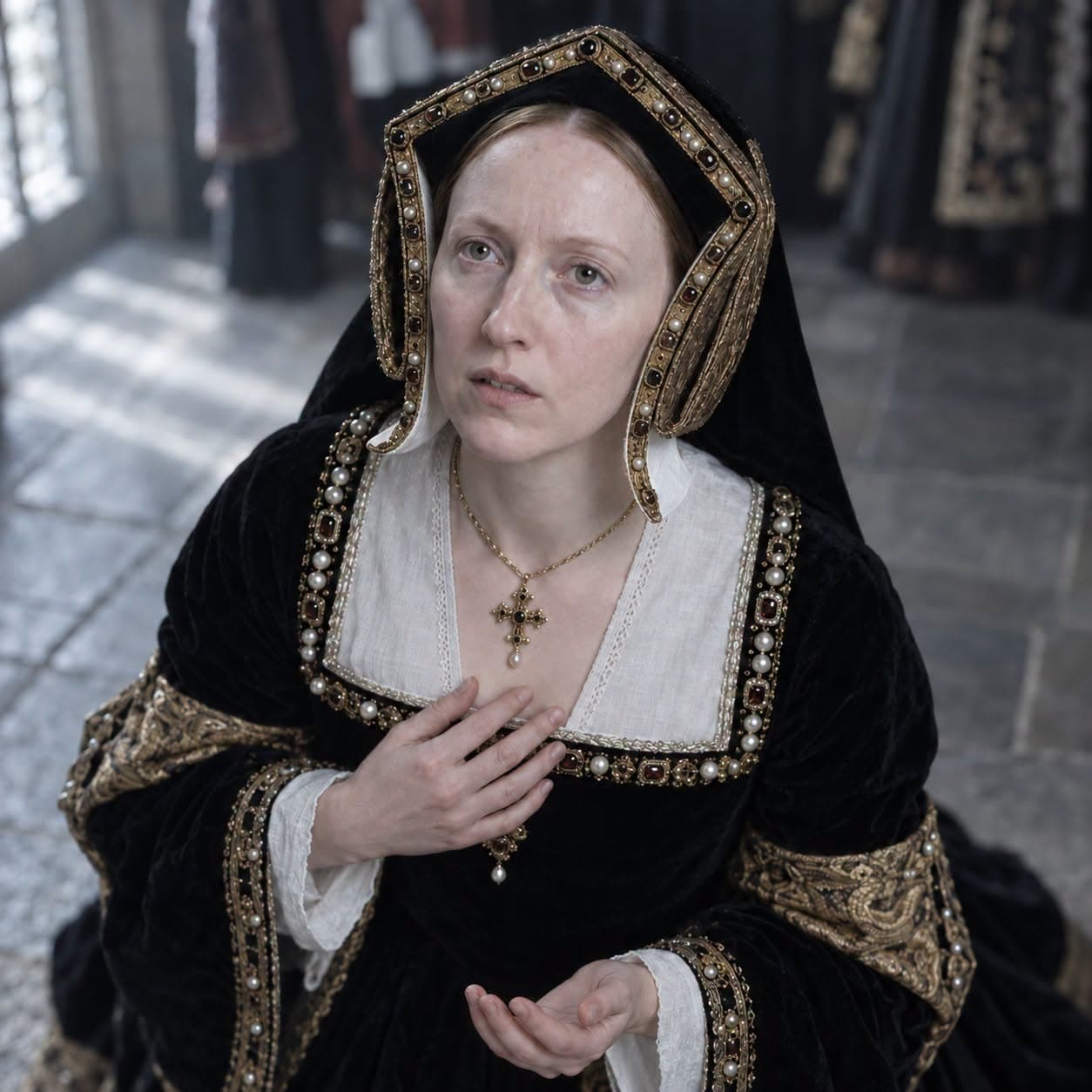
She may have just miscarried twins. She was twenty-four years old, and she was still lying in pain in her bed when the lords came for her crown.
The road there began at Carberry Hill. On the morning of 15 June 1567, Mary and her third husband, the Earl of Bothwell, faced a coalition of Scottish nobles who had risen against them over Bothwell's suspected role in the murder of her previous husband, Lord Darnley. The two sides drew up on opposite hills outside Edinburgh, exchanged challenges to personal combat that never actually took place, and waited through a hot afternoon while the French ambassador rode between them trying to broker terms.
No terms came.
Mary's own men began drifting from the field before evening, until she had no army left to hold ground with. She agreed to give herself up to the rebel lords on the promise that Bothwell would be allowed to ride away unharmed. He did. She did not fare as well.
She rode into the rebel camp expecting, by her own account, to be treated as a queen who had simply lost an argument. Instead the men who had gathered there jeered at her. She was marched into Edinburgh and confined in the house of the city's provost, and the crowds along the way made their feelings just as plain as the soldiers had. Within days she was rowed out to Lochleven, an island fortress in the middle of a loch, and handed over to the custody of the Douglas family. There would be no siege to free her and no army left to attempt one. She was simply gone from the mainland, and the men who had put her there controlled everything that happened next.
What happened to her physically in those weeks is genuinely disputed among historians, not merely uncertain in its details. The main source for the miscarriage is Claude Nau, Mary's own secretary, writing years later under her authority, which makes it her camp's account rather than an independent record. Nau describes her losing twins, reportedly Bothwell's, and the timing of the loss itself is unsettled, with some accounts placing it days before the abdication and others describing her still in pain in bed as the lords entered her chamber on 24 July itself. The uncertainty runs deeper than the dates. One line of doubt has questioned whether the pregnancy timeline holds together at all, and a separate, competing tradition, drawn from Castelnau's memoirs, holds that no twins died at Lochleven, and that Mary later gave birth to a daughter secretly sent to France, who was raised as a nun at Soissons.
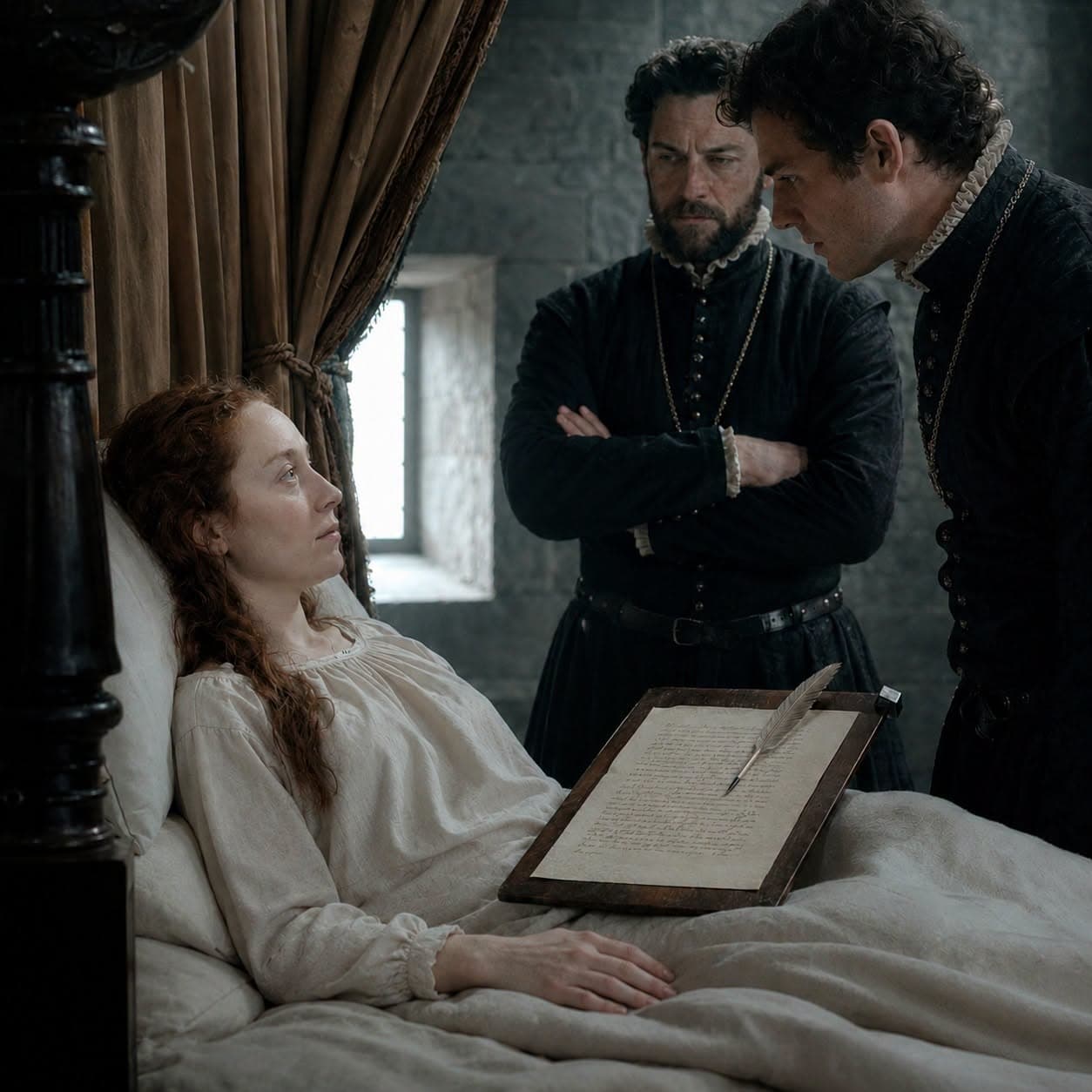
What is not disputed, across every version of the story, is that she was in genuine physical distress when Sir Robert Melville, Lord Lindsay of the Byres, and Lord Ruthven walked into her chamber on 24 July with documents for her to sign.
Lindsay was not a subtle man. According to Nau's account, when Mary refused, Lindsay told her plainly that the lords would cut her throat, "however unwilling they might be" to do it. It was not an idle line delivered for effect. It was a specific threat of death, spoken to a woman too unwell to leave the bed she was lying in, in a room she had no way of escaping. Mary, by her own later account, calculated that a signature obtained this way could eventually be repudiated, and signed rather than call the threat's bluff.
What she signed was not a single dramatic renunciation but three separate instruments, each one doing a specific piece of work. One resigned the crown itself in favour of her thirteen-month-old son, James. A second appointed her half-brother, the Earl of Moray, as regent to govern in the infant king's name. A third authorised a council of nobles to run the kingdom in the gap before Moray, who was out of the country, could return to take up the post. The lords had not simply forced a queen to give something up under threat. They had already worked out, in precise legal detail, exactly how they intended to redistribute what she was giving up before they ever walked into that room.
The documents themselves gave a different account of that day than the one Lindsay had just enforced with a threat of her death. The text Mary signed stated that her body, spirit, and senses were so "vexit, brokin and unquyetit" that she was no longer able to endure the great and intolerable burdens of governing, and that she was resigning out of weariness and vexation alone. Read plainly, it is a confession of exhaustion with no mention of a locked room, an armed lord, or a threat to cut her throat. The lords had not only taken her crown. They had written the official version of why she gave it up, and it was a version with no coercion in it at all.
That version was read aloud twice more before it was finished doing its work. On 25 July, Lindsay carried it to the Tolbooth in Edinburgh, where it was read publicly. Four days later, on 29 July 1567, it was read again inside the Church of the Holy Rude in Stirling, immediately before the infant James was crowned king. At that coronation, Lindsay and Lord Ruthven stood up and swore an oath that Mary had resigned "willingly without compulsion." They said this under oath, in a church, about a woman one of them had personally threatened with death days earlier in a locked room on an island.
The crown passed to a thirteen-month-old who could not yet walk, sworn in on a lie his own captors had just told in a house of God.
Mary did not have the chance to contest any of this while she remained at Lochleven. She got that chance the following spring, escaping the island on 2 May 1568 with the help of her jailer's own brother and illegitimate son. The moment she was free, she repudiated the abdication outright, stating publicly what Lindsay's threats and her own physical collapse had actually looked like from inside that room. It made no practical difference to the throne, which by then belonged fully to her son and the men governing in his name.
It left two competing accounts of 24 July 1567 on the record: the one the lords wrote for the Scottish Parliament, describing a tired queen who simply wished to rest, and the one Mary gave the moment nobody could threaten her into silence again.