Her husband was dead. She was taken to Moulins under arrest. Even the meeting she hoped for on the journey was forbidden.
On 30 October 1632, Henri II, Duke of Montmorency, was beheaded in the courtyard of the Capitole at Toulouse. His wife, Marie-Félice Orsini, would live for more than thirty years after him. Before she could begin any life as his widow, the king's government had decided where she was to spend it.
She had come to France in the winter of 1614–15, an Italian bride from the Orsini family, with Marie de Médicis, the queen mother, as her godmother. Her marriage brought her into one of the great houses of France. There was the court, there was Chantilly, and there was Languedoc, where Henri was governor. At Chantilly she welcomed artists, and one of them gave her a place in poetry. Théophile de Viau called her Sylvie. It was a name that belonged to woods and gardens, and it stayed attached to her long after she had left them.
Her connections reached into the very circle that would destroy her husband. In December 1630, Marie-Félice and Cardinal Richelieu stood as godparents to the same child, the young prince of Conti. Henri had served Louis XIII in Italy and been rewarded with the rank of marshal. This was a family with access to the people who made decisions.
Within two years, access was no longer enough.
The quarrel drew together resentment over royal interference in Languedoc, Henri's disappointed ambitions and the opposition of Gaston d'Orléans, the king's brother, to Richelieu. She was said to have encouraged her husband's opposition to the cardinal. She was politically involved, with loyalties and connections of her own. The rebellion was not something that merely happened around her.
But it was Henri who took arms against the king. Wounded and captured in September 1632, he was brought before the Parlement of Toulouse and condemned to death. His name, his service and his rank brought appeals for mercy. Louis XIII refused them. A monarchy could honour a man's ancestors and still order his death; the ancestors had no means of answering.
The courtyard at Toulouse was closed and guarded by royal troops. The authorities feared an uprising if the execution became an occasion for public protest. The king's authority needed a closed courtyard to display it.
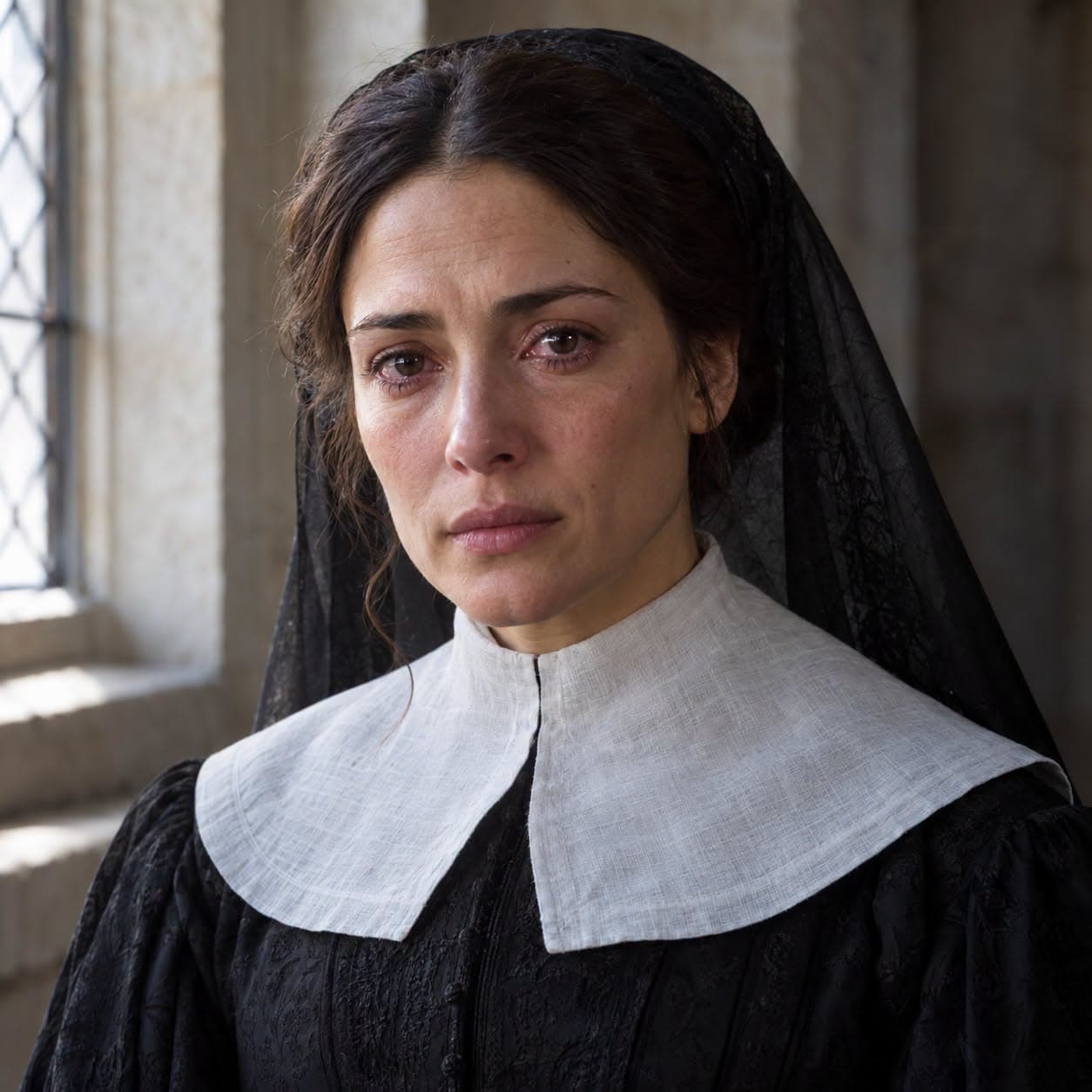
Marie-Félice was herself suspected of involvement in the conspiracy. She was placed under arrest and sent to Moulins, to be confined in the old château of the dukes of Bourbon. The distinction between a widow withdrawing from the world and a prisoner being removed from it was considerable. She had not chosen this journey.
At Lyon, on the way, she hoped to meet Jeanne-Françoise de Chantal. Chantal was another widow, now a religious founder, whose Visitation communities offered Marie-Félice a connection beyond the disgraced household. The meeting was forbidden.
Chantal sent a letter in her place.
Later came a small portrait of François de Sales, with a handwritten note. He had helped found the Visitation with Chantal and had given her the image himself before his death. At Moulins she passed it to the duchess. There was no audience at Lyon, no conversation between the two women, but in time there was an object Chantal had received from the man who had guided her for years and was willing to give away.
The young Visitation community at Moulins supported Marie-Félice during her imprisonment. She also corresponded with Jean Arnoux, the Jesuit who had heard her husband's confession before his death. The man who had attended Henri at the end became someone his wife could write to afterwards. Her surviving connections were becoming a different sort of household, sustained through letters and religious friendship rather than the offices her husband had held.
Her confinement lasted two years. When she began withdrawing to the Visitation in 1634, she did not immediately become a nun. There were years in which she went in and out, advised novices and helped with the community's affairs. She could bring experience to a religious house as well as money. The management of a great household had not become useless simply because the household itself had fallen.
In 1641 Chantal came to Moulins again. The two women had at last met there in 1638, six years after the meeting at Lyon had been forbidden. She urged the duchess to loosen her hold on the world, and that year Marie-Félice retired fully into the monastery. Chantal died at Moulins in December.
For Henri's body, she still needed permission.
In 1644 she obtained authorisation from the regent and the king to have his remains transferred to the Bourbonnais. She commissioned François and Michel Anguier to make his mausoleum and helped provide the church that would house it. The work required money, artists and arrangements extending far beyond the convent. She was giving a permanent form to the remembrance of a man whose public life had ended in disgrace.
Only in 1657 did she take the Visitation habit, becoming Sister Marie-Henriette. Her vows followed the next year. The prisoner of 1632 had reached religious life by a much longer road than the journey to Moulins.
The monument she commissioned remains there, in the chapel of the Visitation. Its figures are carved in marble, Marie-Félice shown in prayer with her eyes raised. Moulins had received her under arrest, unable to obtain even the meeting she wanted on the road. In the chapel she helped build, her own figure is beside the husband she had been left to mourn.