She was eighteen when she married her dead sister's husband. Her sister had died after giving birth. Their little boy had died that summer.
On 30 October 1500, Maria of Aragon married Manuel I of Portugal at Alcácer do Sal. She was a daughter of Ferdinand of Aragon and Isabella of Castile, and the elder sister of Catherine of Aragon. Manuel's first wife had been their eldest sister, also called Isabella. Two daughters of the same parents were to become queens of Portugal, one after the other.
The first Isabella had died in 1498, leaving a son, Miguel. Through his mother and grandparents, the child stood to inherit Castile and Aragon; through his father, Portugal. Three crowns had rested on the survival of one small boy. In July 1500, before his second birthday, he died too. Manuel had lost his only child. Ferdinand and Isabella had lost the grandson who might have brought their kingdoms and Portugal together.
Maria's marriage was already being arranged before Miguel died. His death left the Portuguese king without a child to succeed him, and the wedding went ahead that autumn. The alliance between the two families would continue through another daughter. A marriage alliance could be renewed with a second daughter. A grandson could not be replaced by anyone.
There had to be permission from the Pope. A dead wife's sister was too close a relation under the Church's rules of marriage, although a dispensation could permit the union. That permission was obtained. In August, Maria had married by proxy in Granada, with a representative standing in for Manuel. In October she came to Portugal to meet her husband and complete the marriage in person.
She brought a household with her.
A royal bride travelled with women and men whose work would make her new life possible, as well as the wealth that would make her rank visible. There were brocades and velvets, jewellery, books and furnishings. Some of the objects assembled for Maria came from the possessions of her dead sister Isabella and her dead brother Juan. Her mother's treasury supplied others. The family had lost children; their belongings were still moving through its hands.
Not everything was ready when she left. Her attendant Aldonza Suárez stayed behind to receive further pieces, and more followed Maria after her arrival. Even a marriage between neighbouring royal houses required a considerable amount of packing, paying and sending on what was still unfinished. The splendour took work.
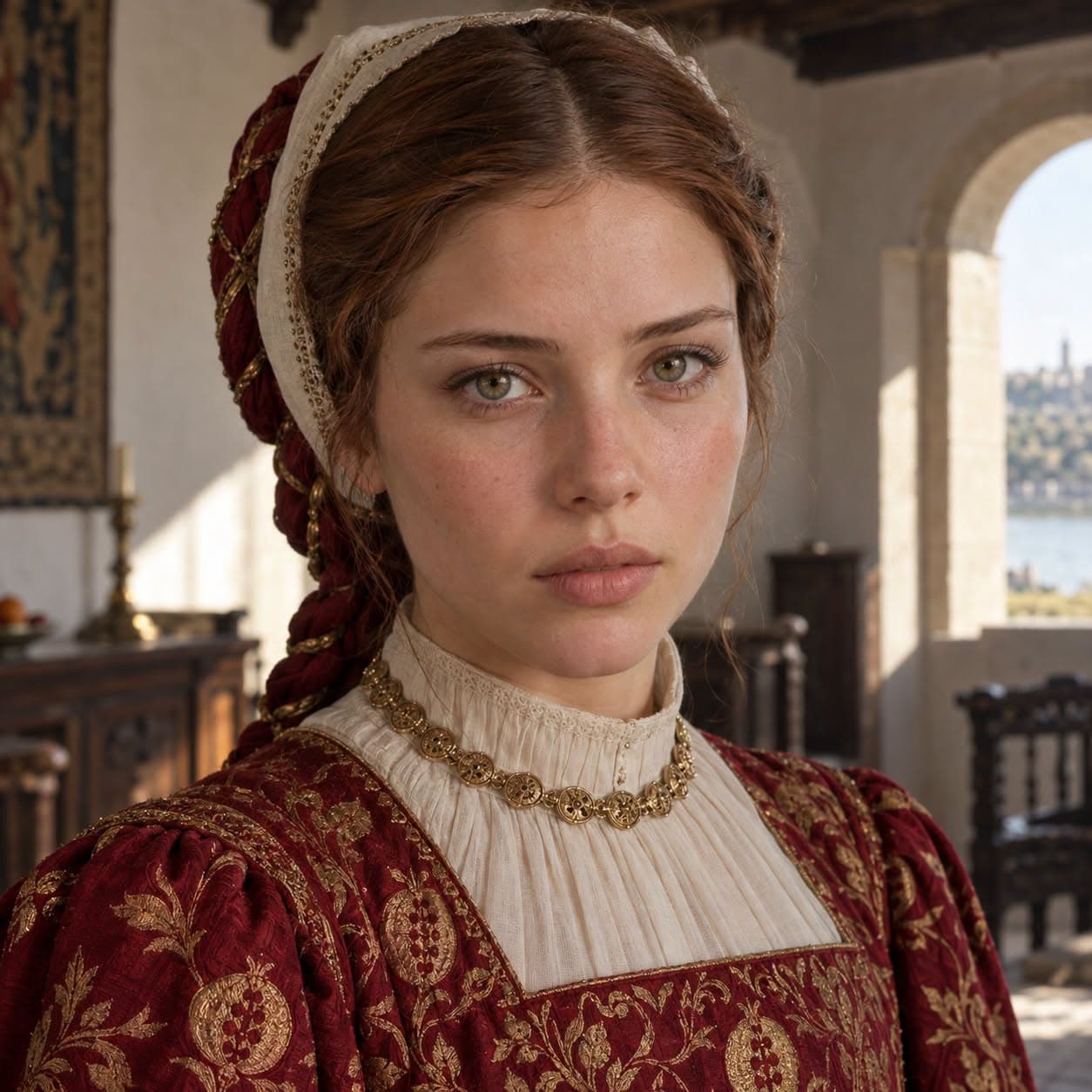
It was a Friday. At Alcácer do Sal, the celebrations occupied the riverside quarter, with festivities at the houses of Rui Gago, near the square. Maria's silver was displayed at the wedding banquet. After the celebrations, the king and queen went on to Lisbon, where there were further festivities. The eighteen-year-old arriving as the king's second wife had a household and a public place of her own to establish.
Less than a month after the wedding, letters arrived from her parents.
Maria was surrounded by courtiers when they were brought to her. Once she knew they were from her mother and father, she asked for them with delight. The men withdrew, leaving the Duchess of Braganza and the ladies with her while she read and heard the news. When the company had gone, she remained praying with Elvira de Mendoza, her senior attendant.
She was a queen now. She was still somebody's daughter.
Her first Christmas in Portugal brought music, worship and elaborate court entertainments. Manuel publicly played the part of the lover paying homage to his queen. His mother, Beatriz, and the Duchess of Braganza spent time with Maria. These were the people among whom her days would now be lived, women with their own standing at court, their own households and their own understanding of what it meant to belong to this family.
The marriage produced ten children. Her eldest son became John III of Portugal; her daughter Isabella married Charles V. But Maria's years as queen also survive in payments to the people around her: rewards for the midwives who attended her deliveries, gifts to servants, money for religious houses and help towards the costs of illness or injury. A queen's household was a place where other people's security depended on her favour. Maria had arrived with people to serve her. She became someone who could provide for them.
In 1502, pregnant with her first child, she made a will. She survived that delivery and the years of motherhood that followed. In 1516, pregnant with her last child, she made another. The documents set out what should happen to her possessions and what those who had served her should receive if she died.
That September she gave birth to António, who lived only a short time. Maria did not recover from the delivery. She lived on for months, dying in Lisbon on 7 March 1517, aged thirty-four. The man she had married at eighteen had lost a second wife after childbirth.