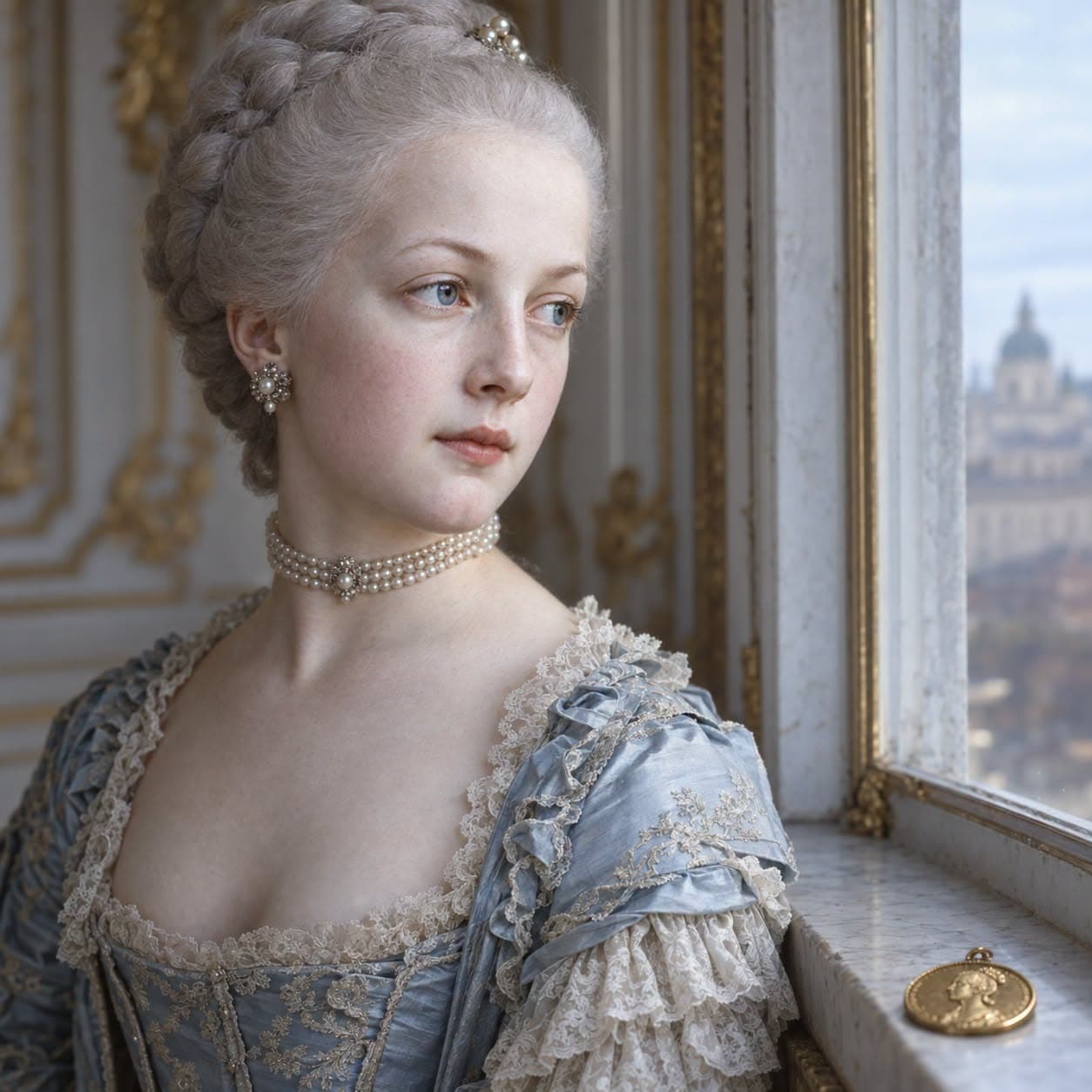
She was sixteen, and she never left Vienna. The pox took her before she could. The gold medal for her wedding had already been struck. Its inscription called her the wife of the King of Naples.
On 15 October 1767, Archduchess Maria Josepha of Austria died of smallpox in Vienna. She was a daughter of Maria Theresa and the late Emperor Francis I, and an elder sister of the girl who would become Marie Antoinette. Her marriage to Ferdinand IV, King of Naples and Sicily, had been years in the arranging, and the ceremony was little more than a week away when she fell ill.
Before Naples, there had been Johanna.
Josepha and her elder sister Johanna Gabriele had shared their rooms and their lessons. They had the same teachers, the same household attendants and the same governess, Countess Lerchenfeld. Within the enormous imperial family, their childhood had been arranged together, down to the adults who taught and looked after them. Johanna belonged to the small daily world inside the great public one, the sister there when lessons began and when they were over.
In 1762, Johanna died of smallpox. Josepha was eleven.
The disease had already killed their brother Karl Joseph. Across the following years it kept returning to a household whose rank offered no protection against it. Their eldest brother Joseph lost both his first and second wives to smallpox, the second in the spring of 1767. There were imperial doctors and prayers and all the resources of a court, and still the family kept burying its young.
Within about a year of Johanna's death, Josepha had been chosen as Ferdinand's future wife. She was twelve. Ferdinand was two months older than she was, and he had been King of Naples since the age of eight, when his father left to take the throne of Spain. It was that father who signed the marriage contract in Madrid in December 1766. The formal betrothal was dated 8 September 1767.
Maria Theresa married off her children the way other rulers signed treaties, and the results tended to last longer. A daughter sent abroad carried the family's interests with her, and the choice of husband belonged to a much larger calculation than either young person's wishes. Ferdinand was a Bourbon. For most of the century the Habsburgs and the Bourbons had been at war, and now they were allies. The preparations were for a wedding, but the business being conducted was an alliance.
The medal made that business visible. On one face was the young archduchess. On the other, above an altar, were the heraldic shields of the two houses, joined by a ribbon held by the figures of Hymen and Cupid. Marriage and love had been given their places in the design. The shields explained what the ceremony was meant to accomplish.
In the spring of 1767, Maria Theresa herself caught smallpox. For a time the fear was for the woman who held the family and the monarchy together. Churches prayed for her recovery, and when she began to improve, the prayers became thanksgivings. Vienna marked her survival with services, music and illuminated churches. That summer the city had a royal recovery to celebrate.
By autumn, the fear was for her daughter.
Josepha fell ill in early October. At first there was still talk of delay. On 7 October it was being reported in Vienna that smallpox had appeared, that the illness seemed mild, and that the journey to Naples would now have to wait until the beginning of the following year. In the same breath came the observation that "everybody is exceptionally afraid concerning smallpox here".
There was reason to be frightened, and there was still room to expect her to recover. Her mother had survived. The wedding could be postponed, the journey rearranged, the preparations taken up again when she was well enough. For the moment, Naples remained somewhere she might go.
The proxy wedding had been set for 14 October. She died the following day.
Her younger sister Maria Carolina was chosen to take her place as Ferdinand's bride. Carolina was fifteen. The king remained the same. The intended alliance remained the same. Another daughter of Maria Theresa would make the journey south.
In April 1768, Carolina married Ferdinand by proxy in Vienna. Medals were needed for her wedding too. Her portrait took its place on the new issue, while the reverse kept the design prepared for Josepha: the altar, the joined shields, Hymen and Cupid. On that side, only the wedding date was changed.