She was thirty-two when she returned to England with French soldiers. Her only son had been written out of the succession. To fight for his inheritance, she had pledged a piece of it.
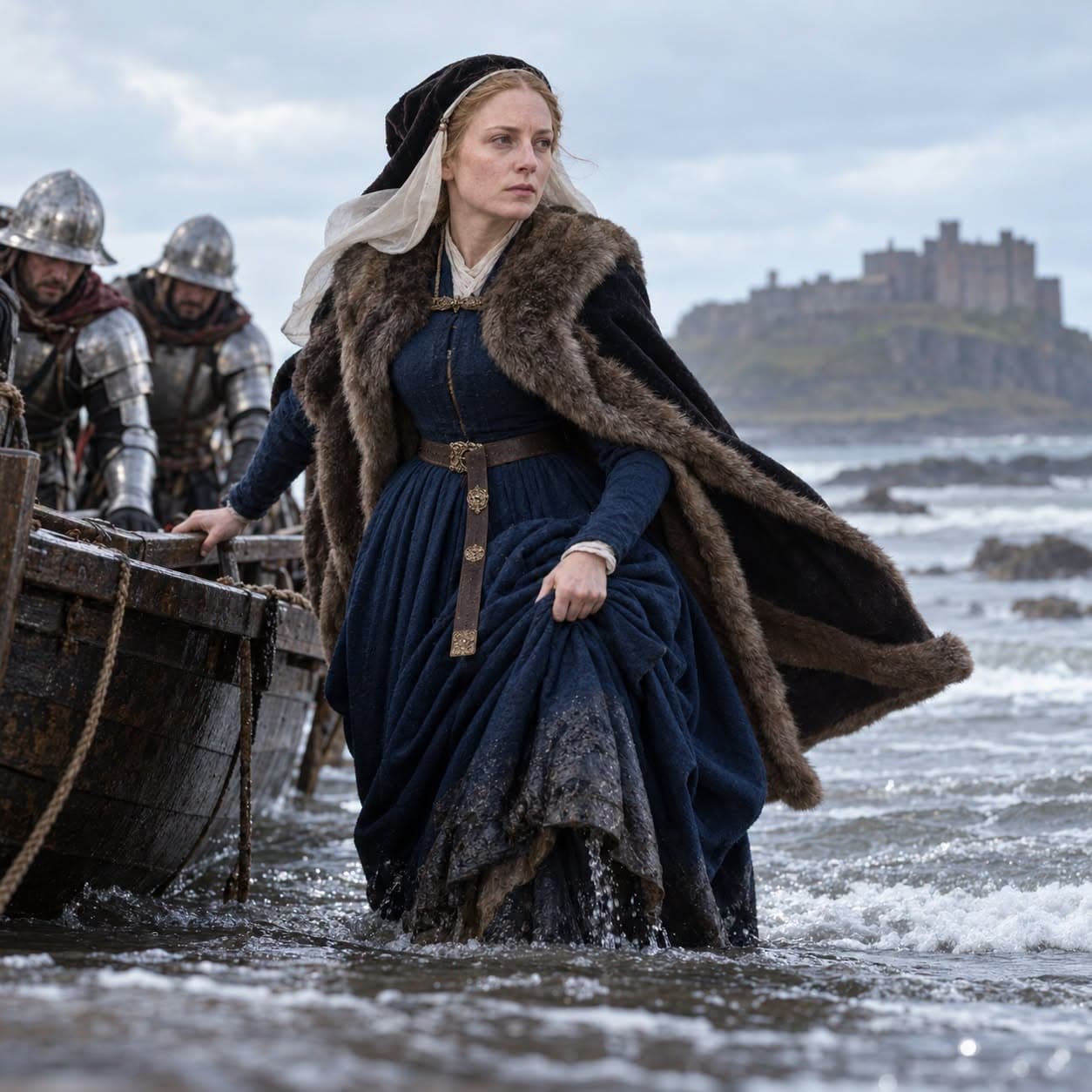
On 25 October 1462, Margaret of Anjou landed on the Northumbrian coast near Bamburgh with an expedition commanded by Pierre de Brézé. Two years earlier, on the same date, the Lords in Parliament had agreed that her husband, Henry VI, could remain king for life, but that Richard, Duke of York and his descendants would succeed him. Margaret's son Edward had just turned seven when they made that arrangement. He had just turned nine when she came back.
There was considerable room in the settlement for the claims of grown men. The king's child had been removed from it altogether.
Margaret had arrived in England at fifteen to marry Henry, a French bride whose marriage was meant to help make peace between the two countries. Eight years passed before the birth of their son. By then Henry had suffered a collapse so severe that he could not respond when the baby was presented to him. The heir had finally arrived, and his father could not acknowledge him. During the struggles that followed, Margaret became the chief defender of her husband's position and their child's succession.
By the autumn of 1462, defending those things meant finding men willing to fight for a king who no longer held his throne. Richard of York was dead, but his son had claimed the crown as Edward IV. The Lancastrian defeat at Towton in March 1461 had secured the new king's position and driven Margaret, Henry and their son into Scotland. They had survived. Their survival did not pay for soldiers.
Help had a price even there. Berwick was surrendered to the Scots in exchange for assistance. In April 1462 Margaret took Edward across the sea to seek support in France, leaving Henry behind. She travelled through Brittany and met her father, René of Anjou, before negotiating with Louis XI at Chinon in June. The woman who had once crossed to England as a royal bride was now asking another king for the means to get back.
Louis wanted Calais.
It was England's remaining foothold across the Channel, a port bound up with the wool trade and with English pride. Margaret borrowed 20,000 livres tournois on its security. The bargain depended on her side recovering control of a place it could not then deliver. It was nevertheless a pledge of English territory to a French king, made to obtain help against an English king. Her family's restoration and the interests of the kingdom were becoming very difficult to fit into the same agreement.
The loan gave her resources. It also gave Edward IV's government something useful to say about her. A French queen seeking French help could be presented as a foreign danger, however plainly she presented herself as the defender of her husband's rights. The soldiers who made her return possible also made that accusation easier.
Her son was never far from the business. On 1 September, writing from Harfleur to de Brézé, Margaret passed on Prince Edward's greetings. He was eight. He would be seventeen when he was killed at Tewkesbury. That autumn he was a boy sending his regards to the man who would command the expedition for his family.
And the expedition achieved something. Bamburgh came into Lancastrian hands, Alnwick was taken, and Dunstanburgh was held for Henry. These were places where his supporters could maintain garrisons and resist Edward IV's government. After exile and negotiation, Margaret's cause once again had strongholds on English ground.
It did not have the rising it needed.
The local gentry did not rally in sufficient strength to turn the landing into a recovery of the north. The countryside could not be counted as Lancastrian simply because Lancastrians held its castles. Edward IV sent the Earl of Warwick north and raised further forces. Against that response, Margaret's expedition could secure a foothold but could not sustain an advance. She withdrew by sea towards Scotland, leaving supporters to hold the fortresses. A storm caught the ships off the coast. Her own vessel was lost with its goods, and she reached Berwick in a fishing boat. Some of the French soldiers were driven ashore on Holy Island, where they were killed or captured.
At Bamburgh, the Duke of Somerset and Sir Ralph Percy remained to defend the cause she had brought back across the sea. In December the Yorkists besieged the castles, and supplies inside Bamburgh began to fail. A relief force was being assembled in Scotland, but the garrison could not be kept waiting indefinitely. By the end of the month Bamburgh and Dunstanburgh had surrendered. Somerset and Percy received pardons and swore allegiance to Edward IV. The king Margaret was trying to displace could offer her supporters a way home.
Alnwick held longer. Early in January, de Brézé and a Scottish relief force reached it and helped its principal garrison withdraw. The castle then surrendered too. Men had been saved, but the foothold gained in the autumn had gone.
Margaret had returned with French soldiers for a boy who had just turned nine. Before the winter was over, all three castles were in Yorkist hands again, and his inheritance was no nearer than it had been at Chinon. The pledge she had made to get there never came due, because the condition attached to it was never met. Calais stayed in English hands for almost another century. Of everything she had staked that year, it was the only piece that never moved.