Margaret Douglas was twenty-two when her confinement ended. The man she had chosen to marry was still in the Tower of London. The king had imprisoned them both, but he was releasing only one.
On 29 October 1537, by the most widely accepted date, she was released from Syon Abbey, where she had been kept under supervision after falling ill in the Tower. Her uncle Henry VIII had allowed her to leave the fortress before he allowed her to be free. Lord Thomas Howard, the man with whom she had made a secret marriage contract, remained his prisoner.
Margaret's mother was Margaret Tudor, Henry's elder sister and the widow of James IV of Scotland. Her father was Archibald Douglas, Earl of Angus. Henry VII was her grandfather. These were the family connections that gave her a place at the English court, and the same connections that made choosing a husband there so dangerous. A king's niece could be welcomed into his household without being permitted to decide whose household she would eventually share.
She had served Anne Boleyn as a lady-in-waiting. Thomas belonged to the queen's family. He was Anne's uncle, though younger than she was: a son of the second Duke of Norfolk by his second marriage, and half-brother of the third. He was no obscure young man making an improbable match. The Howards were already close to the throne. A contract with Margaret would bring one of them closer still.
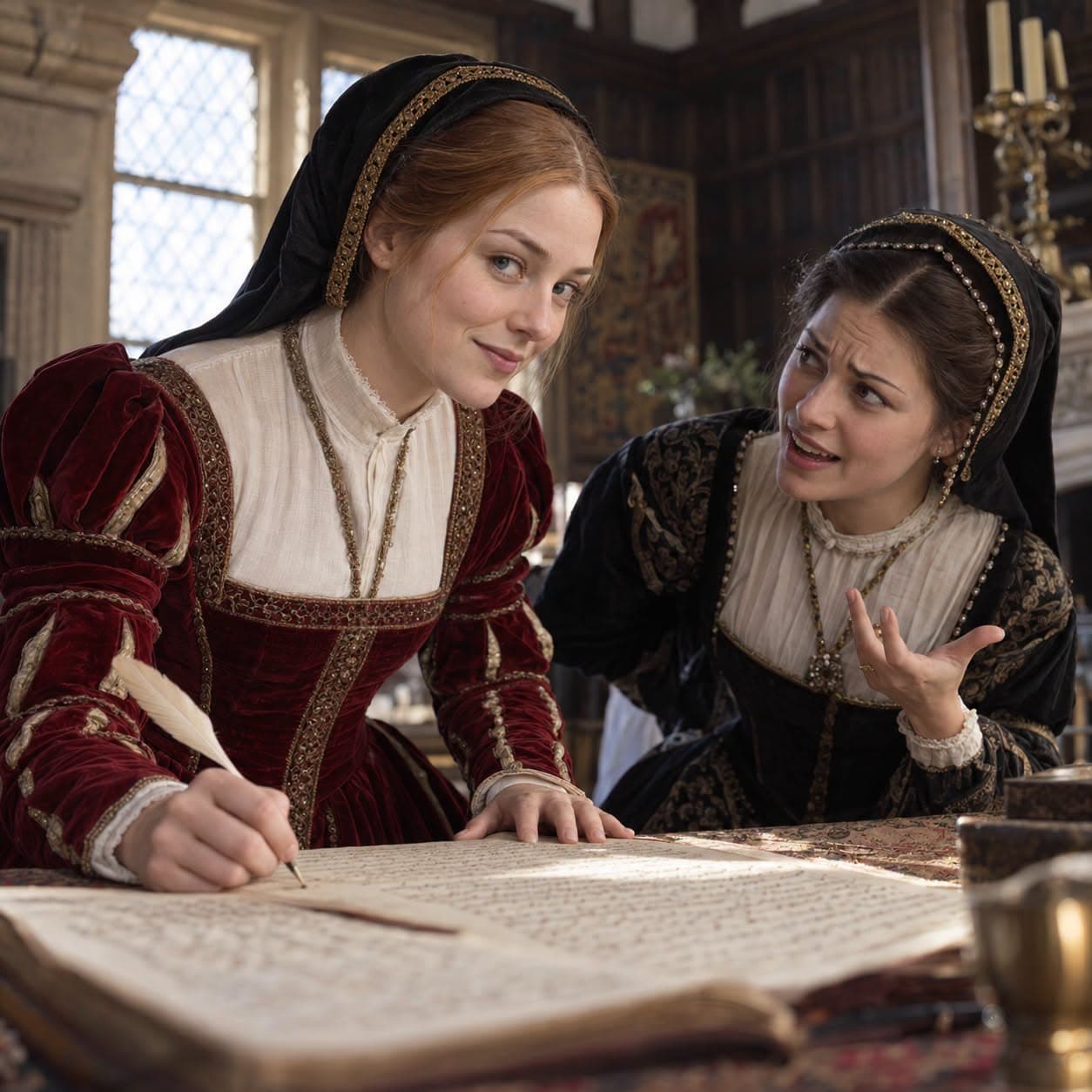
The court in which they met left behind a book of verse now called the Devonshire Manuscript. Its pages contain poems copied by different hands, corrections, comments and small exchanges in the margins. Margaret was among its busiest contributors. She copied and annotated; she had opinions about what deserved a place on the page. Beside one poem in which a male speaker pleads for a woman's love, she wrote "forget this". Another court woman, Mary Shelton, answered that it was worthy. Even a suffering lover could receive an unenthusiastic review. The margins keep a Margaret the official proceedings had no use for: a reader with opinions, quite capable of answering back.
The marriage contract brought a different kind of reader to her affairs. By July 1536 Henry had discovered the agreement, and both Margaret and Thomas were in the Tower. Margaret was twenty. Her uncle had had Anne Boleyn executed only weeks before, and his daughters Mary and Elizabeth had both been declared illegitimate. With no legitimate son yet born to him, the marriages of other people with Tudor blood carried a weight that had very little to do with their own wishes.
On 18 July, Parliament attainted Thomas, condemning him to death without a trial. The act accused him of seeking to interfere with the succession to the Crown, and treated the contract as a threat to the kingdom rather than a match made without permission. That was the Crown's accusation. What the couple had demonstrably done was agree to marry. Henry's government supplied the larger ambition. The death sentence was never carried out. He simply stayed where he was.
Margaret fell ill and was moved to Syon, but the move did not give her back her independence. In confinement she had to account to Thomas Cromwell, the king's chief minister, for the people around her. Two of her servants had belonged to Thomas. She explained that she had taken them in because they were poor, and agreed to send them away since Cromwell wished it. She begged him not to think "any fancy doth remain in me touching him, but that all my study and care is how to please the King's Grace".
Her letter narrowed from a marriage to the management of a small household. She listed who remained: a gentleman, a groom, a chaplain and one other attendant. She received no visitors but gentlewomen; men, she wrote, would not be fitting, "being a maid as I am". She asked Cromwell to arrange her servants' wages. The great question of whom she could marry had become the smaller question of whom she could employ. Neither was hers to settle.
She had been moved. She had not been freed.
By October 1537 the royal family around her had changed again. At Hampton Court on 12 October, Jane Seymour gave birth to Edward, the legitimate son Henry had wanted for most of his reign. Margaret's Tudor blood was unchanged, but England now had a prince, and the succession no longer hung so heavily on the marriages of the king's relations. The birth changed the setting of her imprisonment. It did not release Thomas.
On 24 October, Jane died at Hampton Court. Five days later, Margaret's confinement at Syon ended. The month that had given Henry a son had also taken his queen; for his niece, it brought permission to leave. Her agreement with Thomas had been renounced, and there was no wedding waiting at the end of her imprisonment.
Margaret was free at twenty-two, after more than a year in royal custody. Thomas was still in the Tower under the act Parliament had passed the summer before. He fell ill there, and on 31 October 1537, two days after her release, he died, still a prisoner. He was about twenty-six. Henry had sent two people to the Tower in the summer of 1536. He let one of them go.