She was the most powerful woman in Cologne. So they killed her.
In 1627, Katharina Henot was Germany's first known female postmaster. She had inherited the position from her father, ran the imperial postal routes across the region, and had spent decades building a network of influence, wealth, and civic respect that few men in Cologne could match.
She had enemies.
A rival family was lobbying the Holy Roman Emperor to strip the Henot family of their postal monopoly and hand it to a centralised imperial system. The cathedral chapter, powerful clergy who had clashed with Katharina for years over jurisdiction and money, were watching closely.
Then a nun at a local convent claimed to be possessed by the devil.
She named Katharina as the cause.
The charges came quickly. Katharina's daughter and sister were both nuns at the same convent. She had visited often. The judges decided this proximity was suspicious. They looked harder. They found a scar on her forehead, a childhood injury, she explained. She brought witnesses who confirmed she had received it in an accident as a girl. The judges decided this proved the devil had marked her in childhood. The scar became evidence. Her defence became evidence. Everything became evidence.
She was arrested in 1627.
The law at the time, the Constitutio Criminalis Carolina, prohibited repeating torture unless fresh evidence appeared. Local judges had a well-worn solution: declare each new session a continuation of the last. Katharina was subjected to session after session. She denied the charges through all of it.
She denied them when they stopped.
She denied them in letters home.
She denied them until the morning they killed her.
Three days before her execution, Katharina wrote a final letter to her family. The torturers had destroyed her right hand. She wrote with her left anyway.
The judges noted this. In the logic of witch trial law, the left hand was the devil's hand. A woman writing with her left hand was a woman whose God-given hand had been made useless. They recorded it as further evidence against her.
She had tried to tell them she was innocent.
They recorded how she held the pen.
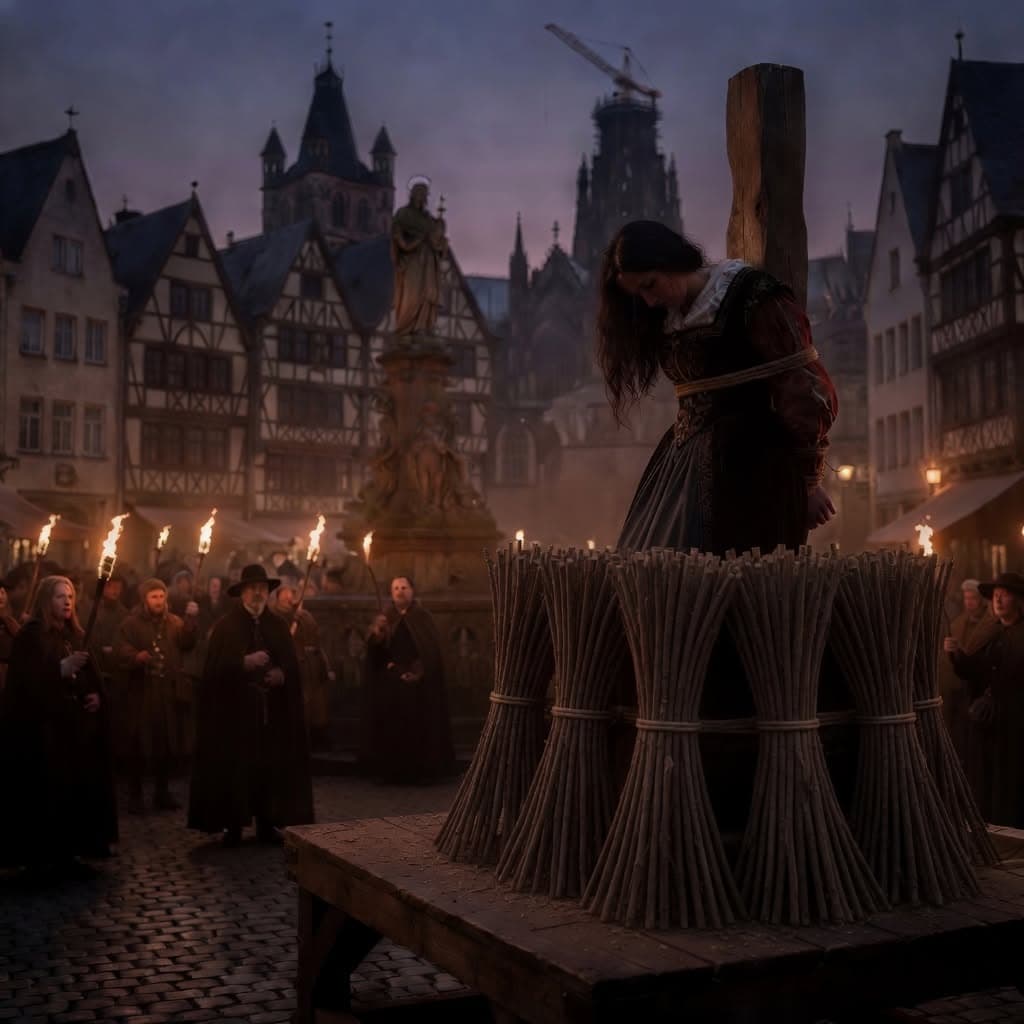
On May 19th, 1627, Katharina Henot was paraded through the streets of Cologne in an open cart. Before a notary, in the presence of witnesses, she made a final formal declaration of innocence. She did not confess. She never confessed.
She was strangled. Then her body was burned.
Strangulation before burning was typically reserved for those who had confessed and repented, a mercy for the cooperative. Katharina had not confessed. The judges granted her the mercy anyway, and the records offer no explanation for why.
A Jesuit priest named Friedrich Spee had watched the Cologne trials. He had heard Katharina's case. He had watched what the courts were doing to people who denied the charges and people who confessed, and he understood that the process had been designed so that no one could survive it.
In 1631 he published a book called Cautio Criminalis, a direct and systematic attack on the legal practices behind the witch trials. He did not name Katharina. He didn't have to. Her case was one of the reasons he wrote it.
Germany executed an estimated 25,000 people for witchcraft between 1300 and 1850. Germany was the undisputed epicentre of the European witch hunts. Katharina Henot died at the height of it, in the middle of a decade when the trials in Cologne, Würzburg, and Bamberg were running simultaneously, killing hundreds.
In 2012, 385 years after her execution, the city of Cologne formally cleared her name.
Her statue on Cologne Town Hall was placed there in 1988, carved by one of her own descendants. It took 361 years for someone to put her back.