The question of whom queen Elizabeth might marry had reached the printing presses. A book warned that her proposed wedding would swallow England. Its author called it loyalty. Her government called it sedition.
On 30 October 1579, John Stubbs, Hugh Singleton and William Page were tried at Westminster over The Discoverie of a Gaping Gulf. Stubbs had written it, Singleton had printed it, and Page had helped put copies into circulation. All three were convicted. Each was sentenced to lose his right hand.
Elizabeth I was still considering marriage to François, Duke of Anjou, the youngest brother of the French king. He was Catholic. She governed a Protestant kingdom, and a French alliance offered a possible counterweight to the power of Spain. It also raised questions that could reach into every parish in England. What religion would a royal husband practise? What influence would he acquire? What would happen to the country after Elizabeth died?
She had no child to succeed her. A marriage might provide an heir and make the succession less dangerous. It might also bring a foreign prince into the heart of her government. The same proposed wedding could be presented as England's protection or its undoing, depending on who was doing the advising.
Anjou had come to England that August, one of the very few of her foreign suitors to cross the sea and court her in person. He was twenty-four. The match was no longer only a matter of ambassadors and draft terms; it had a face, and it had stood in her presence. Her age made the question increasingly urgent. It did not make the answer simpler.
The same month, Stubbs's answer appeared in print.
The book was published anonymously, and its full title did much of its arguing for it: The Discoverie of a Gaping Gulf Whereinto England is Like to be Swallowed by an Other French Mariage, if the Lord Forbid Not the Banes, by Letting Her Maiestie See the Sin and Punishment Thereof. Before the reader reached the argument, Elizabeth's proposed marriage had already been placed before a higher court.
Inside, Stubbs warned that a union with a Catholic French prince threatened England's religion, its independence and its moral welfare. He presented his opposition as concern for his queen and country, and claimed the right to speak because the danger was so great. A loyal subject, in this understanding, could have a duty to tell his sovereign something she did not wish to hear.
But publication gave that advice an audience. Elizabeth's judgement was being examined by people who had no place at her council table. Readers could consider the warning, repeat it and judge the proposed husband for themselves. William Page sent fifty copies to be circulated in Cornwall. An argument about the queen's marriage could travel considerably further than a conversation at court.
Elizabeth answered in public too.
Her proclamation of 27 September condemned the book as seditious and ordered copies to be surrendered and destroyed. It also defended the French prince and her own government. Her subjects were assured that he had demanded no alteration in their laws or their religion. A pamphlet had suggested she might give away what she had defended for twenty years. The proclamation answered in her name.
There was a claim to loyalty on each side. Stubbs offered a warning meant to preserve the queen and the Protestant country she ruled. Elizabeth asserted that her subjects could trust her to protect them while she negotiated. For a woman whose marriage had been urged on her for two decades as the remedy for England's troubles, the public argument had become a challenge to her authority. She could consider a husband, but she also had to defend her right to judge one. Her government chose to make that defence in court.
At Westminster, the three men faced a statute against seditious writing passed under Philip and Mary and extended to Elizabeth at the start of her reign. It reached beyond the man who composed the words to those who printed and spread them. The author, the printer and the man circulating copies received the same sentence. Anonymity on a title page had protected none of them.
Singleton received a pardon. Five days after the conviction, on 4 November, the sentence on the other two was carried out in the market-place at Westminster. Stubbs and Page had their right hands cut off.
Afterwards Stubbs took off his hat with his left hand and cried, "God save the Queen." The crowd around him stood silent. He had addressed her as a loyal subject in print. He addressed her as one again from the scaffold.
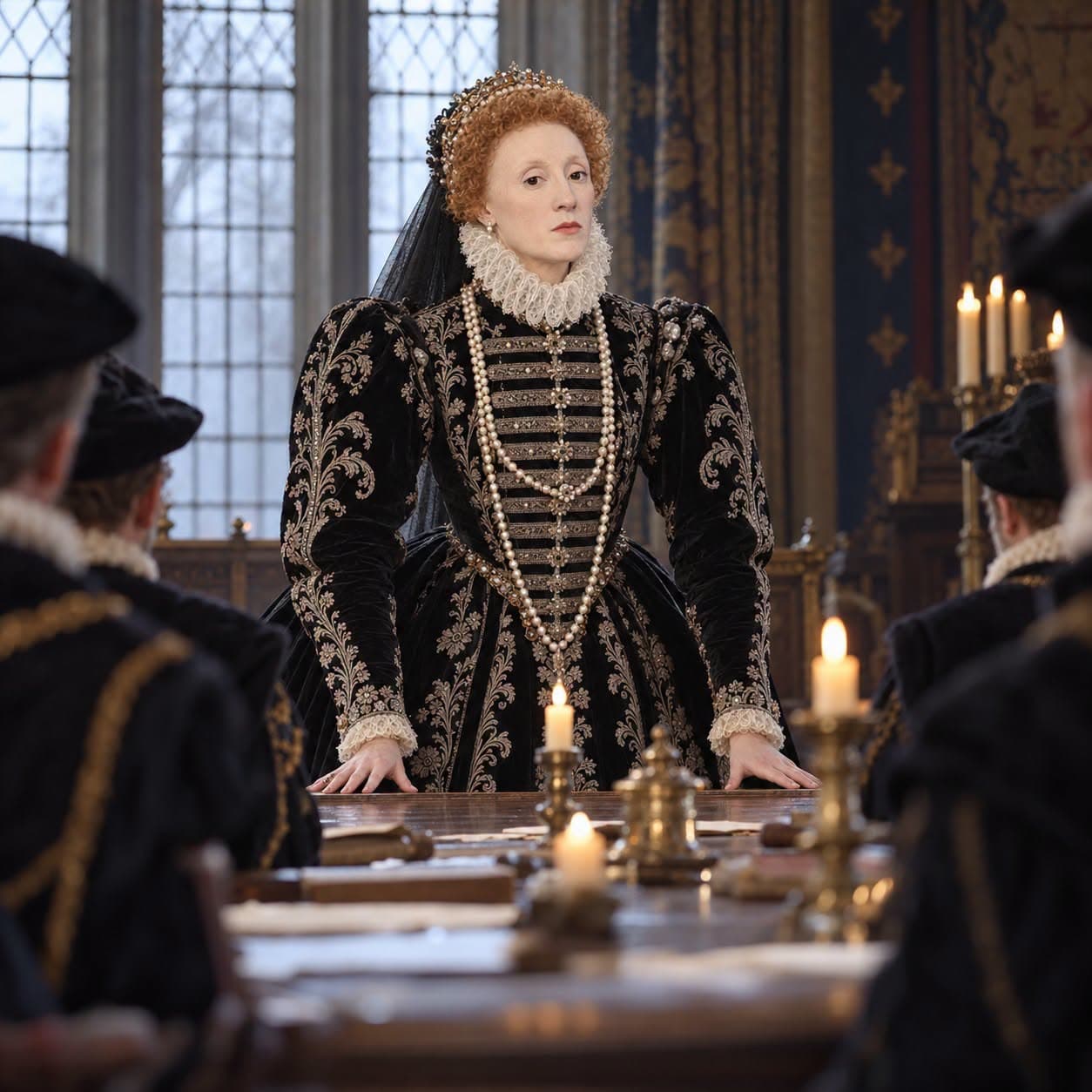
The marriage negotiations continued. On 10 November, Elizabeth summoned her principal councillors and told them she had determined to marry. They were to discuss the arrangements rather than argue further against the match. The prosecution had taken place while the choice was still open, and the punishment had settled nothing about the wedding.
The book had warned that a French marriage would swallow England. Copies of it outlived the order to destroy them. Elizabeth never married Anjou, and she never married anyone.