England had its prince. Eight days later, his mother was fighting for her life.
On the afternoon of 23 October 1537, Jane Seymour seemed a little better. She had been gravely ill at Hampton Court, and this small improvement offered a reason to hope that she might survive. It lasted until towards night. Then the sickness worsened again. Her son Edward was eleven days old.
Jane had come to the king's attention while serving the women who preceded her. She had been a lady-in-waiting to Katherine of Aragon, then to Anne Boleyn. Both queens had borne Henry daughters who survived infancy. Neither had given him the living, legitimate son around whom he wanted to arrange the future of his kingdom. Jane had attended queens before she was expected to solve the problem that had helped to undo them.
She married Henry on 30 May 1536, eleven days after Anne's execution. The speed left very little space between one queen's destruction and the next queen's beginning. By the spring of 1537 Jane was expecting a child, and by October the court was waiting at Hampton Court for its arrival.
The labour was long and exhausting. On 12 October 1537, in the early hours of the morning, she gave birth at Hampton Court. The baby was a boy.
That day an announcement went out in Jane's name and under her signet. It told Cromwell that she had been delivered of a prince, conceived in "most lawful matrimony", and asked for thanksgiving and prayers for his preservation. Even the announcement of a newborn had to put the marriage beyond question. Henry's previous marriages had made the legitimacy of his children a matter of state. Jane was still in childbed, and her name and seal were already carrying the news beyond the palace.
Three days later, Edward was taken to the Chapel Royal for his christening. The procession had places for the great officers and noblemen of the court, for bishops and ambassadors, and for the women who had attended the birth. The nurse and midwife went with the baby. Even beneath a canopy, surrounded by all that rank, he still needed them.
His half-sister Mary was his godmother. Elizabeth carried the christening cloth, and because she was so young she was herself carried by Jane's brother Edward. Anne Boleyn's daughter went to the font in the arms of Jane Seymour's brother. Henry's two daughters were given their places in the ceremony for his son. Afterwards, gold and silver gifts were carried back in the procession, and Edward was brought to his parents for their blessing.
Jane and Henry had stayed away from the service, as custom required. In the private apartments she sat up in bed to receive the child. She had survived the labour. She was well enough for this part of the celebrations. Preparations had already begun for her churching, the religious ceremony that would mark her return from confinement to court life.
There was a future being arranged for her.
Instead, she became seriously ill. The birth and christening were scarcely over before her recovery became uncertain, and by 23 October she had been sick for days. Her attendants watched for signs that she was improving. That afternoon she seemed to gain some relief, and for a few hours she appeared to mend. Such a small bodily change had become something worth reporting to the king's chief minister.
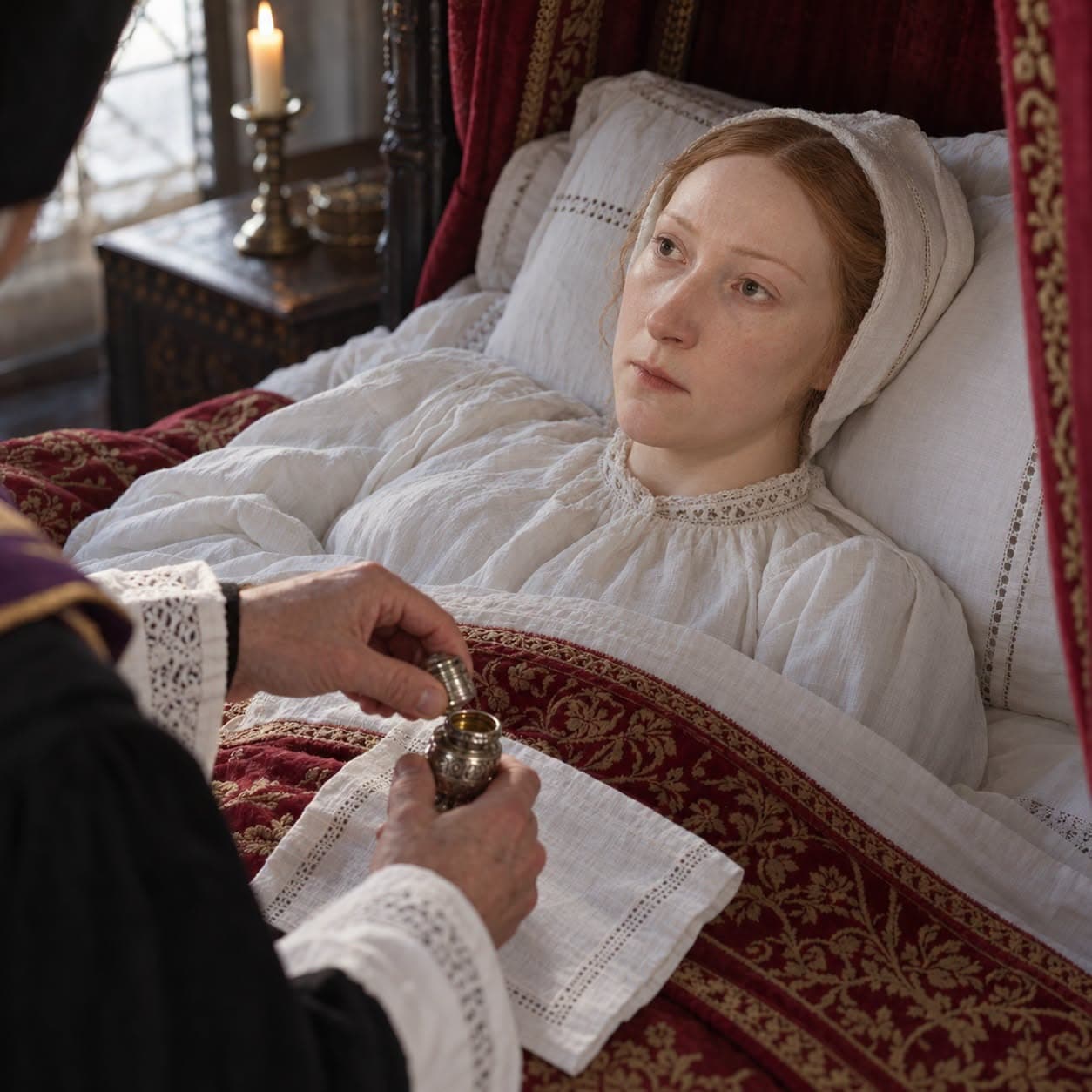
By the following morning, the report was worse. She had been very sick throughout the night. At eight o'clock on 24 October, her confessor had already been with her and was preparing to administer the sacrament of unction, the anointing of the sick. The queen who had been making ready to return to public life was now being prepared for the possibility of death.
Hope persisted even then. If she could sleep that night, her physicians still thought she might pass out of danger. Henry had intended to leave Hampton Court for Esher, but her illness had kept him at the palace. His plans remained unsettled while the people attending Jane waited to see whether she would recover.
By that evening, the Duke of Norfolk expected her to die. He asked Thomas Cromwell to come early the next morning to comfort the king, fearing that Jane would already be dead when the message was read. The correspondence that had so recently carried news of a prince was now making arrangements for the loss of his mother.
Jane died at Hampton Court on 24 October 1537. After the christening, her son had been carried back to her bed, with his place in the succession secure and his mother still able to receive him. When he lost her, he was twelve days old.