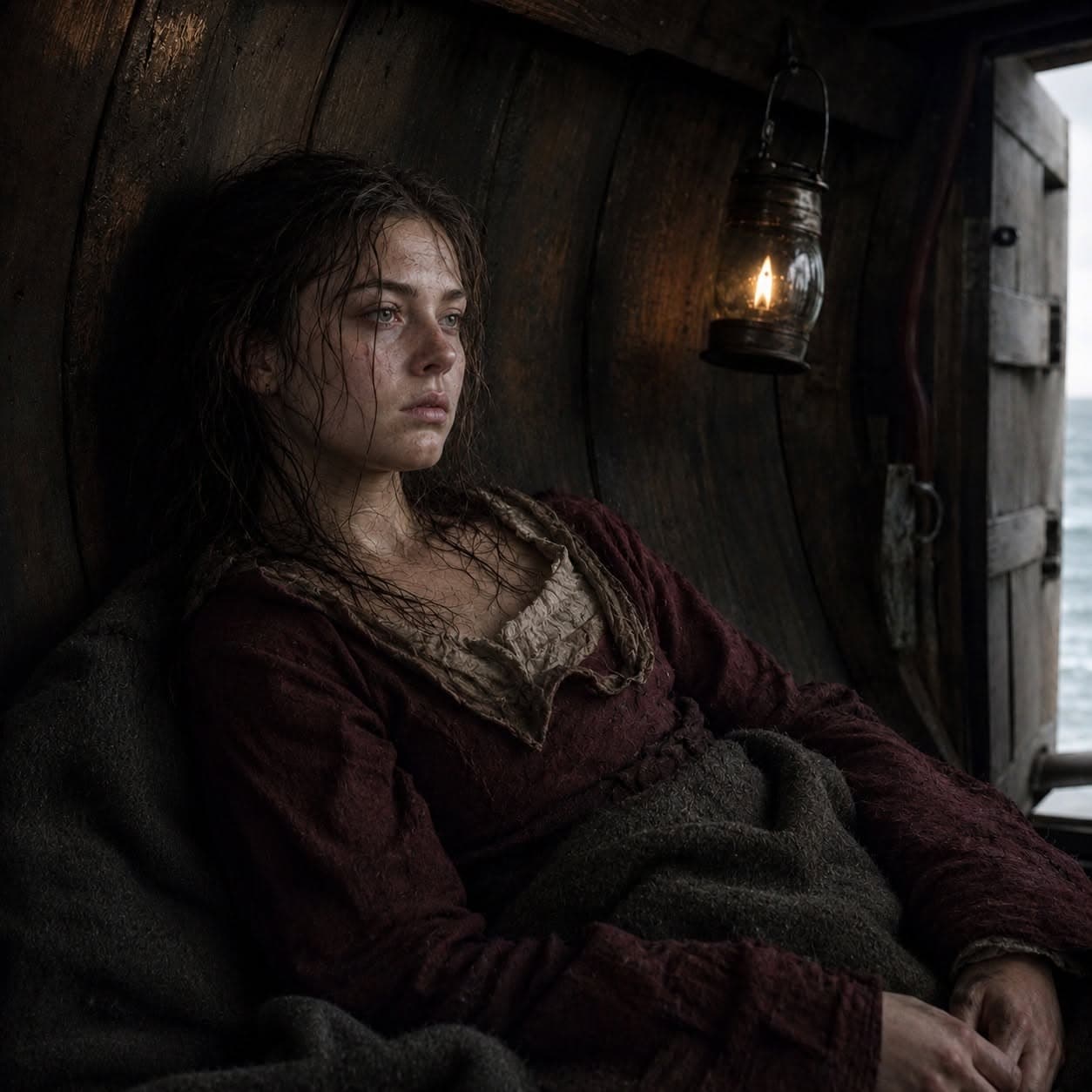
She gave birth on a ship off Calais in April 1470. The captain had refused to let them land. Her father was negotiating. The baby did not survive. The negotiations did.
Isabel Neville was born on the fifth of September 1451 at Warwick Castle, the eldest daughter of Richard Neville, Earl of Warwick, and Anne Beauchamp. She grew up in the largest private household in England, in a family that had more land, more income, and more political reach than almost any other in the kingdom. Her father had placed Edward IV on the throne in 1461 through the management of military force and political alliance, what contemporaries called kingmaking, because the name fit. He had expected the gratitude that placement required. When Edward married Elizabeth Woodville in secret in 1464 and the Woodville family began accumulating the influence Warwick had expected to hold himself, the gratitude curdled.
Warwick began looking for instruments. He had two daughters. He had a plan.
The plan required a marriage. George, Duke of Clarence, was Edward IV's younger brother, unstable and ambitious and perpetually convinced he was owed more than he had. Warwick offered him Isabel. The match would bind Clarence to the Neville interest and give Warwick a prince of the blood as a son-in-law and potential counter to Edward. Edward IV refused permission. Warwick took Isabel to Calais in July 1469 and married her there without it. She was seventeen. Nobody asked what she thought of the arrangement. The question would not have been considered relevant.
The marriage announced itself as a political act before the ceremony was complete. Within weeks Warwick and Clarence had returned to England, raised a rebellion, and captured Edward IV at Warwick Castle. The rebellion collapsed, Edward was released, and the reconciliation that followed was the uneasy kind that satisfied no one. By 1470 Warwick had broken with Edward entirely, allied with the Lancastrian cause he had spent a decade fighting, and was moving his household to France to negotiate with Margaret of Anjou. Isabel was pregnant. She made the crossing with them. She was on the ship when she went into labour off Calais in April 1470, and when the captain refused permission to land, and when the baby was delivered and did not breathe, and when the ship moved on because the politics required it to.
Her father was conducting the business that had put her at sea. The business continued. The baby was buried at sea.
She followed her father back to England in the autumn of 1470 when the Lancastrian restoration briefly put Henry VI back on the throne. She was present through the months that followed, through the collapse of the restoration at Barnet in April 1471, through her father's death on that field and her mother's flight into sanctuary.
Isabel was nineteen years old when Warwick died and the entire Neville inheritance became the object of a struggle between Clarence and his brother Richard of Gloucester, both of whom understood that the Neville fortune was now in the hands of two daughters and that the daughters were the means of obtaining it. Richard moved quickly. Anne Neville, Isabel's younger sister, was taken into his custody and eventually became his wife. The sisters were separated by the inheritance dispute their father's death had created. They were not instruments of the same plan anymore.
They were instruments of competing ones.
Isabel spent the next five years managing what her marriage had become. George of Clarence was by this period a man who had switched sides twice, been forgiven twice, and was trusted by no one. Isabel had borne him four children by the time she was twenty-five, of whom two survived infancy. What her daily life contained during those years the record does not say. She left no letters, no accounts, nothing in her own voice. The silence is not Jacquetta's silence, which was deliberate and strategic. It is the silence of a woman who was not considered a subject worth recording, whose interiority was not the business of the chroniclers who surrounded her household.
She died on the twenty-second of December 1476, two and a half months after the birth of her last child, who did not survive either. The cause was almost certainly puerperal fever or the consequences of a body already weakened by tuberculosis, worn through by four pregnancies in five years and unable to recover from the last one. She was twenty-five years old.
George's response to her death is the clearest evidence the record preserves of what her life had been. Within months he had accused one of her ladies-in-waiting, Ankarette Twynho, of poisoning Isabel. He had Ankarette seized from her home in Somerset, dragged to Warwick, tried before a jury, convicted and hanged, all within a single day. Edward IV later pardoned Ankarette posthumously and described the proceedings as a perversion of justice.
He produced a servant and a charge and a verdict in a day because what he could not face, that Isabel had died from what he had put her through, required a different explanation, and Ankarette was available and powerless and could not refuse to supply one. He was arrested by Edward IV in June 1477 and executed in the Tower in February 1478. He was buried beside Isabel at Tewkesbury Abbey, behind the high altar, where she had lain for more than a year before he arrived.
She left two children. Her son Edward, Earl of Warwick, was almost three years old when his father was executed. Henry VII imprisoned him in the Tower in 1485, when he was ten, and he remained there for fourteen years, executed in 1499 at the age of twenty-four for the crime of carrying Plantagenet blood in a dynasty that had decided Plantagenet blood was a problem to be managed. Her daughter Margaret survived longer, carrying the same blood into the Tudor age.
The Kingmaker's daughter. Married at seventeen to a man her father chose. On a ship off Calais at nineteen, delivering a child that did not live, while the men around her managed the crisis she was peripheral to. Dead at twenty-five. Her children on Tudor scaffolds. Nobody called it strategy. Nobody needed to.