Emily and Mary went to a Halloween dance in the dresses that would cost them their lives. One sister caught fire. The other tried to save her. Neither died that night.
On 31 October 1871, the sisters attended a gathering at Drumaconnor House in County Monaghan, Ireland. Emily was twenty-four. Mary was twenty-two. Their host was Andrew Reid, and towards the end of the evening one of the sisters was dancing near an open fire when her dress caught alight.
They were daughters of Sir William Wilde, the Dublin eye and ear surgeon, and elder half-sisters of Oscar Wilde. Emily had been born in 1847 and Mary in 1849, before their father's marriage. William acknowledged them and provided for their education, but they were brought up by relatives rather than in the household he established with his wife. In Monaghan they lived with his brother, the Reverend Ralph Wilde. The surname became one of the most famous in literature. Very little about the two women who carried it into Drumaconnor that night was ever written down.
Their life in Monaghan was not a hidden one. They were known in the county, and they were invited. On that October evening, both were guests at a country-house dance.
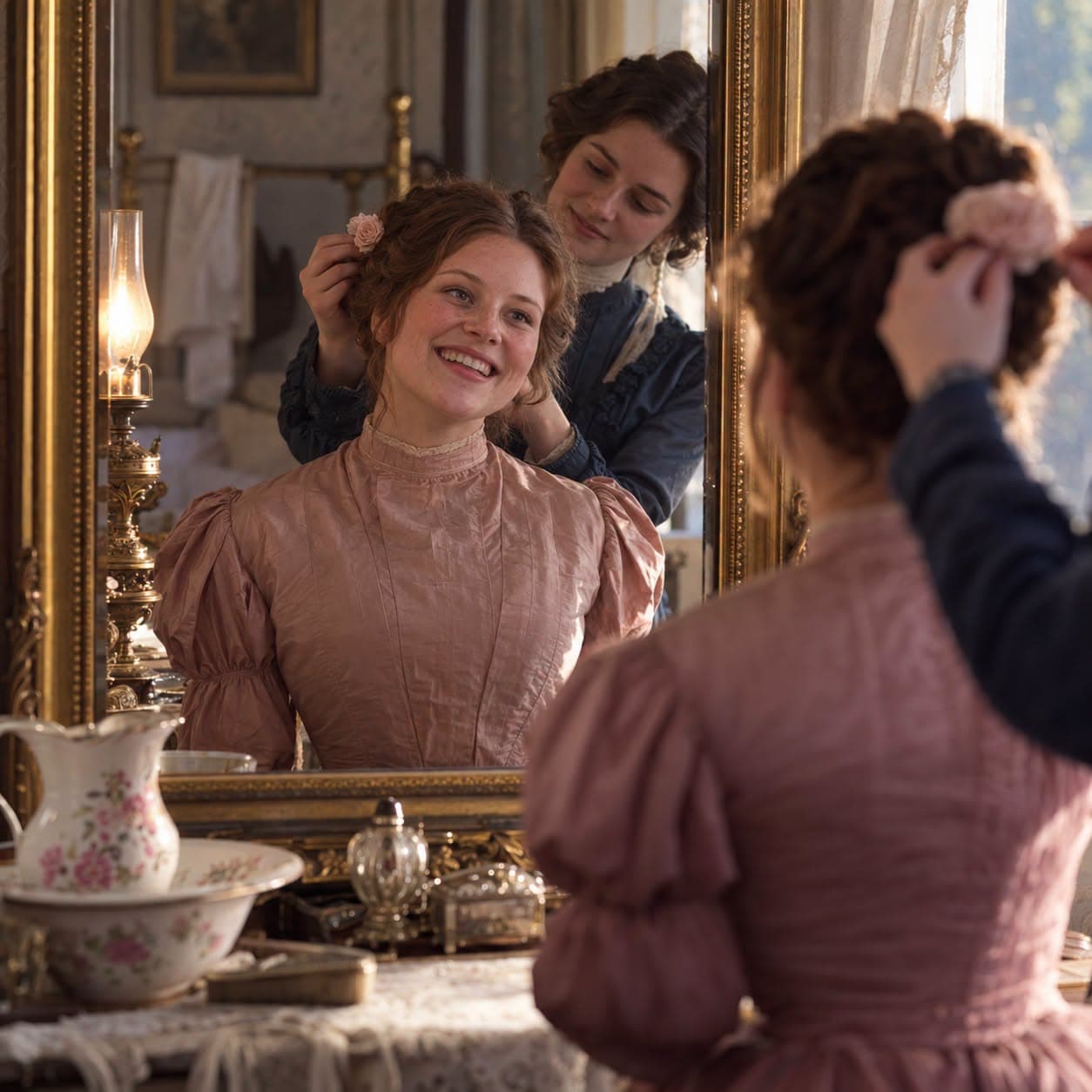
The clothes they wore belonged to a world in which women carried a considerable quantity of fabric about them. For years the fashionable skirt had spread out over a cage of light steel hoops, replacing some of the heavy petticoats that had previously supported it. The new structure was flexible, comparatively light and easier to move in. It also allowed a woman to wear a wide skirt without feeling its full extent against her legs.
A hem could be much nearer a hearth than the woman wearing it.
By the beginning of the 1870s, fashion was changing. Skirts were becoming flatter at the front, with their fullness gathered towards the back over smaller supports and early bustles. But a change in shape did not remove the danger of combustible fabric beside an exposed flame. The steel did not have to burn. The material it held away from the body could do that readily enough.
At Drumaconnor, fire caught one sister's clothing. The other went to help her, and her own dress caught too. She had gone towards the fire because her sister was in danger, and in trying to put it out she became the second person who needed saving.
Both survived the immediate accident. Both remained at Drumaconnor House, where they received medical attention. The party was over, but the sisters were still there, injured in the house where they had come to dance.
Mary died on 8 November.
Emily lived until 21 November, three weeks after the gathering. The accident had happened on one night, and its consequences stretched through most of the following month. For thirteen days, Emily was the sister who remained.
A short notice in the local newspaper on 25 November recorded both deaths. Two entries, two dates, the same house. Mary's gave the eighth of the month. Emily's gave the twenty-first and printed her name as Emma.
They were buried in the Church of Ireland graveyard at Drumsnatt, the parish where their uncle served. Their memorial gives their names together, Emily's first and then Mary's, with their ages, and calls them two loving and beloved sisters who lost their lives by accident in this parish in November 1871. The names the newspaper had printed in separate entries, one of them wrongly, share a single stone.
Emily and Mary had gone to the dance together. When the fire caught, one had gone to the other, and their deaths came on different November days. Beneath both their names, the stone at Drumsnatt ends with a single line: "They were lovely and pleasant in their lives and in their death they were not divided."