Elizabeth was fifty-two. For years she had fought to recover her children's inheritance. The peace that offered her son a way home would require him to accept the compromise she had spent those years resisting.
On 24 October 1648, the Peace of Westphalia settled the future of Elizabeth Stuart's family along with much of the map of Europe. Her son Charles Louis was to recover the Lower Palatinate, part of the German lands his father had lost. He would have a territory to govern and a place among the princes who chose the Holy Roman Emperor. Elizabeth had campaigned for the restoration of the whole inheritance. Europe had agreed to return a portion.
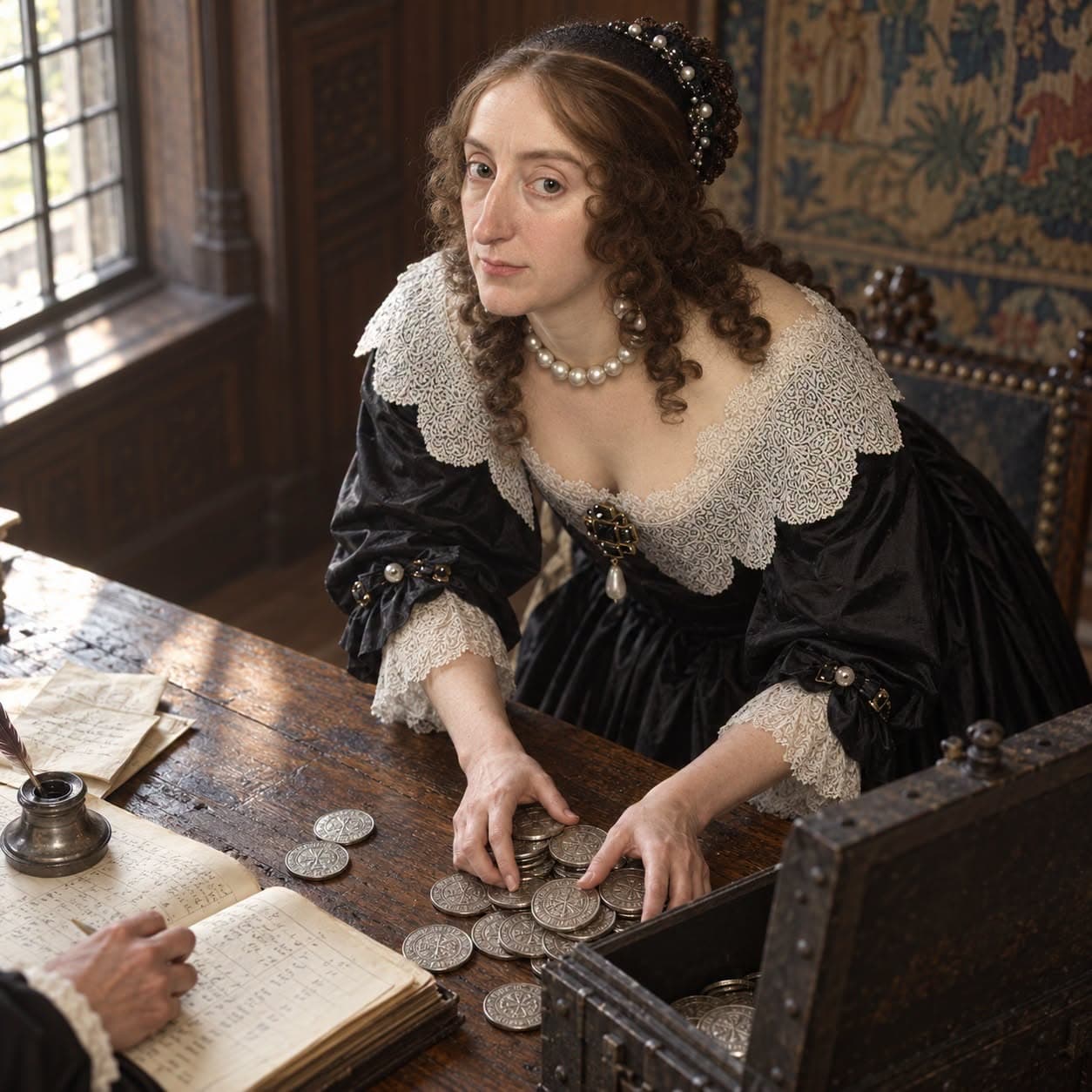
Six years earlier, she had been painted full length in black, with a black ribbon tied around her right arm. Pearls and black stones supplied the jewellery. Her earrings had been a gift from her husband, dead for ten years when the portrait was made. The picture allowed room for both things Elizabeth had become: a widow in mourning and a queen who still expected to be recognised as one.
She was the daughter of James VI of Scotland and I of England, and the sister of Charles I. In 1613 she had married Frederick V, Elector Palatine, whose capital was Heidelberg. Frederick already held that rank when he accepted another crown, the kingship of Bohemia, in 1619. Elizabeth was crowned queen in Prague.
The Bohemian monarchy lasted little more than a year. Defeat in 1620 drove them out, and in the years that followed Frederick lost his hereditary Palatine lands as well. By 1621 they were exiles in The Hague. The crown he had accepted and the inheritance he had been born to were separate possessions. He had managed to lose both.
Frederick died in 1632. Elizabeth was thirty-six, and the work of recovering the family's position continued without him. Her mourning became part of her public identity, but there was nothing withdrawn about her politics. She corresponded, sought allies and pressed the claims of her children. A queen in exile still needed people to treat her as a queen. The portraits and the royal household helped keep that claim visible when there was no kingdom beneath it.
She also spent money on something less decorative. During an earlier attempt to recover the family's lands, she used her cash reserves to buy Meppen for Charles Louis as he pursued a military command. The effort ended in defeat at Vlotho in 1638, where his brother Rupert was captured. Her campaign had required more than letters. Money committed to an army could not be called back when the army lost.
She had fought for the inheritance. Now her son had to decide what he could recover of it.
By the autumn of 1648, Charles Louis was thirty and living in England. He had spent most of his life displaced from the country he claimed. That October he wrote to his mother about the difficulty of obtaining enough money to make the journey if peace were concluded. Before there could be a return to government, there had to be money for the road. The distance between an elector's dignity and an exile's means could be measured quite practically.
The settlement gave him the Lower Palatinate and created a new, eighth electorate. Bavaria kept the Upper Palatinate and the old electoral dignity that had belonged to his father. The arrangement made room for Charles Louis without requiring Bavaria to surrender what it held. He would regain a place, but the old place had not been left empty for him.
There was a provision for the Upper Palatinate and the original dignity to revert if the specified Bavarian male line died out. Until then, Charles Louis and his brothers were required to renounce their claims to it. This was the difficulty beneath the language of restoration. Accepting what was returned also meant accepting that something else would remain withheld.
Elizabeth herself appeared in the treaty as the prince's widowed mother. The emperor promised her a one-off payment of twenty thousand rixdollars for her maintenance and subsistence. After the provisions about territories and rank came the question of what a widow was to live on. The document could create a new electorate for her son and specify a sum for her support. Neither one was a return to Heidelberg.
Charles Louis did not immediately accept the terms. His delegates were not among the signatories to the final treaty, and his acceptance came in December. It came after ten years in which every other route home had failed.
For Elizabeth, it was the partial restoration she had refused to accept. For Charles Louis, it offered land on which he could begin again.
In 1649 Charles Louis returned to Heidelberg. His mother remained in The Hague, where exile had already occupied more than a quarter of a century of her life. She had spent years fighting for her children's return, and her son had gone home. Elizabeth never returned to the Palatinate.