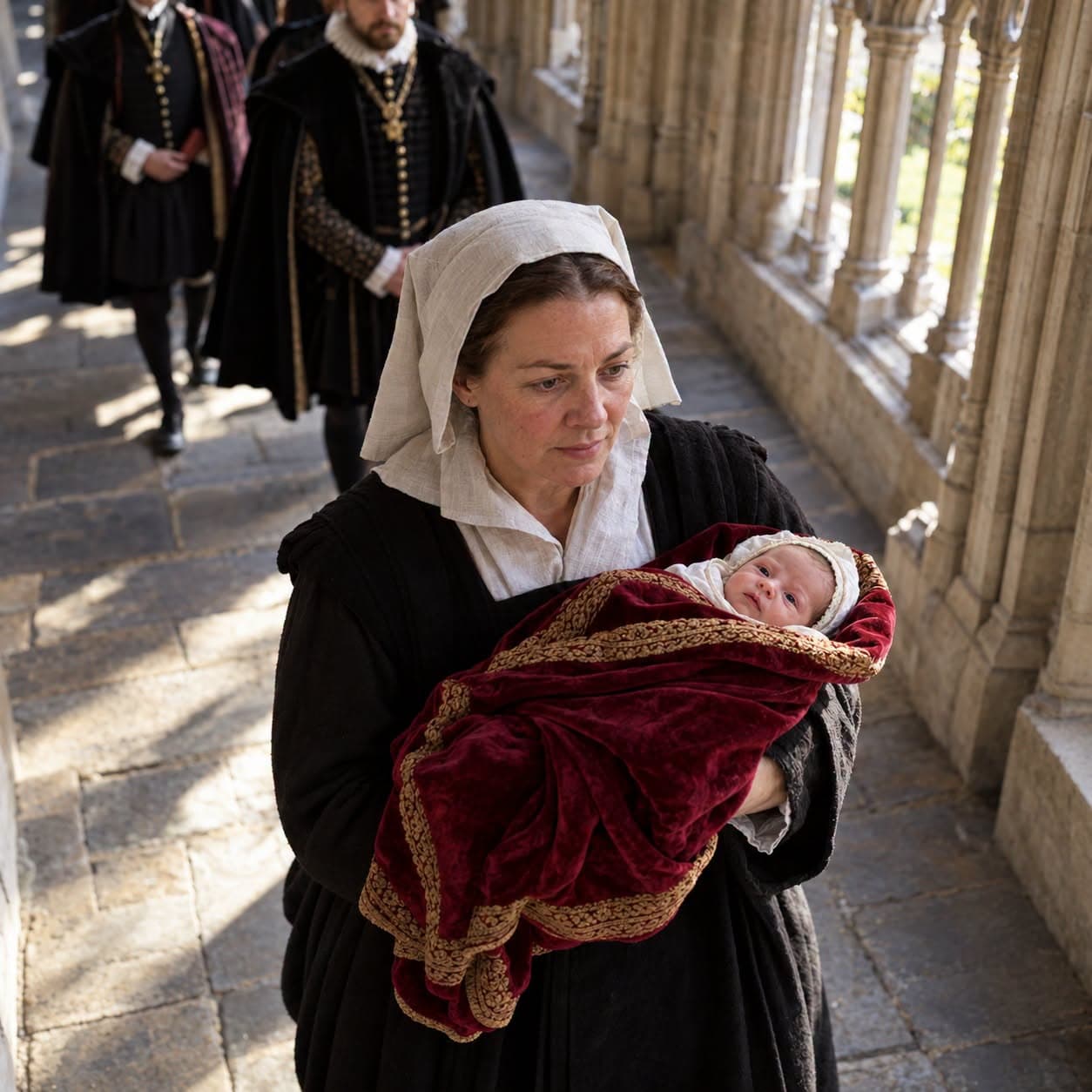
Elizabeth was five days old when her midwife carried her through Westminster's cloister in crimson velvet. Her mother had come there to escape the plague. The Queen had agreed to be her godmother.
Elizabeth Russell was born on 22 October 1575, within the precincts of Westminster Abbey. Her mother, Elizabeth Cooke, Lady Russell, was lodging there, within the Abbey's walls, to keep clear of the plague in London. Her father, John, Lord Russell, was a son of the Earl of Bedford. Before the baby was a week old, her family had arranged a christening with the Queen's own representative in attendance.
Her mother had been born into a household where daughters were given an education usually reserved for somebody else's sons. Sir Anthony Cooke, who helped educate the young Edward VI, also educated his five girls at Gidea Hall in Essex. They studied classical languages, theology and philosophy, alongside music. Elizabeth Cooke grew into a woman who could compose in Latin and Greek, and whose learning would eventually cover the tomb of her husband.
She had already been widowed once. Her first husband, the diplomat Sir Thomas Hoby, died in 1566; she married John Russell in December 1574. The daughter born the following October belonged to both sides of a family with unusually good access to the Crown. Lady Russell's sister Mildred was married to William Cecil, Lord Burghley. Another sister, Anne, was the wife of Sir Nicholas Bacon. The women had been educated together. Their marriages had brought them into the households of the men who governed England.
On the day his daughter was born, John Russell wrote to Burghley. He admitted that he had wanted a boy, but fear of losing both mother and baby had made him rejoice in having a girl. Then came the practical business. Would the Queen agree to be godmother? He wanted Burghley's advice and help. Relief at a birth and an application for royal favour fitted into the same letter.
The Queen agreed.
She was at Windsor when the christening took place on 27 October, and sent the Countess of Warwick in her place. The countess was the baby's aunt, her father's sister. The Earl of Leicester was godfather, and the Countess of Sussex another godmother. The little girl's sponsors could hardly have been better connected. Even the absent Queen had a gift for her, a gilt cup with a cover.
Inside the Abbey, a basin stood on a frame covered with white linen, flowers arranged around its brim. A crimson taffeta screen enclosed a chair and cushions of state. At ten o'clock the company came through the cloister, the gentlemen and noblemen in their appointed order, then the baby in Mrs Bradshaw's arms. Her crimson velvet mantle was trimmed with gold. For all the precedence and ceremony, it was the midwife who carried her.
The girl grew up to take her own place in the Queen's entertainments. In 1592, when the Queen visited Bisham, Elizabeth and her younger sister Anne appeared as shepherdesses in the welcome. Elizabeth was sixteen. The performance placed the girls on a hillside with Pan, keeping sheep and sewing. He wanted the love of both shepherdesses. The girls rejected his suit, joked about men's untrustworthy tongues, and turned their praise towards the Queen. Pan had to give way. The infant once carried into a royal ceremony now had a speaking part.
She entered the Queen's household. By March 1600, her mother was appealing for a grant of property on the strength of Bess's almost six years of service. The royal connection made at her christening had become employment. Her mother clearly expected that employment to be worth more than a place near the Queen.
That June, Anne married Henry, Lord Herbert, and the Queen joined the wedding celebrations at Blackfriars. Bess was named among the eight women chosen for a masque of the Muses. After supper the masquers appeared, and later drew other ladies into the dancing. The Queen herself rose to dance. Anne had her marriage, her mother had entertained the sovereign, and Elizabeth was among the women selected to help make the occasion splendid.
Within weeks, she was dying.
Her aunts, the Countesses of Warwick and Cumberland, took turns watching with her. Warwick had represented the Queen at her christening. Almost twenty-five years later, she was beside the girl for whom she had stood. By the beginning of July, news reaching London gave Elizabeth no hope of recovery. She died that month, aged twenty-four.
At Westminster, her monument shows her seated in a wicker chair, her head supported on her right elbow, one foot resting on a skull. Her other arm points towards it. The gesture acquired a story that she had died from pricking her finger. The skull is a reminder of mortality, not an account of an injury.
She had first come into the Abbey in a midwife's arms, wrapped in crimson velvet and gold. She is there still, in stone. The inscription beneath her begins, "She is not dead, but sleepeth," and ends with the girl who had shared the hillside with her at Bisham: "her afflicted sister Anne has erected this monument."