She placed a gold coronet on the admiral who had helped save her kingdom. His services against the Spanish Armada were read aloud before the court. Three days later, word reached her that another Spanish fleet was at sea.
On 26 October 1597, Elizabeth I received intelligence of a Spanish fleet holding course for England or Ireland. She was sixty-four and had been queen for almost thirty-nine years. Nine years had passed since the Armada of 1588. Her government was now ordering coastal towns to go out and find the next one.
The admiral was Charles Howard, whom she had created Earl of Nottingham at Whitehall on Sunday 23 October. After morning prayers he was brought to her in the Presence Chamber. She made a speech acknowledging his service and put on him the sword, the cap and the gold coronet, and the letters patent recited what he had done in 1588 and at Cadiz. He left to the sound of trumpets. His new title recognised victories already won. There was still a war to conduct.
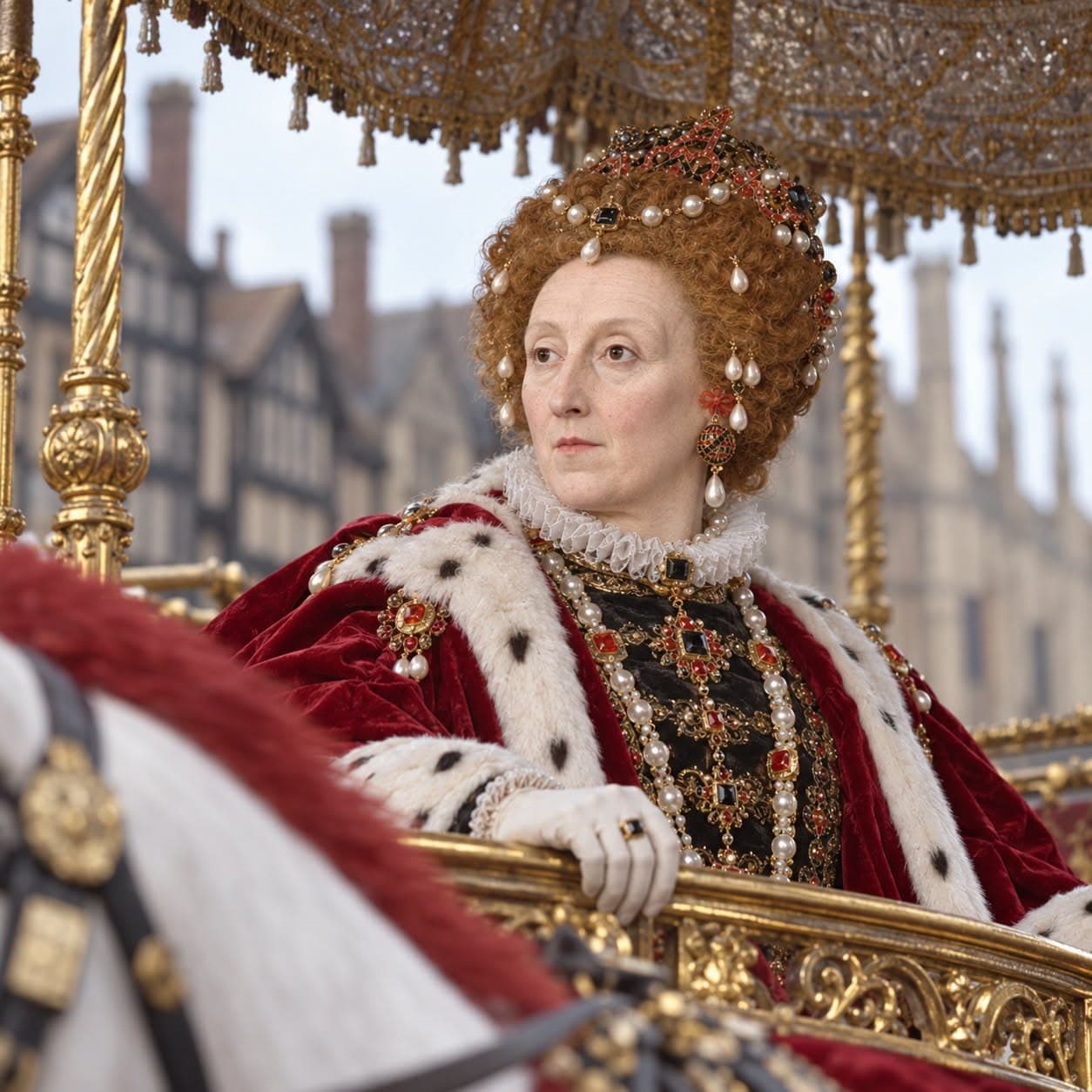
The next day she rode to Westminster to open Parliament, in an open chariot drawn by two white horses, under a canopy of cloth of silver. Her Lord Keeper told both Houses that she had called them to help withstand the malice of her "mighty and implacable enemies". Two days later, those enemies were reported thirty leagues from Scilly.
Her own fleet was not there to meet them. She had sent the Earl of Essex out that summer to burn the Spanish fleet at Ferrol before pursuing anything else, and he had taken much of her strongest naval force with him. Storms drove the expedition back into port, and dwindling supplies forced him to send most of his soldiers home. When he finally reached the Spanish coast, he made no attempt on Ferrol and sailed instead for the Azores, hoping to intercept the treasure ships returning from Spanish America. Her defence depended on an enemy being destroyed before her ships went elsewhere. They had gone elsewhere.
Philip II took the opportunity. His fleet was to capture Falmouth in Cornwall, establish a base and march on Plymouth, while ships waited between Falmouth and the Scilly Isles to pick off Essex's fleet on its way home.
At home, the difficulty was knowing how much of that danger had already become fact. Ships could be sighted, lost again, reported from a port, and be somewhere quite different before the report reached the court. A warning might be accurate and already too old to act upon safely. Elizabeth still had to act upon it.
The orders of 26 October went to Southampton, Weymouth, Portsmouth, Dartmouth, Plymouth and Falmouth. Their mayors and chief officers were to send out their "best fisher-boats", repeatedly, to discover the enemy's course and intentions. Someone who understood sea affairs was to go aboard, someone capable of judging what he saw. Whatever was discovered had to be reported with all possible speed. The instruction came with the words "upon peril of your life".
Royal authority could require an answer. It could not make the answer arrive sooner.
The boats were being sent to look, to bring back the information on which every other order would depend. Nobody yet knew where an attack might fall. At Plymouth, Sir Ferdinando Gorges was told to help Falmouth if the enemy landed there, but only so far as he could without leaving Plymouth and his own charge in peril. Every place strengthened might mean another place weakened.
It was a crowded day at Whitehall. About noon, confirmation came that her Lord Deputy of Ireland had died of fever at Newry. That afternoon the Lords sat in Council. At eleven that night her secretary, Robert Cecil, wrote to her envoy in France. The intelligence included the examinations of seven men taken from a Spanish vessel and brought to Plymouth. Their account named Falmouth as the rendezvous. The warning had substance behind it.
Cecil set out the Queen's predicament plainly. She had no fleet ready to fight the Spaniards at sea and would have to trust to defence ashore. Troops serving in Picardy were being recalled, and her envoy was to explain the necessity to the French king. Essex had most of the captains who were needed at home. Cecil ended "expecting hourly" to hear of the Spaniards' arrival, unless the storm had forced them back to their own coast.
Even at that hour, the storm was a possibility. It was not yet an answer.
By then Essex was back at Plymouth, writing that he would put out again with as many ships as he could, "though we eat ropes' ends and drink nothing but rain water". On 27 October Elizabeth went by water to Westminster, accepted the Commons' new Speaker, and had Parliament adjourned until 5 November. Her Lord Chamberlain was appointed to command the forces in the west, and the gentlemen of the western and coastal counties were ordered home to guard the coast. Her government was still making arrangements to meet an enemy whose movements it could not establish.
But the Spanish expedition had already been scattered. Some thirty miles off the Lizard, a gale had caught it and blown for three days, until its commander had only a couple of dozen ships in sight. He had ordered a return to Spain.
Vessels driven onto the Cornish and Welsh coasts, as far north as Aberdovey, helped reveal what had happened. A forty-ton carvel at Milford Haven and a bark at St Ives gave up their sailing instructions, exposing the plan behind the alarm. The evidence of an invasion and the evidence of its failure came from the same broken expedition. At Whitehall, Elizabeth had put a gold coronet on the admiral who had commanded against the Armada of 1588. The next Armada had been scattered before word of it reached her.