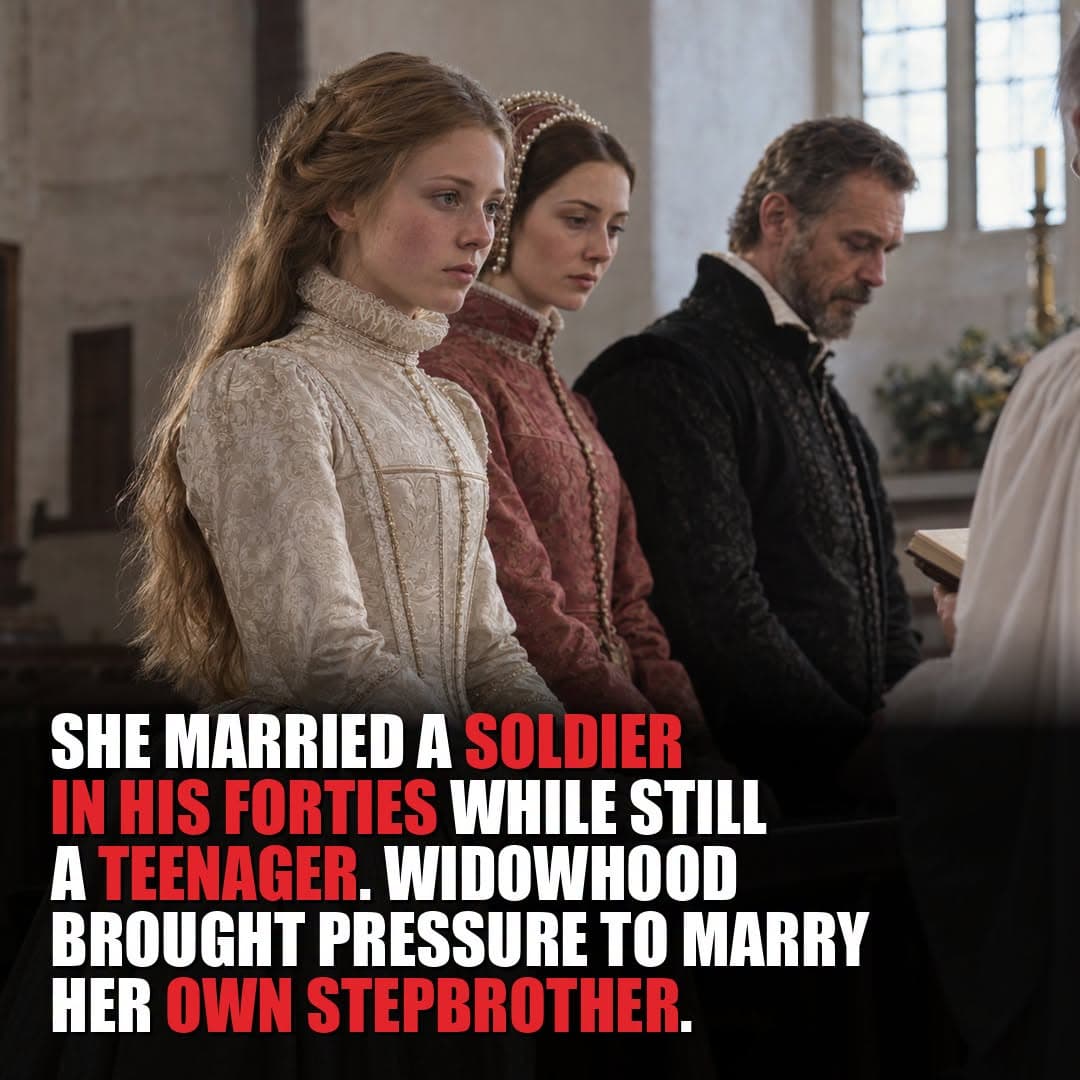
She was still a teenager when she married a soldier in his forties. Her sister married beside her. Less than two years later, Elizabeth was a widow. The next husband pressed on her was her own stepbrother.
On Monday 26 October 1607, Elizabeth Dent married Sir Francis Vere at Mitcham in Surrey. Her elder sister Mary married Sir Henry Savile of Methley, Yorkshire, on the same day and at the same time. Their stepfather, Sir Julius Caesar, arranged the double wedding. He was Chancellor of the Exchequer, and the parish entry took care to record his office. Even a wedding register had room for the family's connections.
The sisters' father had made his living in London. John Dent was a merchant and a member of the Salters' Company, with a country house at Mitcham where Queen Elizabeth herself had been entertained. His money had bought a place in a world where a prosperous citizen could receive his sovereign beneath his own roof. When he died in 1595, his daughters were small children. He left the Mitcham property to their mother Alice for her lifetime, with Mary and Elizabeth to inherit after her.
Alice married Julius Caesar the following year. The house remained hers during her lifetime, although it acquired the name and standing of her new husband. By the time her daughters married, the household joined the wealth of a London merchant to the office of one of the king's ministers. There was considerably more behind these brides than a useful stepfather.
Mary's bridegroom was a Yorkshire landowner. Elizabeth's had spent much of his adult life fighting in the Netherlands, commanding English troops in the Dutch struggle against Spain. He had distinguished himself at Nieuwpoort and in the defence of Ostend. His reputation belonged to the wars of Elizabeth I; his wedding took place under James I. For Elizabeth Dent, those campaigns were the history of the man she was marrying. For Vere, they were years he had lived through.
The marriage brought him £2,000. In return, he settled his landed property on Elizabeth for her lifetime. Her money went into the marriage, and provision for her widowhood was written into its terms. The ceremony joined two people with very different experience of the world, but the arrangements acknowledged that she might have a long life to live after his death.
In London, the match "bred some wonder". Vere's friends pitied it. Others smiled at it, "for it is said she is not the fairest". The soldier's reputation had earned him admiration. His young wife's appearance was available for inspection by people who did not even claim to be speaking from their own observation. The words were "it is said". That was quite enough to pass them on.
Her marriage was already other people's conversation.
Vere died on 28 August 1609 and was buried the following day in Westminster Abbey. Elizabeth was still in her teens. The two sisters had begun their married lives together; twenty-two months later, one of those marriages was over.
Elizabeth had a substantial monument raised to him in the Abbey. Four life-sized knights in armour kneel at its corners, carrying a slab on their shoulders. Upon it lies his armour. Beneath it, Vere himself rests in civilian dress on a carved rush mattress, the soldier separated from the equipment of his profession. The marriage that had drawn smiles in London received a very different public commemoration from its widow.
Widowhood also brought another proposed husband. Charles Caesar was a son of Sir Julius, and therefore Elizabeth's stepbrother. Their parents' marriage had already joined the two families. A marriage between the children would join them again.
Elizabeth was pressed towards the match, and kept waiting while the pressing went on. It went on so long, and so hard, that it was feared she would "cast herself away upon the first comer". There was evidently a wrong way to remain unmarried and a wrong way to choose a husband, with plenty of advice available on both.
Her marriage was other people's conversation again.
In 1613 she married Sir Patrick Murray, a Scot who had already been married once, to an Englishwoman, when King James first came south. Those who had pressed the Caesar match found they had to give her way, and ended by helping this one forward. Charles remained her stepbrother. In 1628 Murray was created Earl of Tullibardine, and the merchant's daughter from Mitcham became a countess.
At Mitcham, she and Mary had been entered in the register together, marrying on the same day and at the same time. Elizabeth's first marriage lasted less than two years. The memorial she placed for it still stands in Westminster Abbey, and beneath the account of Vere's ancestry and commands, the teenage bride of that double wedding has her line in the stone: Elizabeth, his wife, in great sadness and sobbing with tears, placed this supreme monument to conjugal faith and love.