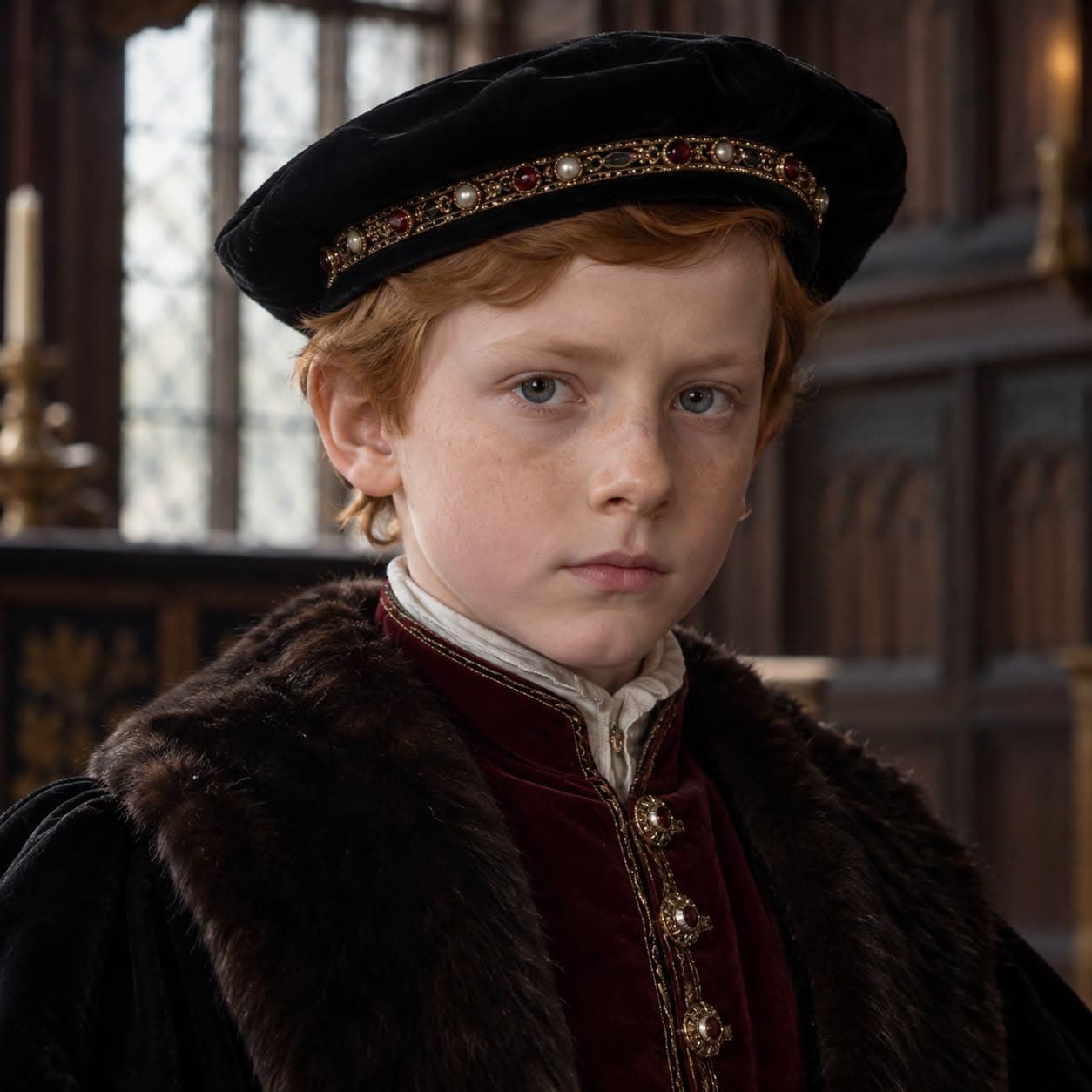
The uncle who had governed England for him was in the Tower. He had been twelve for eighteen days. The men who had removed his protector now governed in his name. Across the country, people were being warned that repeating the wrong story about that change could get them arrested.
On 30 October 1549, Edward VI's government issued a proclamation against rumours that the fall of the Duke of Somerset would bring back the old religion and the Mass. Somerset had lost his authority. The religious changes made during his protectorship were to remain, and the government ordered the arrest of people spreading claims that they would be reversed.
Somerset was Edward Seymour, the brother of the king's mother, Jane. Edward had never known her. She had died shortly after his birth, leaving a son whose survival mattered to the whole Tudor succession. When Henry VIII died, that son became king at nine, and his mother's brother became Lord Protector. Somerset's authority joined the business of governing England to the much more intimate business of keeping the king.
By the autumn of 1549, other councillors had had enough of him. The year had brought war and rebellion, and a struggle over who should decide policy around a sovereign too young to govern alone. John Dudley, Earl of Warwick, emerged among Somerset's opponents. Both sides claimed to be acting for Edward. Both needed the king whose name made their commands lawful.
Earlier that month, Edward had been taken out of Hampton Court at night.
On 6 October, Somerset ordered armour brought from the palace armoury, the gates fortified and men summoned. People gathered at Hampton Court while the councillors in London prepared their case against him. At nine or ten that night, Edward left for Windsor with the company around him. He was still eleven. At the castle, watch was kept each night while the dispute continued through messengers and letters.
The accusations reached the boy as well as his uncle. Somerset was charged with ambition, with vainglory, with entering into rash wars during Edward's youth, with enriching himself from the king's treasure and with doing everything by his own authority. These were the accusations of men trying to remove him, but they were set out in letters and read openly. The quarrel was being conducted around the boy it was about.
At Windsor, Somerset was taken into custody and held apart from his nephew, before being taken through Holborn to the Tower of London. Edward turned twelve on 12 October, in the middle of it. By the time he returned to Hampton Court, his uncle was a prisoner.
His uncle was gone. The Prayer Book was still there.
Earlier in 1549, Parliament had required the use of the first Book of Common Prayer. Drawn up under Archbishop Thomas Cranmer, it brought an English order of worship into parish churches in place of the old Latin services. The change reached far beyond the men arguing at court. It altered the words people heard at worship and the forms through which they had marked the most solemn occasions of their lives. Removing the Protector who had overseen those changes could look like an opportunity to recover what had been lost.
Edward's own sister had already refused to accept the new order.
Mary was thirty-three, old enough to remember England before the break with Rome. In June she had been told that Mass should no longer be celebrated in her household. Her reply challenged the law itself. She regarded it as a religious alteration devised by the councillors, and she wanted her brother to reach an age at which he could judge such matters himself. Conscience, in her argument, could not be settled by the instructions of the men governing during his childhood. Her resistance brought negotiation and concessions over private worship. It did not bring agreement.
The proclamation of 30 October addressed the expectation that Somerset's overthrow would reverse the religious settlement. It was aimed at people accused of spreading seditious rumours that the laws made for religion would be abolished and the old Latin service, the Mass and its ceremonies brought back. A change at the head of government had become a promise passed around the country. The new government answered with the threat of arrest.
The men had changed. The Prayer Book had not. The councillors who had condemned Somerset's conduct were keeping the reforms made under him, and their victory gave no one permission to turn parish worship back. What the coup meant was for the king's government to announce, and anyone who announced it differently could be arrested for it.
Edward did not share his sister's attachment to the Mass. He had been taught by reformers and was growing into their faith. But the power exercised in his name was still being managed by adults who had just shown how quickly they could remove the man closest to him. At twelve, he was the authority invoked in an order reaching across England, while his own daily company was being carefully arranged.
After Somerset's fall, six lords of the council were appointed to attend Edward, with at least two to be present at any time, alongside four knights. Warwick was among the six. Edward recorded the arrangement as made with his consent. The boy who had left Hampton Court at eleven was now twelve and back at the palace, and his uncle's place beside him was filled by a rota of councillors.