
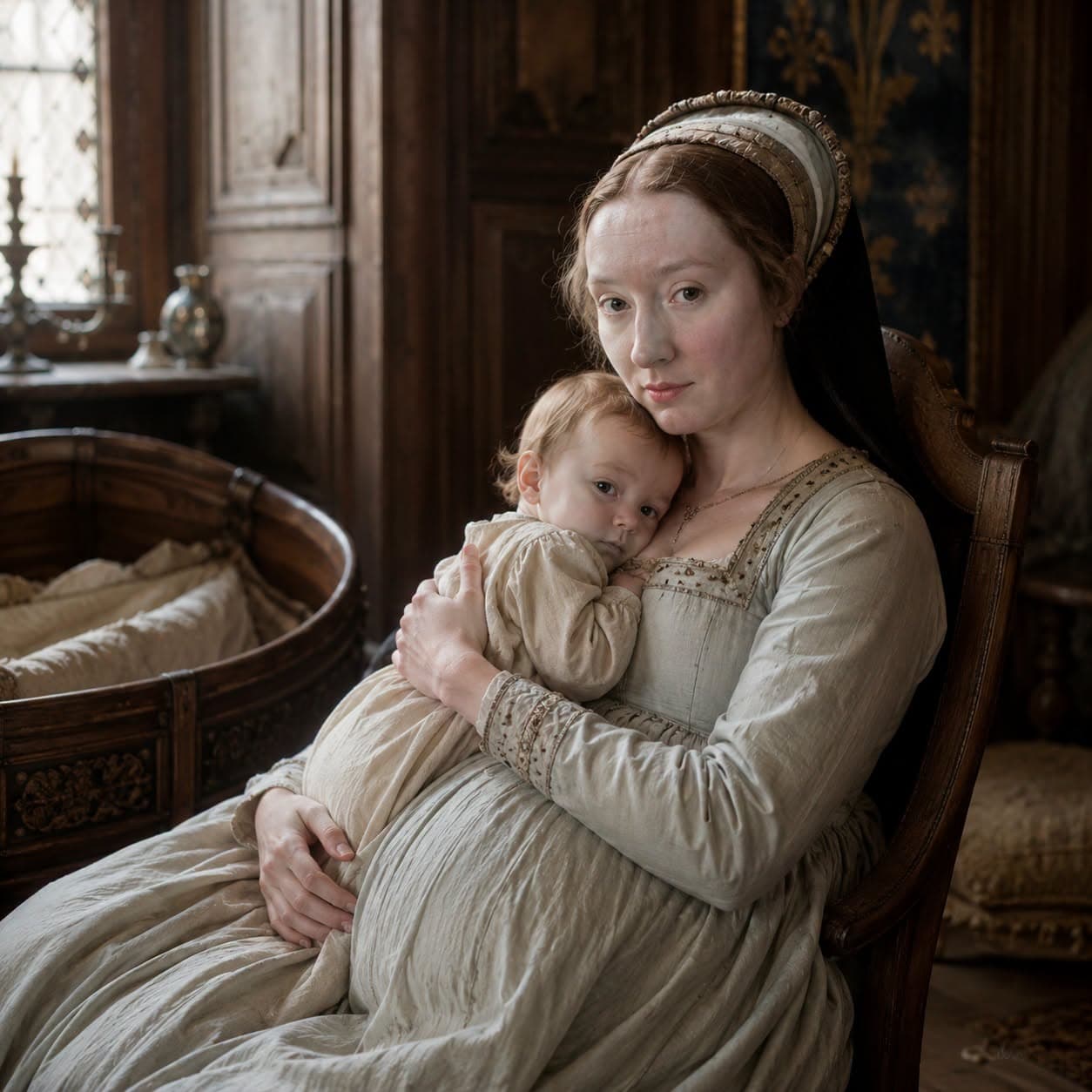
She died at the Château de Blois on 20 July 1524. Her frail body finally broken by the physical toll of delivering seven children in less than eight years. She was twenty-four years old.
Claude of France had never been given much choice about anything in her life, starting with her own birth. She was the eldest daughter of Louis XII and Anne of Brittany, and her mother spent years fighting to keep the independent Duchy of Brittany out of French hands, going so far as to try to promise Claude's hand to Charles of Austria, the future Emperor Charles V, specifically to prevent it from being swallowed by the French crown. French ministers overruled her.
Claude was betrothed instead, as a small child, to François, Duke of Angoulême, heir to the throne of France, and the marriage was consummated in 1514, the same year her mother died. Anne of Brittany had been anxious about how her plain, quietly lame daughter would be received by a young man already known for his appetites. Louis XII reportedly told her not to worry: "She is not beautiful, but her virtue will touch the count, and he will not be able to help giving her his due."
When François became king in 1515, Claude became queen, and by every contemporary account, nothing about her changed at all. She kept the same gentleness, the same modesty, the same quiet devotion she'd always had. She spent her days with her ladies, sewing clothes for the poor and ornaments for altars, living by a motto that translated roughly to sincerity among the sincere. Contemporaries called her simply "the good queen," the same title once given to her father. She was, by all accounts, genuinely beloved.
What her devotion bought her was seven pregnancies in under ten years. Between 1515 and 1523 she gave France three sons, including the future Henri II, and four daughters, one of whom, Louise, died shortly after her third birthday, within Claude's own lifetime. Each pregnancy took more from her than the last. She developed a worsening limp, likely from scoliosis that grew more severe with every birth, and withdrew further from public life each year, praying, working quietly with her ladies, fading from the glittering centre of a court that never once slowed down to accommodate her.
Because the court around her did not slow down. Francis I was, throughout their marriage, a chronic and well-documented womanizer, maintaining mistresses openly while his wife's body was steadily consumed by the demands of producing his heirs. Brantôme, writing decades later, claimed outright that Francis had given Claude "the pox, which shortened her days," meaning syphilis, passed to her through his own infidelity. No historian has ever proven this with certainty, and the truth is her actual cause of death was never officially recorded at all. Other theories point to complications from childbirth, sheer physical exhaustion, or the same bone tuberculosis that had afflicted her mother.
Her final years were spent in near isolation at Blois while he remained exactly where he had always been, at the centre of one of the most extravagant courts in Europe. She prayed. She grew closer to religious devotion. She faded. He hosted, hunted, and continued as before.
When she died, at Blois, Francis wrote to his own mother, Louise of Savoy: "If I thought I could buy her back with my own life, I would give it gladly, and I never thought that the bond of marriage joined by God could be so hard and difficult to break." He was not at her bedside when she died. He was travelling toward Provence to confront the Constable of Bourbon and an invading imperial army; his mother and sister had accompanied him only as far as Bourges. Claude died surrounded by her household servants.
She was buried that same year in the chapel of Saint-Calais at the Château de Blois, but her solemn funeral at the royal basilica of Saint-Denis did not take place until 1526. In the months after her death, Francis continued his campaign into Italy and was captured at the Battle of Pavia in February 1525, spending a year as a prisoner of the Emperor Charles V in Spain. Only after his release in March 1526 did he order her body moved.
The funeral procession left Blois on 12 October 1526 and reached Saint-Denis on 6 November, where her burial finally took place the following day. By then her body was no longer presentable, so a wax effigy dressed in her crown, carrying the sceptre and the hand of justice, stood in for her at the ceremony, a common practice in French royal funerals, made especially necessary when death and burial were separated by so long a gap.
Her eldest daughter, Charlotte, then nearly eight years old, died after several days of fever on 8 September 1524, only weeks after her mother. A surviving funeral placard, still held today at the Bibliothèque Abbé-Grégoire in Blois, commemorates the two of them together, mother and daughter shown lying beneath a canopy, hands joined in prayer, Claude in her crown with her sceptre and the hand of justice beside her, a small altar at their feet where priests came to say Mass for their souls.
A Paris lawyer named Nicolas Versoris recorded the moment in his own journal at the time: "died my lady Claude, queen of France, a woman of good and virtuous life, mourned and well esteemed by all the people."
She was, in her own lifetime, called good, and beloved, and gentle. She is remembered today mostly as a footnote and the namesake of a small green plum still called "reine-claude" in France.