Charlotte was only five or six when Jean Clouet painted her. She had already been promised to the king of Spain. She never reached her eighth birthday.
Charlotte of France was born at Amboise on 23 October 1516, the second daughter of Francis I and Claude of France. Her mother was seventeen. Her elder sister Louise was still a baby herself, but there was already an agreement about whom Louise would marry, and a provision for what should happen if she died.
The Treaty of Noyon had been concluded that summer between France and Charles, king of Spain, the future Emperor Charles V. Louise was to become his wife. The marriage would settle the French claim to Naples, giving the two rulers a family connection where they had competing interests. It required a certain amount of patience. The intended bride had not yet reached her first birthday.
If Louise died, Charles was to marry a later daughter of the French king or, failing that, Renée, the daughter of the late Louis XII. Charlotte was born into a family whose diplomatic arrangements had already allowed for losing a child.
Louise died in September 1518. Charlotte was not quite two when she became the proposed bride in her sister's place. Charles accepted the substitution. The little girl who had been the younger sister was now the eldest surviving daughter, with a marriage intended to bind her father's kingdom to Spain. The agreement could continue. Louise could not.
Meanwhile Claude kept having children. Three sons and two more daughters followed, until there were seven children born between 1515 and 1523. Charlotte's younger brother Francis was the dauphin, the heir to the French throne. Another brother, Henry, would eventually become king. Around them stood the king's elder sister, Marguerite d'Angoulême, Charlotte's aunt. For Claude, the births followed one another through almost the whole of her married life. By twenty-four she had borne all seven children and lost her eldest girl.
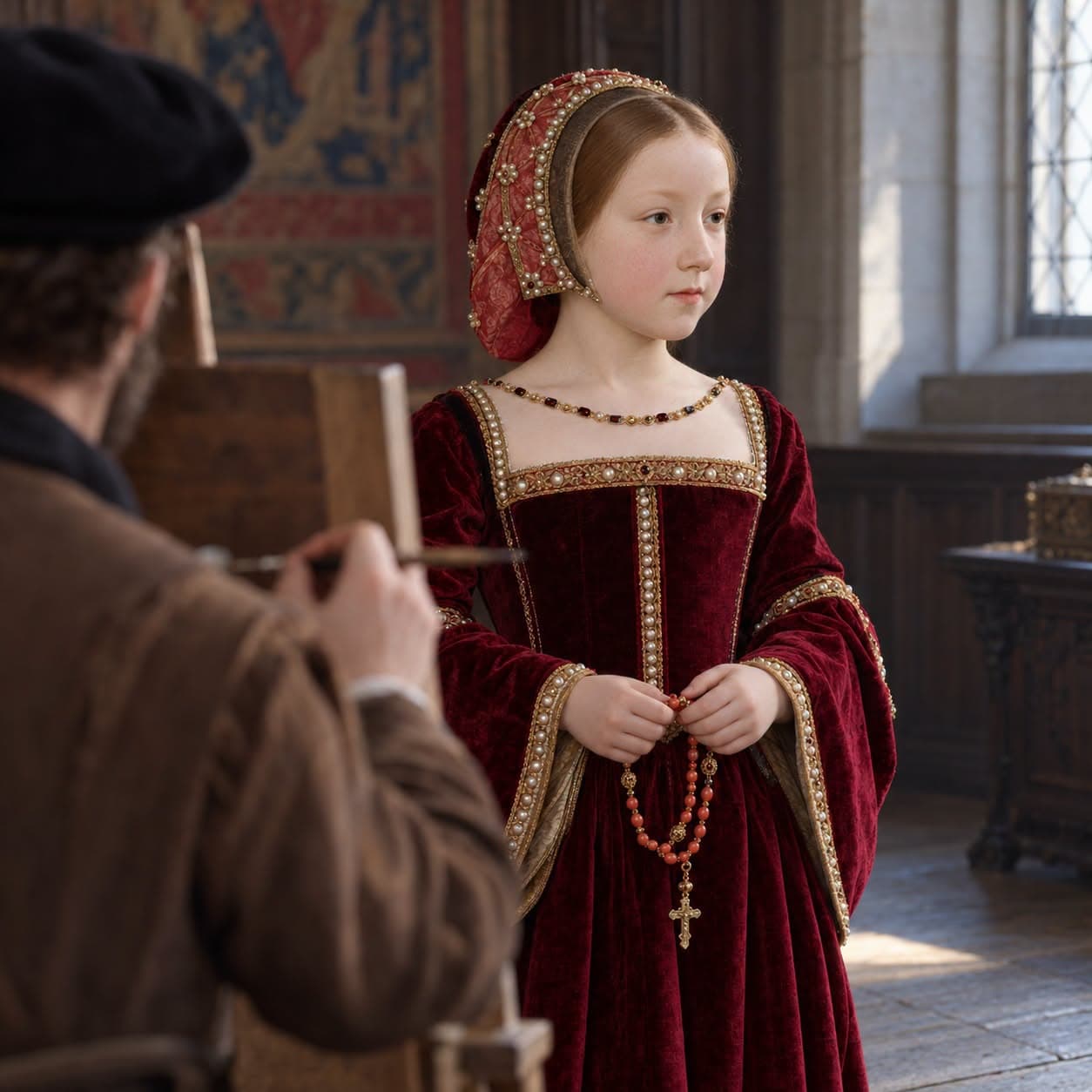
In about 1522, Jean Clouet painted Charlotte on a small wooden panel. Her cap is set with jewels, her clothes rich, her hands occupied with the beads of a rosary. The painter gave her the clothing and devotional object appropriate to a king's daughter. Beneath the cap is a child's face, years away from the marriage the adults had arranged for her.
Portraits of royal children could travel between courts, carrying a likeness where the child herself had not gone. Charlotte's painted face belonged to that world of possible marriages, but her own was already being overtaken. In 1522 Charles turned towards England and another projected bride, Henry VIII's daughter Mary. The peace that had supported the French match did not last.
Charlotte stayed a child while the adults altered their plans.
In July 1524 Claude died at Blois, aged twenty-four. Charlotte was seven. Her mother had lived long enough to give birth to seven children, but not to see any of them grow up. Louise was already dead; the six surviving children had now lost their mother.
That September Charlotte died of measles. She had lived through seven birthdays. The next one, on 23 October, would have been her eighth.
Marguerite answered the loss with a poem. In the Dialogue en forme de vision nocturne, or Dialogue in the Form of a Nocturnal Vision, she wrote an encounter between herself and Charlotte's soul. The aunt grieves. The child speaks to her from beyond death. It is a written vision, with Charlotte given a voice by the woman who had lost her.
The consolation is Christian, and it asks a great deal of the mourner. Charlotte is at peace with God. Her aunt must learn to accept that peace, even while she longs for the child. The bereaved woman becomes the questioner, the little girl the one who understands.
Marguerite asks about the pain of dying. In the poem, Charlotte answers her aunt, and tells her that the soul's longing for heaven was stronger than its hold on a failing body. Marguerite asks to be taken to her. She is told she must wait until God calls her in his own time.
The portrait keeps Charlotte in her jewelled cap, with the rosary between her hands. Marguerite's poem gives that child a conversation with the aunt who survived her. The woman brings her grief and her questions; the little girl brings the answers. In the dialogue, Charlotte is the one telling her aunt to stop weeping.