She was thirty-one and pregnant when her husband died. She would never be queen beside him. Their twelve-year-old son was now next in line.
On 25 October 1760, that son became George III. His grandfather, George II, had died, and the crown passed to a young man of twenty-two whose father had been dead for nine years. Augusta, Princess Dowager of Wales, was forty. She had come to Britain to marry an heir to the throne. She had stayed to raise another.
She had arrived from Saxe-Gotha as a teenage bride in 1736, to marry Frederick, Prince of Wales, the eldest son of George II. Marriage placed her inside a family in which father and son maintained rival courts and rival political interests. Frederick's household offered a gathering place for opponents of his father's government. Augusta was marrying into a succession, but also into a quarrel.
Frederick died in 1751. There were eight children already, and another on the way. The youngest, Caroline Matilda, was born after her father's death. George, the eldest boy, became heir to his grandfather, and the future of the monarchy now depended on a child who had just lost his father.
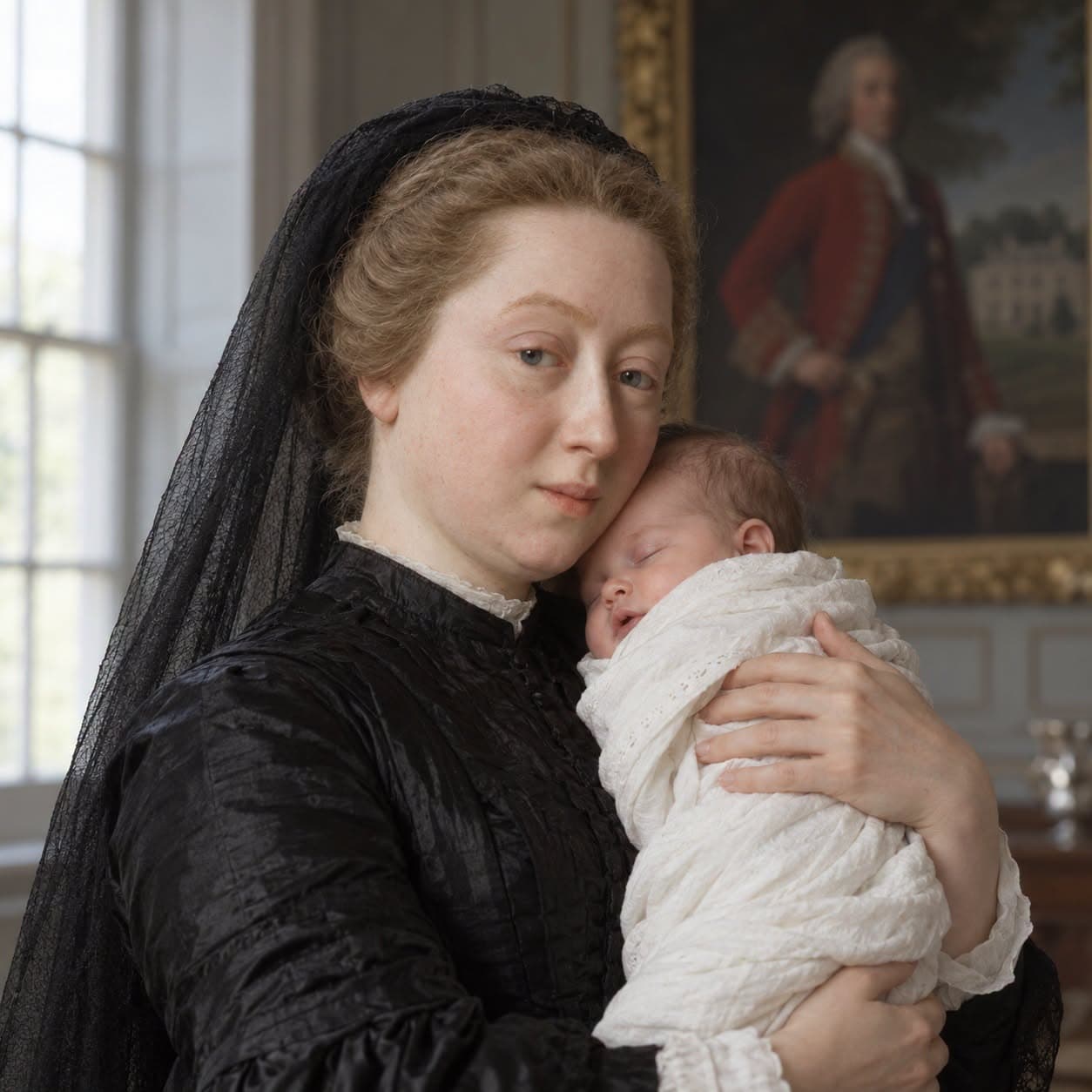
A family portrait painted that year puts them all in one room. Augusta sits at its centre, wearing a mourning veil and holding the baby Caroline Matilda. Frederick is there too, but only in a portrait within the painting, standing before their home at Kew. His widow holds the child he never saw.
Augusta had become the mother of the heir, and Parliament made provision for what would happen if the old king died before the boy came of age. She was nominated to act as regent, assisted by a council. It was a position she never had to occupy, but the arrangement acknowledged how much now rested with her. The woman whose husband would never reign might yet have to govern in her son's name.
She also remained involved in the politics of Frederick's former circle at Leicester House. Widowhood had not removed her from the argument over how Britain should be governed. Among those she trusted was John Stuart, Earl of Bute, a Scottish nobleman who had belonged to Frederick's circle and kept her confidence after his death. Bute became George's tutor and a father figure to the young prince.
In 1756, George II proposed that George and his younger brother Edward should have an establishment of their own. George asked permission to "remain with the Princess my Mother". He assured his grandfather of his duty. He also asked for Bute to be given a place in his household.
The king permitted it. In her thanks, Augusta described his decision as making her "unspeakably happy". She promised to show herself worthy of the confidence he had placed in her. Even keeping her son at home called for a royal favour, and gratitude expressed in the proper form.
He had asked to stay. She thanked the king for letting him.
At Kew, there was work of her own to attend to as well. Frederick had begun collecting exotic plants, and Augusta continued developing the gardens after his death, helped by Bute and the clergyman-scientist Stephen Hales. Bute introduced the architect William Chambers, whose buildings became part of her expanding grounds. In 1759 she founded a nine-acre botanic garden within them, stocked with plants and trees brought from abroad. The Royal Botanic Gardens still count their founding from that year. By the time her son inherited the throne, Augusta, Bute and George had years of shared work and familiarity behind them.
The accession gave those relationships a different public weight. Within two days of the new reign, Bute was appointed to the Privy Council. In 1761 he became a secretary of state, and in 1762 prime minister. The tutor and trusted adviser had become a minister. His rapid promotion was resented by established politicians.
Augusta's friendship with him was turned into a sexual accusation. In the satirical prints of the early reign, the pair appeared as lovers, their supposed intimacy tangled up with attacks on Scottish influence and the scramble for government posts. Bute became a jackboot, a pun on his name, and Augusta a petticoat. A widow's trusted companion and her son's favoured adviser gave the caricaturists a convenient explanation for political advancement. The drawing did the work of proof.
On 25 October 1760, all of that was still to come. The boy who had asked his grandfather to let him stay with his mother was now the sovereign whose favour other men sought. Nine years earlier, Augusta had been pregnant with Frederick's last child when his death ended their prospect of sharing a throne. Now their eldest son sat on it. She was forty, her son was king, and her title still belonged to the husband she had buried.