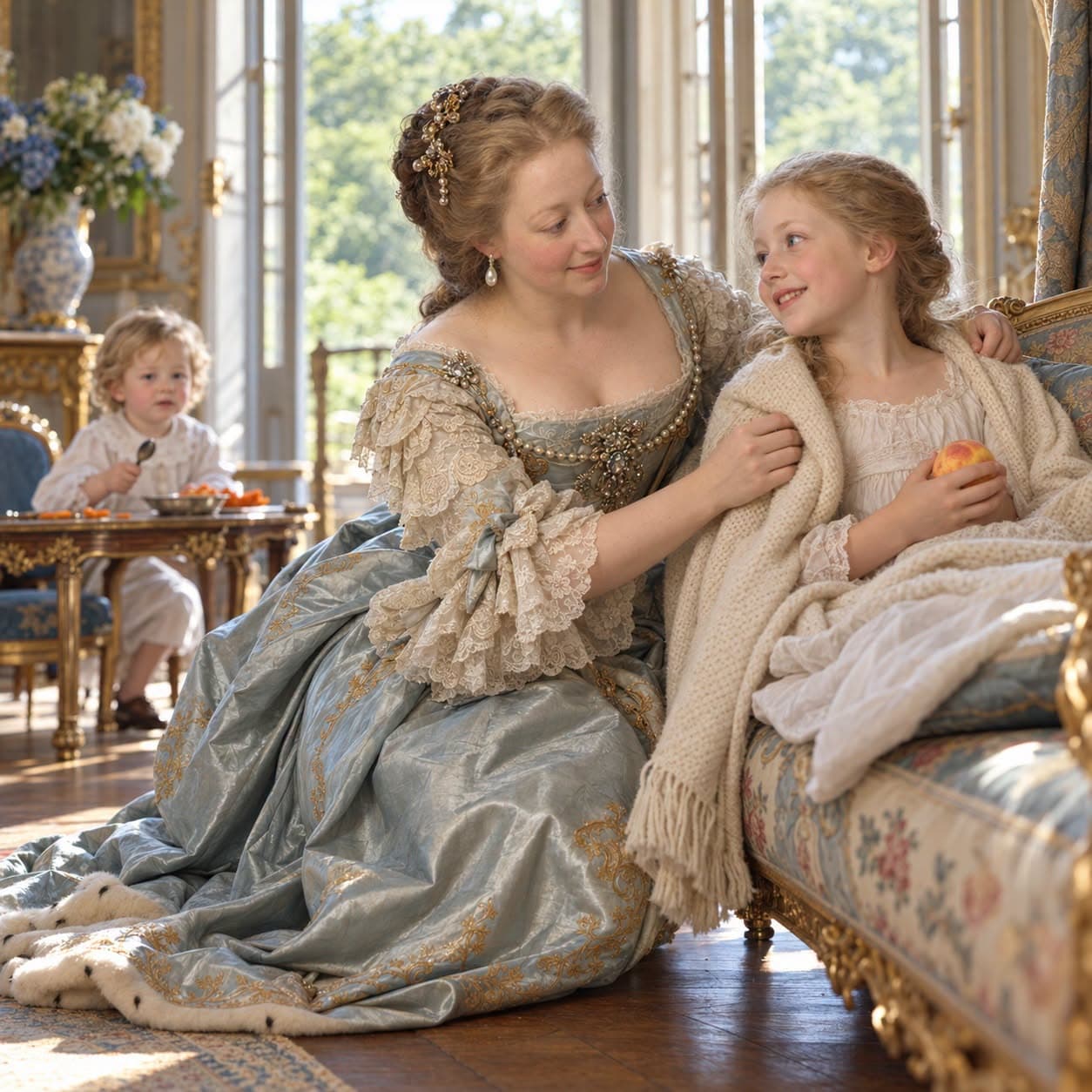
She received officials from her bed on the day her husband died. Their son was three. The business of government had already reached her.
On 22 October 1751, William IV, Prince of Orange, died at forty. His widow, Anne of Hanover, was forty-one. Their little boy, William V, inherited his father's position as stadtholder, the powerful office through which the House of Orange exercised its influence in the Dutch Republic. His mother would exercise its authority on his behalf.
That same day, deputies of the nobility and the council pensionary came to her bedside to prepare for her oath. By that evening she had been appointed gouvernante, the title under which she would govern on her son's behalf. The Republic now had a stadtholder who was three years old, and it did not intend to leave him unattended for an afternoon.
Anne was the eldest daughter of George II of Great Britain and his wife Caroline. She had married William in 1734, bringing a connection to the British royal family into the House of Orange. Seventeen years later, she had a place in Dutch politics of her own. She regularly attended her husband's meetings, corresponded with statesmen and cultivated relationships with men whose cooperation mattered. Government had been part of their marriage.
The inheritance now belonging to their son had only recently taken its present shape. In 1747, after a French invasion, William had become the first stadtholder of all the Republic's provinces. Hereditary succession had been established across them. A position that had depended upon the decisions of provincial assemblies could now pass within the family, and in October 1751 it passed to a small boy.
The provinces still had their assemblies. The towns still had their governing families. Anne's authority would have to work among them. In a republic with so many people entitled to have a say, possession of the right title was only the beginning of an argument.
As William's health deteriorated, she had already taken over current business. She knew the work, and she knew the people: Dutch regents, foreign politicians, the officials whose cooperation decided whether a proposal went anywhere at all. The men she had written to as the stadtholder's wife now received letters from the woman governing for his son.
Only months earlier, her letters had followed William to Aachen, where he had gone for his health. From Huis ten Bosch she reported on negotiations with Frederick the Great over the purchase of estates held by Prussia, and passed William's messages on to his officials. In the same letters she told him that their little boy was cheerful and ate his carrots every day. Carolina, their eight-year-old daughter, had come through a short but severe bout of flu, and Anne thought that warmth, plenty of fruit and the Bristol waters would soon put her right. Frederick the Great and the carrots shared the same pages.
She also advised him against giving money to a member of the Bentinck family. Their own finances were fragile, she pointed out, and the council pensionary had advised against it as well. Affection did not prevent her from disagreeing with him.
Then there was no husband to write to.
On 15 November, Anne wrote to his mother, Maria Louise, in French. "The misfortune that has befallen me," she wrote, "makes me almost incapable of writing." Her children still needed her, and caring for them would be her chief occupation. The woman who had sent their father news of carrots and fevers was now explaining to their grandmother what kept her at her task.
They still needed her.
That need had a public meaning as well as a private one. William had to be brought up for the office he already held. Anne's responsibilities joined the education of a child to the preservation of his family's political position. As gouvernante and guardian, she undertook the stadtholder's civil functions, while military command was entrusted elsewhere. She had authority to exercise, advisers to work with and a son to prepare to succeed her.
Even those who supported her could find female government difficult to describe without apologising for it. In sermons after William's death, preachers asked for divine strength to help her bear the burden that had fallen upon a woman's shoulders. Her knowledge of state affairs could be praised, her diligence admired, and her sex still treated as a difficulty requiring special assistance from heaven. The work remained hers to do.
George II expressed pride in her response to her new responsibilities and hoped for closer cooperation between Britain and the Republic. By the middle of the decade, as war approached, Anne's British sympathies encountered Dutch arguments for neutrality. The daughter of a king had to conduct her politics among people who were under no obligation to share her father's wishes.
The regency continued until Anne died on 12 January 1759, aged forty-nine. The boy whose future had brought officials to her bed on the day she became a widow was ten by then. He would come of age in 1766. She had received the business of government while he was too young to undertake it, and she died while he still was.