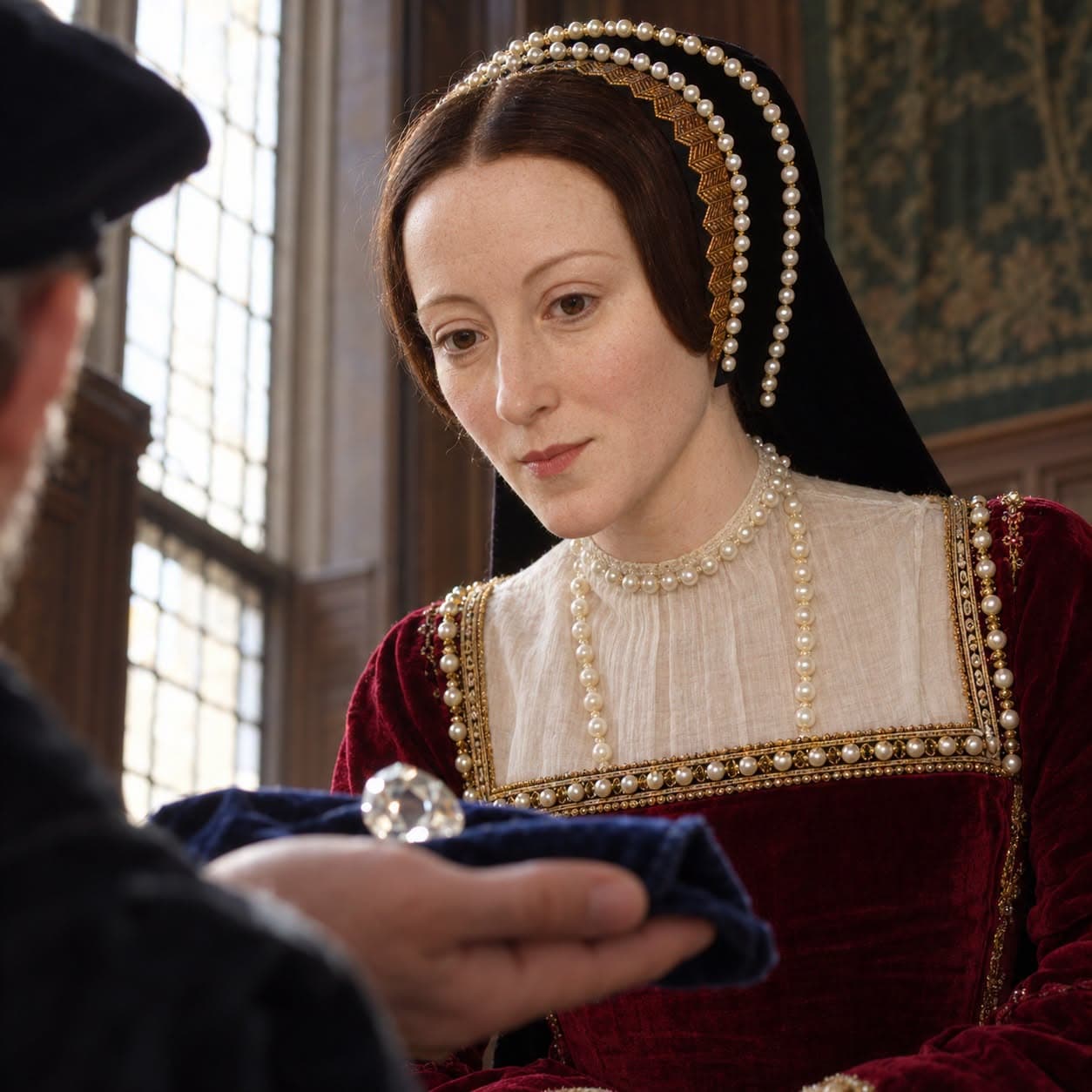
Anne Boleyn was sent a diamond by the King of France. A decade earlier she had been one of his wife's attendants. Now another King meant to marry her. He was still married to someone else.
On 25 October 1532, Henry VIII returned to Calais from Boulogne, bringing Francis I with him. Anne Boleyn was already in the town. During his stay, Francis sent the Provost of Paris to her with the jewel, reportedly valued at fifteen or sixteen thousand crowns. The gift went to a woman who had crossed the Channel beside Henry, but who could not yet call herself his wife.
Henry had made her Marquess of Pembroke the previous month. There were lands to support the title, and an acknowledged place among the nobility. He could give her those things himself. The marriage required the removal of Catherine of Aragon, who was still his queen, and years of effort had failed to secure the annulment he wanted. Anne had acquired a title while the one that mattered most remained beyond her reach.
France offered the possibility of help. Henry wanted Francis's support for the marriage he intended, and French influence brought to bear on the Pope. Anne's presence on the journey made the request unusually plain. She was there to be received, as well as to accompany him. A king could conduct negotiations through ambassadors. Bringing the woman herself made it rather harder to discuss her future as though she were an inconvenience elsewhere.
For Anne, the French court was familiar ground. Her father, Thomas Boleyn, had sent her abroad for a court education, first with Margaret of Austria and then in France. She had served Mary Tudor, Henry's sister, and remained after Mary's husband, Louis XII, died. For years she belonged to the household of Queen Claude, the wife of the new king, Francis. She had learned the language and the accomplishments of that court from within it: music, dancing, the manners expected of a woman in royal service.
By 1522 she was back in England. Ten years later, Francis was sending a costly present to Claude's former attendant. The connection between them reached back beyond Henry's courtship, beyond the letters and negotiations that had made her future a matter for other people's governments. Before she was the woman Henry wanted to marry, she had been a young Englishwoman learning how to live at Francis's court.
Yet familiarity had not given her a place at every part of this meeting. On 21 October, Henry had left Calais to meet Francis and spend several days at Boulogne. Anne remained behind. Calais stood across the sea from England, but it was an English possession, and it was there, on Henry's ground, that the French king would encounter her.
When the kings rode into the town on the 25th, soldiers stood along one side of the streets in red and blue. On the other were English serving men in tawny coats, scarlet caps and white feathers. Guns fired from the fortifications and the ships in the harbour. Henry escorted Francis to lodgings hung with cloth of gold and damask worked with flowers of satin, silk and silver. The welcome was expensive, elaborate and impossible to overlook.
Anne's honour came by a messenger.
It was substantial all the same. In the middle of a welcome built entirely around Francis, Francis had sent a valuable gift to her. The former attendant had become someone to whom a king paid a costly courtesy. A jewel cost him a great deal and committed him to nothing. Anne received it while the negotiations went on around her.
Two days after the kings' arrival, on Sunday 27 October, Anne appeared after supper at Henry's banquet for Francis. She came masked, with seven ladies in cloth of gold edged with crimson satin and cloth of silver, the costumes worn loose and knotted with laces of gold. They were brought in by four young women in crimson satin. The room was hung with tissue and cloth of silver and lit by wax candles in branches suspended on long chains. A cupboard of gold plate stood seven stages high. Henry had provided a setting in which almost anything less splendid would have disappeared.
Anne took Francis as her dancing partner.
The other ladies each took a lord, and while they danced Henry removed their visors. When the dancing ended, Francis stayed to talk with Anne for a while before he took his leave. The woman who had remained in Calais while the kings met at Boulogne was now at the centre of the room, dancing with one king while the other revealed her face. She had once attended Francis's queen. Now she was his partner in the entertainment Henry had staged in his honour.
The diamond had reached her through an official. Two days after the kings' arrival she led its giver out to dance in front of both courts, and afterwards he stayed to talk with her. A decade earlier she had been one of the women who waited on his wife. She now held a marquess's title and a French king's diamond, and she had danced with him while Henry lifted the masks. Henry was still Catherine of Aragon's husband, and nothing Francis gave her in Calais could alter that.