
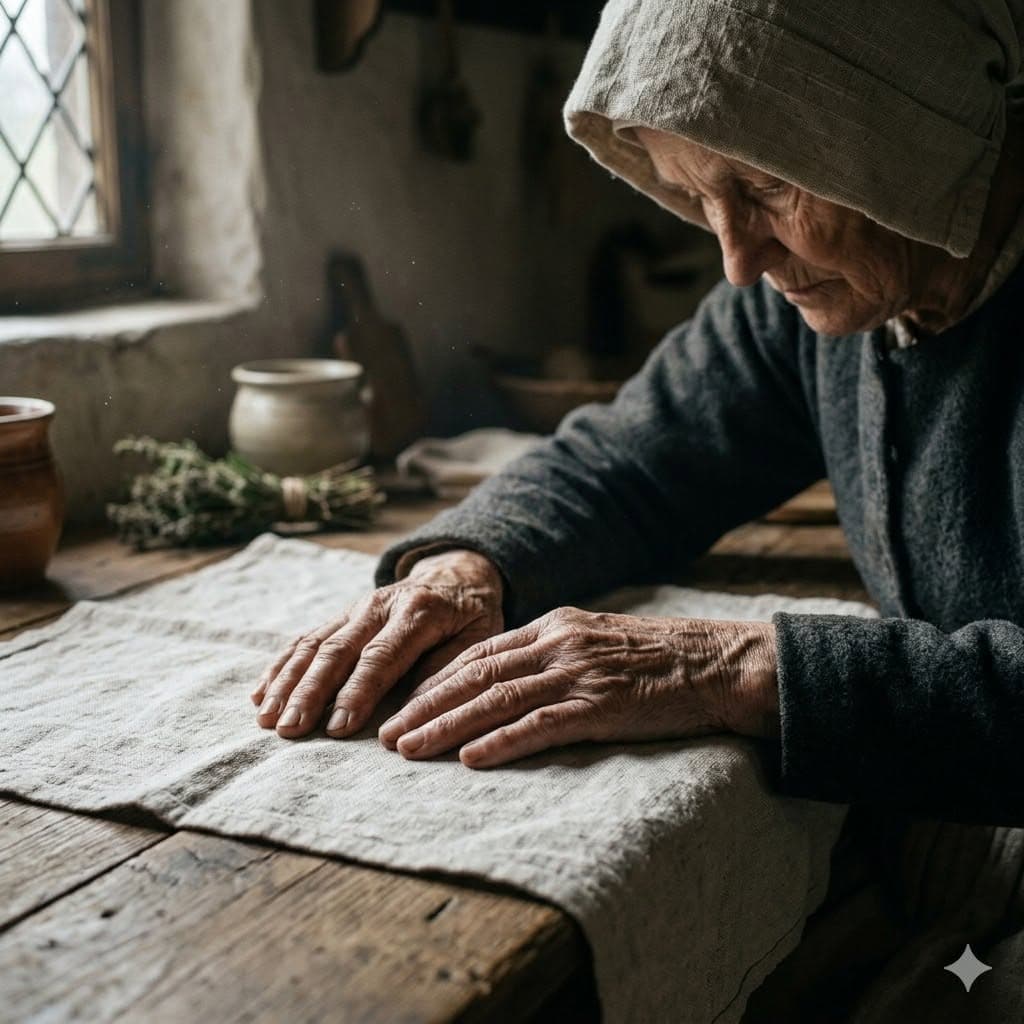
She had delivered babies in Dillingen for nineteen years.
She was a licensed midwife, which meant she had been examined and approved and trusted with the most dangerous crossing a woman of the sixteenth century made, the passage between pregnancy and survival, for the mother and for the child. She had sat at bedsides and held hands and brought lives into a world where arriving safely was never guaranteed. She had done this work for nineteen years as a widow, alone, supporting herself with the only skill the period made available to a woman of her position.
In 1587, she was arrested and accused of witchcraft.
Her name was Walpurga Hausmännin. The court record that survives describes her confession in terms that tell you everything about the confession and nothing reliable about Walpurga. She had made a pact with the devil, it said. She had murdered forty infants in her care before they could be baptised, applying a special salve or pressing on their foreheads. She had sucked their blood. She had eaten children with other witches. She had caused hailstorms. A demon named Federlin had visited her for sex in the streets at night and in prison.
The confession was obtained, as the record itself notes, 'upon kindly questioning and also torture'.
That phrase, 'kindly questioning and also torture', is the most honest sentence in the document. The court wrote it without apparent awareness of what it revealed. They were describing a process. The process was: ask, then break, then write down what the breaking produced, then call what was written down a confession.
What the record actually tells us, stripped of the devil and the salve and the demon Federlin, is this.
Walpurga Hausmännin was an elderly widow in a century that had no safe place for elderly widows. She worked in a profession where infant mortality ran at approximately eighteen percent and the woman present at every death was the midwife. She lived alone. She had no husband, no sons, no political protection, no family name that carried weight. She had her licence and her skill and nineteen years of a reputation that was indistinguishable, to a court looking for a witch, from nineteen years of suspicious proximity to dead children.
She was exactly what the period needed her to be.
The witch trial machinery of sixteenth-century Bavaria required specific raw material: a woman without protection, with access to the spaces where unexplained deaths occurred, with enough years of accumulated suspicion to make the accusation feel like confirmation of something already known. Walpurga supplied all of it simply by having lived her life. The charges did not describe her. They described the role the system had prepared for her long before she was arrested.
Both the local church under the Bishop of Augsburg and the imperial court sentenced her to death.
They sentenced her to a death of specific and documented brutality, which is worth stating plainly because the record is plain.
She was taken through the city of Dillingen and stopped five times before she reached the place of execution. At each stop, her flesh was torn with red-hot irons, her left breast, her right breast, her right arm, her left arm, her left hand, each at a separate stop, each tearing conducted in the open street in front of the city she had served for nineteen years. At the place of execution, her right hand was cut off. It was the hand with which she had taken her oath as a midwife.
Then she was burned alive.
When it was over, her ashes were not permitted to remain on the ground. They were gathered and thrown into a stream. The concern was contamination, that even her remains, if left in the earth, might do harm. The woman who had spent nineteen years keeping babies alive was not permitted, in death, to touch the ground of the city she had worked in.
The confession the court recorded became one of the most cited documents in the history of witch trials, a template, a set of standard accusations that appeared in trial after trial across Bavaria and the German states in the decades that followed. The specific imagery of the devil's pact, the infanticide, the blood drinking, the demonic lover, all of it travelled outward from Walpurga's confession into the legal and theological machinery of persecution and was used to construct the charges against women who had never heard her name.
She had delivered babies for nineteen years. The document produced by her torture outlived her by centuries and killed women she never met.
Her ashes are in a stream somewhere near Dillingen.
The stream does not know her name.