Henry VIII had given her a "Rough Wooing" since she was barely old enough to walk. His son continued it. On the seventh of July 1548, Scotland promised its five year old queen to France. She was some seventy miles away and did not know it was happening.
For two years English armies had torn through the Lowlands in what contemporaries called the Rough Wooing, burning towns and taking fortresses to force a marriage between Mary and Edward, son of Henry VIII. At Haddington the English garrison had held out through disease and bombardment until thousands of French soldiers landed at Leith and marched to join the Scots, surrounding the town in the summer of 1548. The price of that help was set out on a single day.
On 7 July, at the abbey of St Mary at Haddington, a parliament met under James Hamilton, Earl of Arran, governor and regent of Scotland, to hear the French king’s proposal. In return for defending Scotland and driving the English from its fortresses, Henry II of France asked that his son, the Dauphin Francis, should marry Mary at her majority and that she be promised to no other. The estates agreed. In the same arrangement, Arran secured a French duchy for himself. He would be made Duke of Châtelherault.
The cost did not fall only on the girl whose future was being signed away. As surety that Scotland would keep its side of the bargain, Arran had to send his own eldest son, James Hamilton, to France as a hostage. One father had traded his sovereign’s marriage and handed over his child in the same negotiation. By then she had already been moved to Dumbarton Castle, the safest rock in Scotland, while men who could reach her only by argument decided she would leave it.
The ground did not become safer because the treaty existed. Mary of Guise, the queen’s mother, was present at Haddington that summer as French and Scottish guns battered the English positions. When she returned to visit the siege lines after the agreement, English artillery opened fire on the camp she was leaving and killed several people in her company. The parliament that had pledged her daughter to France was framed as protection against English violence. Within days, English shot tore through the party of the woman who had helped to arrange it.
Mary herself never saw the abbey where the treaty was made. Her fortress sat on a rock above the Clyde so steep that her councillors believed no English army could force it. From there she watched ships on the river and recovered from an illness while men argued over her marriage in a town nearly seventy miles to the east. John Knox would later write that the French soldiers who had marched north to relieve Haddington were “officers to that parliament”, the men in armour standing over its decisions as much as the Scottish lords did. The girl they were talking about was not in the room.
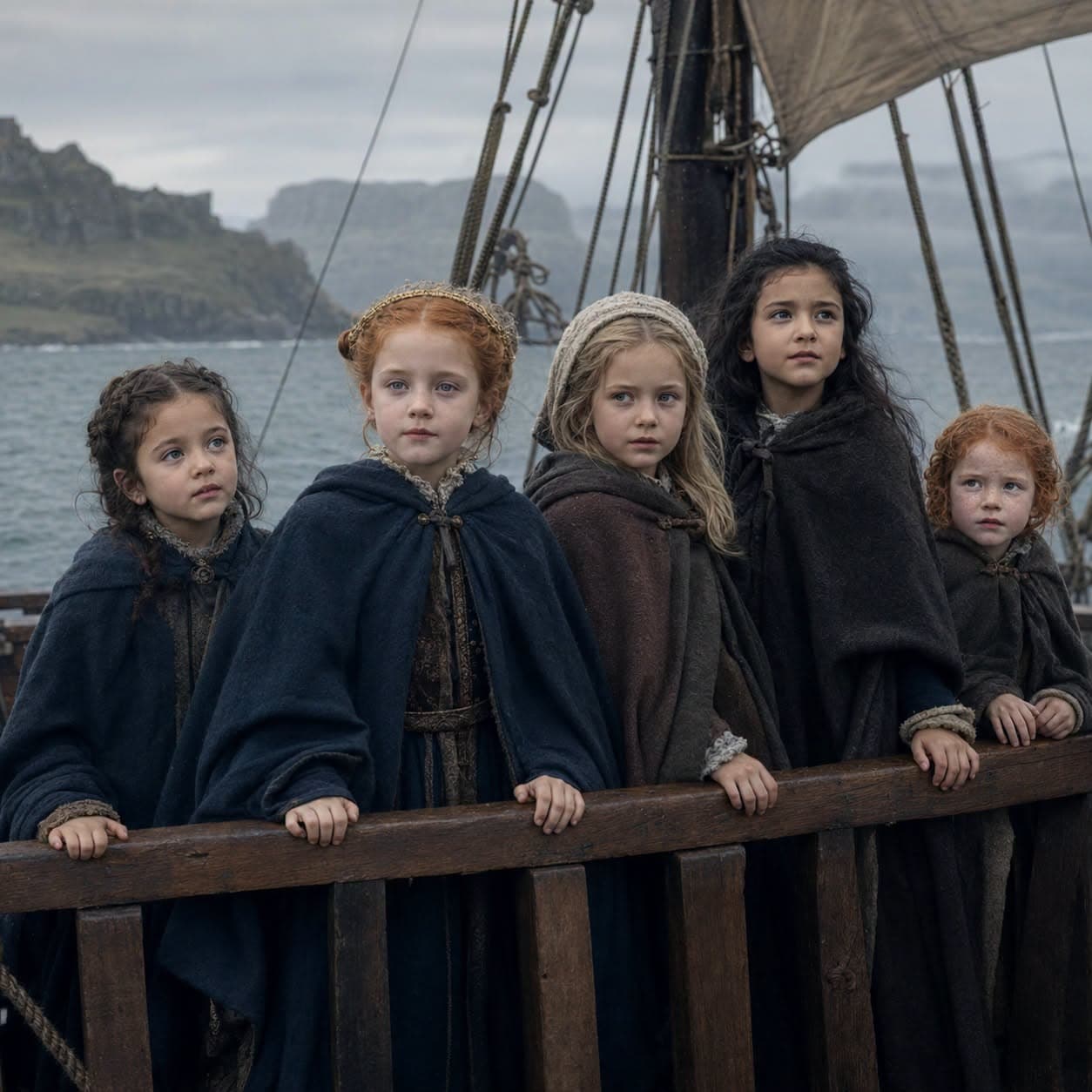
A month after the treaty, on 7 August, the French fleet that had carried soldiers to Leith sailed into the Clyde and anchored below Dumbarton. Mary went aboard with four girls her own age, Mary Fleming, Mary Beaton, Mary Seton and Mary Livingston, the Four Marys who would share her exile. The crossing to Brittany took several storm-driven days. She was five years old when she landed in France and would not see Scotland again for thirteen years.
The marriage that had been promised at Haddington did not last a lifetime. Mary wed Francis in April 1558; he became king the following year and died in December 1560, aged sixteen. She had worn a French crown for less than two years. The treaty had promised her that crown to keep her safe from an English one. She crossed the sea to claim it and came home a widowed queen to a country that had changed without her.