Thomas would not leave the house until he had seen his servants. They had been shut in the chapel. The king could have him taken south, but the departure would have to wait.
On Sunday, 6 November 1530, Cardinal Thomas Wolsey was preparing to leave Cawood Castle in Yorkshire as a prisoner. He had expected to spend that evening in York, ready for his ceremonial installation in the Minster the following morning. Instead, his household was being broken up, his belongings were under the control of the king's commissioners, and five of his own servants had been chosen to accompany him. Everyone else was to stay behind.
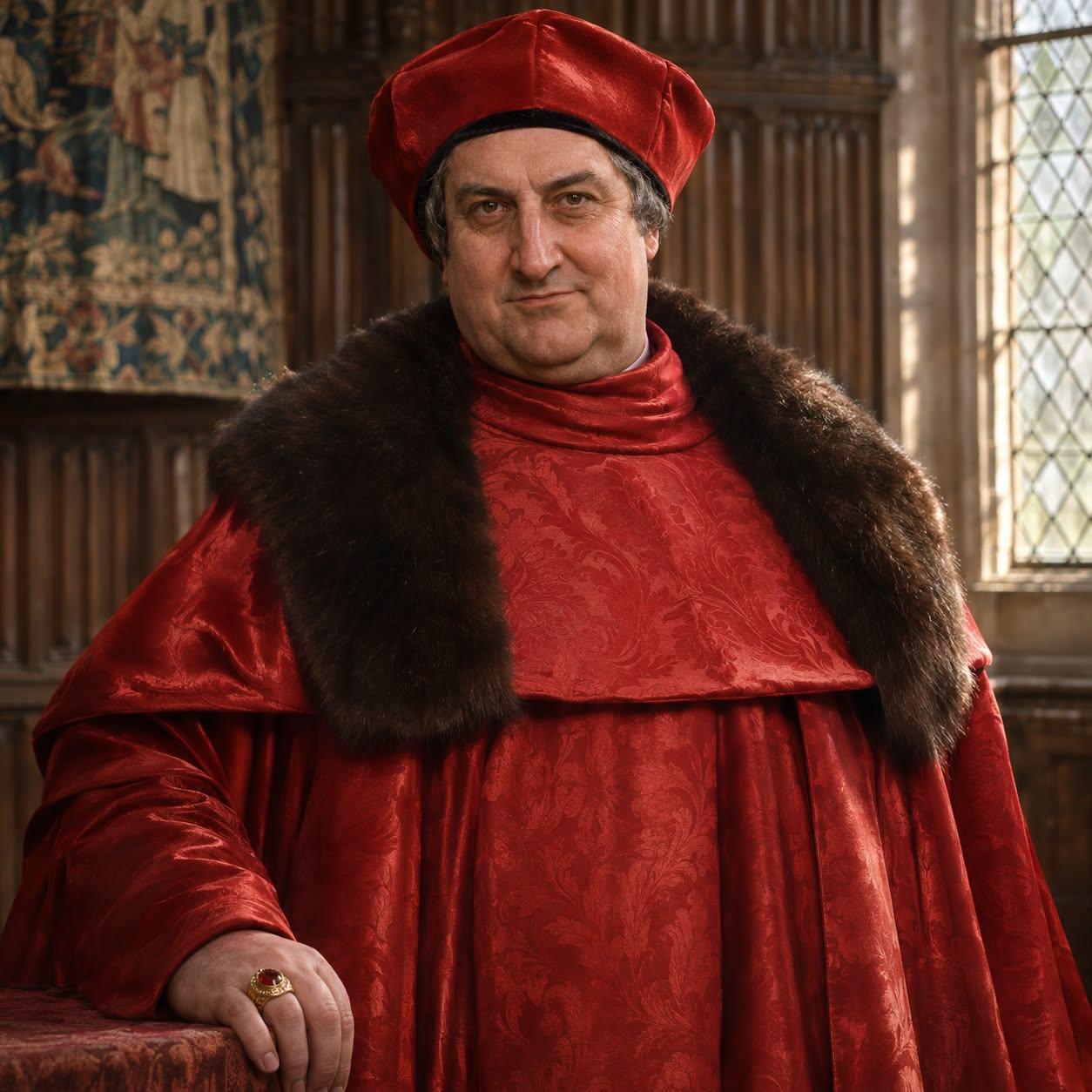
Wolsey had once been the man through whom much of Henry VIII's government passed. A butcher's son from Ipswich, he had risen through the Church to become a cardinal, Archbishop of York and Lord Chancellor of England. At its height his household ran to about five hundred people, a scale that made his importance visible before he entered a room. Service to him offered a way upwards. His favour could give a man a future.
Then Henry asked for something Wolsey could not deliver. The king wanted his marriage to Catherine of Aragon annulled so that he could marry Anne Boleyn. Wolsey's years of usefulness did not secure the necessary decision from Rome, and they did not protect him when it failed to come. In 1529 he lost the chancellorship. He retained the archbishopric of York, and in 1530 he travelled north.
There was still work for an archbishop there. Wolsey confirmed children by the hundred, gave relief to the poor and set more than three hundred workmen to repairing his decayed residence at Cawood. The clergy of York came to arrange his formal installation in the Minster, and he asked for less display than custom allowed. There would be no sumptuous cloth laid down for him to walk upon. His servants were to dress plainly.
He planned to arrive on Sunday evening, lodge with the dean, be installed on Monday and dine with the mayor on Tuesday. It was a small, orderly programme for a man whose arrangements had once involved kings.
On Friday, 4 November, Henry Percy, Earl of Northumberland, arrived at Cawood with Walter Walsh, one of the king's servants. Wolsey welcomed the earl as a guest, worried aloud that there might not be enough good fish to entertain him, and reminded him of the time he had spent in the cardinal's household as a youth. It was an awkward thing to remember. As a young attendant there, Percy had formed a secret match with Anne Boleyn, and Wolsey, at the king's wish, had been the one to break it up.
In the bedchamber, at a window by the chimney, the earl laid a hand on his arm. He was trembling, and his voice was faint. "My lord, I arrest you of high treason." The accusation grew out of Wolsey's dealings with contacts abroad. He demanded to see the commission. "Nay, sir," said the man who had once waited on him, "that you may not."
On Saturday, the tables were laid for dinner, but Wolsey had something other than the meal before him. George Cavendish, his gentleman usher, came into the chamber, and the sight of him brought Wolsey to tears. Cavendish had left his own country, his wife and children, his house and family, to serve him through his troubles. Now Wolsey had nothing to reward him with.
A great household rested on those obligations as well as on wages. Men served, and their master was expected to remember it. Wolsey remembered. Remembering was no longer enough to help them.
The departure was delayed until Sunday. After dinner, as the preparations were completed and the day drew towards night, Wolsey asked where the rest of his servants were. Northumberland said they were nearby. He had confined them in the chapel so that they would not disturb the departure.
"Let me see them or ever I depart," Wolsey said, "or else I will never go out of this house." Northumberland urged him to be content without it. The prisoner refused to go.
Inside the chapel, the servants learned that their master was about to be taken away without seeing them. They made such a rueful noise that the commissioners feared a disturbance. Between the man who would not leave and the men who would not quietly let him, the arrangements had to change.
They were brought into the great chamber. They knelt before Wolsey, weeping, while he praised their faithful service and declared his loyalty to the king. Then he took them each by the hand. There was little daylight left for the journey, but they had their farewell.
His mule was waiting in the inner court. The porter opened the gate, and Wolsey rode out with the men appointed to conduct him. Outside, some three thousand people were waiting, by the estimate of a man riding with him. "God save your grace," they shouted, and "The foul evil take all them that hath thus taken you from us!" They ran crying after him through the town.
Northumberland remained at Cawood to deal with the household and secure what had been left behind. Cavendish rode with his master, along with a chaplain, a barber and two grooms. There had once been five hundred.
On the road, Wolsey asked where they were taking him that night. When Cavendish answered Pontefract, he feared the castle, and asked if he was to "die like a beast" there. His usher made enquiries and returned with the reassurance that he would lodge in the abbey. They reached it after nightfall. He had planned to be lodging with the dean in York that night.
The journey continued through Doncaster to Sheffield Park. Later that month the Constable of the Tower arrived there with twenty-four of the king's guard to take him south. By the time they set out he was gravely ill, and he got no further than Leicester Abbey. On 29 November, before he could be brought to trial, Wolsey died there. The household he had insisted on seeing at Cawood was far behind him. Cavendish was standing at his bedside. The servant he had been unable to reward was still there.