He had spent ten years deciding who went to the Tower. On the tenth of June 1540 he found out what it felt like from the other side. He already knew exactly what it meant.
Thomas Cromwell had built the machinery of Tudor power with a precision that no one before him had managed and no one after him would equal. The son of a Putney blacksmith, he had risen through the law and through Cardinal Wolsey's household and then through the ruins of Wolsey's fall to become Henry VIII's chief minister, the man who administered the break with Rome, dissolved the monasteries, reformed the administration of the English state, and decided, with the specific efficiency of a man who understood that sentiment was a liability in his profession, who among the king's enemies would live and who would not. Thomas More had gone to the scaffold. Anne Boleyn had gone to the scaffold. The Pilgrimage of Grace had been crushed with a thoroughness that left no room for misunderstanding. Cromwell had built the instruments and operated them, and he had built them well, and he understood them from the inside in a way that no one else in the kingdom did.
He was arrested on the tenth of June 1540 at a Privy Council meeting he had expected to conduct as normal. His conservative enemies, led by the Duke of Norfolk, had moved against him while Henry's attention was elsewhere and his own position had been weakened by the failure of the Anne of Cleves marriage, which Cromwell had arranged and which Henry had found so repellent that he had reportedly been unable to consummate it. The Earl of Essex was stripped from him in the room. His papers were seized. He was taken to the Tower by river, as others had been taken before him, through the same gate, in the same boats, by the same mechanism he had helped to perfect.
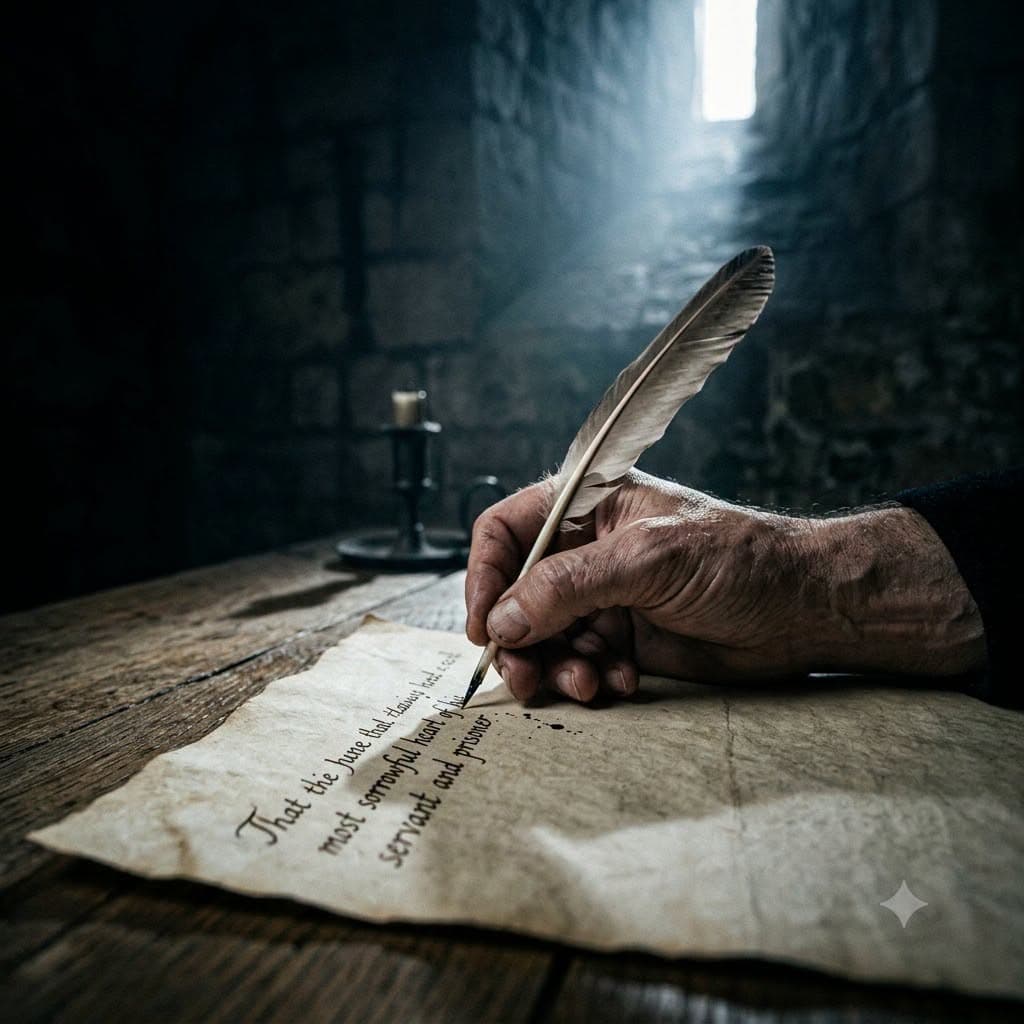
Two days later he picked up a quill.
The letter he wrote on the twelfth of June 1540 is one of the most extraordinary documents in the Tudor archive, not for what it conceals but for what it cannot. He denied treason with the directness of a lawyer who knew the charge had to be answered in its own terms: he had never wittingly or willingly thought to offend the king, his realm, or his posterity. He acknowledged that he had meddled in countless matters of state and committed procedural errors, but maintained that none of his actions were malicious. He addressed the Anne of Cleves question with the care of a man who understood it was the wound that had made him vulnerable, explaining that he had merely urged the queen's Lord Chamberlain to encourage Anne to behave pleasantly toward Henry, to try to make something workable of a marriage that had never had a chance. He defended himself against the charge of illegally retaining men. He did all the things a trained lawyer would do: he answered the specific accusations, he denied the malicious intent, he positioned himself as a servant whose errors were those of excess of zeal rather than of disloyalty.
And then he signed it. With the quaking hand and most sorrowful heart of his humble servant and prisoner.
That signature is the whole distance between the man who had written letters for a decade as the most powerful person in England below the king and the man writing this one in a cell in the Tower, and Cromwell knew the distance as precisely as he knew everything else, because he had measured it himself across ten years of other people's falls. He had watched men write letters like this. He had received them. He had read them and assessed them and made his recommendations and the machinery had run its course, and now he was writing one.
On the same day, Thomas Cranmer wrote to Henry on Cromwell's behalf. Cranmer, who owed his position as Archbishop of Canterbury in significant measure to Cromwell's support, wrote that Cromwell had been such a servant as no prince in this realm ever had. And then he asked a question that has no comfortable answer: who shall your Grace trust hereafter, if you might not trust him? It was the most dangerous question available in the Tudor court, the question that named the mechanism and asked the king to look at it directly, and Cranmer asked it anyway, because he was a braver man in that moment than history generally gives him credit for being, and because the question was true and he knew it.
Henry did not answer the June 12 letter. He did not answer Cranmer's question. He was already looking at Anne of Cleves and calculating what a divorce would cost and what a new marriage might offer, and Cromwell's fate had been decided in that calculation, not in any assessment of the charges against him. His enemies had understood this and moved at exactly the right moment, when the king's irritation with the marriage Cromwell had arranged was fresh enough to be weaponised.
Cromwell wrote again on the thirtieth of June, a longer letter, more desperate, and added a postscript in a hand the historians who have read it describe as visibly deteriorating: Mercy, mercy, mercy. Three times. A man who had shown very little of it to others, sitting in the room where others had sat before him, asking for the thing he had not often given.
He wrote a final letter on the twenty-fourth of July, four days before his execution. It was not about his survival. It was about a shipping dispute, a procedural matter he wanted to resolve before he died, clearing his name of an administrative error as though the paperwork still mattered, as though the machinery he had spent ten years building was still worth tending even from inside the cell it had placed him in.
He was executed on Tower Hill on the twenty-eighth of July 1540. The executioner was reportedly inexperienced and it took multiple blows. Henry VIII married Catherine Howard the same day.
He had known, from the tenth of June onward, exactly what was going to happen, because he had made it happen to others and he understood every step. The quaking hand was the hand of a man who had no illusions left. He wrote the letters anyway, because he had always understood that the only alternative to the letters was silence, and silence in a court run by Thomas Cromwell was an admission.
The court had been run by Thomas Cromwell. He had built it that way himself. In the end the only thing it knew how to do was what he had taught it.