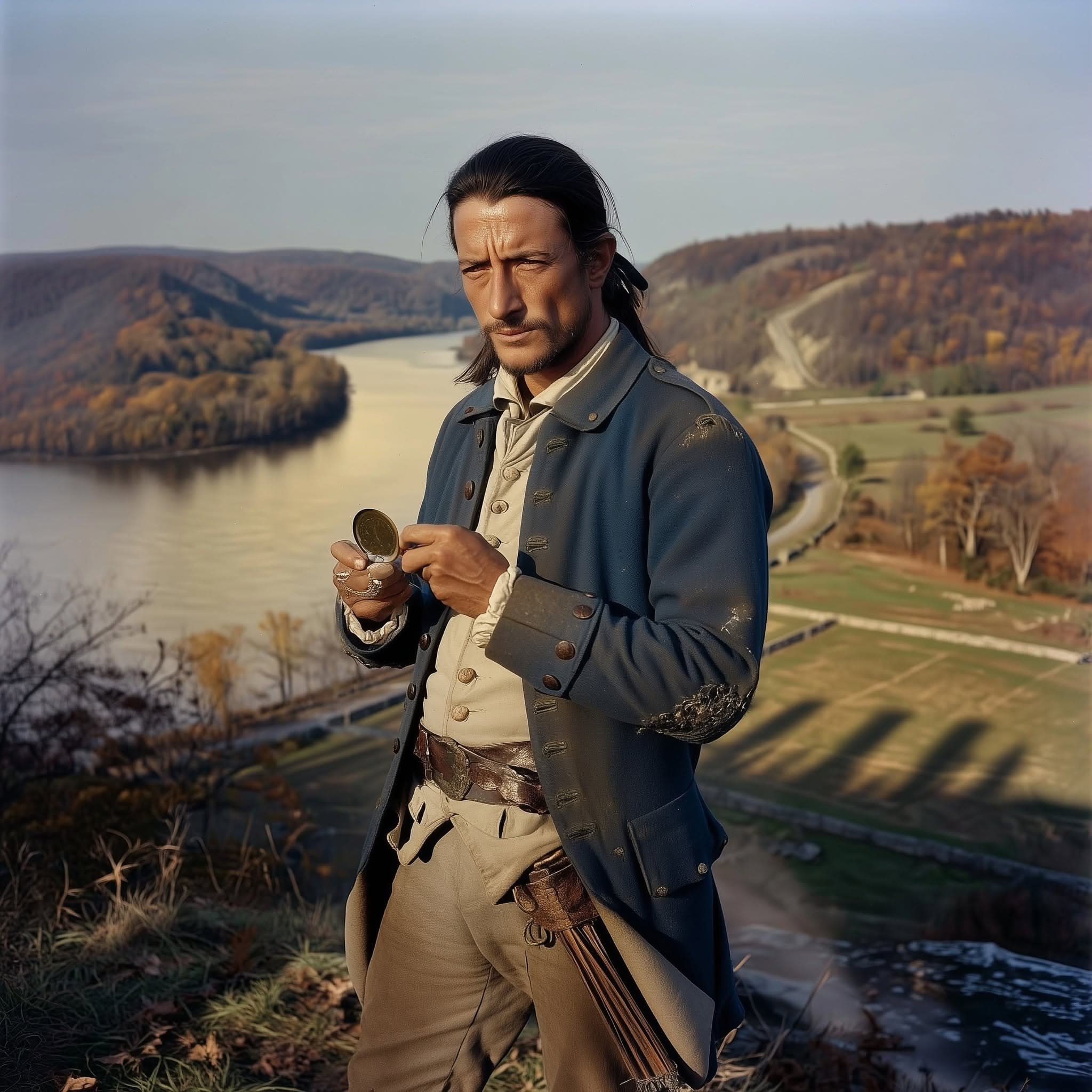
He came to America with nothing and left it all to the slaves of the man who was supposed to free them. The man did not free them.
Tadeusz Kościuszko was born on the fourth of February 1746 in the Polish-Lithuanian Commonwealth. He was the son of a minor noble family in a country that had already begun to understand what it meant to be surrounded by empires with appetites. He grew up watching Russia and Prussia and Austria press against his country's borders the way a man presses a thumb against a bruise. They pressed steadily and with patience, knowing what will eventually give.
He studied military engineering in Warsaw and Paris. He learned the mathematics of fortification and the geometry of defence. He arrived in Philadelphia in 1776 with a compass, almost no money, and almost no English, because the war he had been training for had finally started somewhere he could reach. He was thirty years old. He did not go home for eight years. When he tried to go home after that, home was gone.
Franklin put him to work. Congress made him a colonel of engineers in October 1776. He was not Lafayette. He had no title, no ship, and no dramatic entrance. He had a surveyor's eye and the understanding that a battle is decided before the first shot is fired. He knew it was decided in the choice of ground, and he was very rarely wrong about the ground.
In the summer of 1777 Fort Ticonderoga fell to the British because the American commanders had ignored Kościuszko's recommendation about the high ground above it. The British hauled cannons up the slope everyone said was impossible and fired down into the fort and the Americans ran. He was not wrong about the ground. He was simply not listened to. He was learning something about the republic he had come to build.
He chose the ground at Bemis Heights.
He surveyed the bluffs above the Hudson River and found what he was looking for. He found high ground above a bend, woods on one side, and the river on the other. It was a position that could be made into something close to a trap. He laid out the earthworks. The British came in October 1777 and walked into exactly what he had designed for them to find.
General Burgoyne surrendered at Saratoga on the seventeenth of October with eight thousand men. It was the victory that brought France into the war. It turned a colonial rebellion into a global conflict Britain could not afford to win. It made American independence possible rather than merely imaginable. Kościuszko's name is not on the surrender document. His earthworks were.
He spent two years fortifying West Point, the great complex of defences on the Hudson that became the most formidable position in America. These were the defences Benedict Arnold subsequently tried to sell to the British for twenty thousand pounds. In the south he served under Nathanael Greene and proved that his gifts were not confined to stone and timber.
In the winter of 1781 Cornwallis was chasing Greene's army across two hundred miles of Carolina backcountry. It was Kościuszko who scouted the river crossings. He built the boats that moved the army faster than Cornwallis could follow and found the ground where Greene finally turned. The army survived it. The war turned with it.
He went home to Poland in 1784, and what he found there was what he had always known was coming.
The country was being partitioned. Russia, Prussia, and Austria were carving it between them with the unhurried confidence of powers who understood that no one was going to stop them. The Polish nobility was fracturing between those who would resist and those who had already begun calculating what collaboration might preserve.
Kościuszko had spent eight years watching an idea become a country. He believed it could be done again. He was standing on different ground now and he knew it and he went ahead anyway. The alternative was to watch Poland disappear and do nothing, and he was not made for that.
He stood in the market square of Kraków on the twenty-fourth of March 1794 and declared himself Supreme Commander of a national uprising. He had no professional army. He armed the peasants with scythes and belief and the specific authority of a man who had stood at Saratoga and knew what an outnumbered force could do with the right ground. His first battle he won. His second he won. Then Russia sent Suvorov.
On the tenth of October 1794 at Maciejowice, on a flat plain in eastern Poland where there was no high ground to choose and no river to use and nowhere to put the engineering that had saved him every time before, the Russian cavalry found his flank. The battle lasted hours. He was struck by two lances and a sword and fell from his horse into a ditch. His men carried him off the field.
He lost consciousness and when he returned to it Poland was lost with it. The uprising had collapsed the moment he fell because there was no one else. He had always known there was no one else, and he had gone to Maciejowice anyway.
Finis Poloniae, he is supposed to have said when he came back to himself. The end of Poland. He denied saying it later. But Poland ended regardless.
He sat in a Russian prison for two years. The Third Partition was completed in 1795. Poland was removed from the map of Europe. It was not diminished or occupied. It was erased, and it would remain erased for the next hundred and twenty-three years. There was no Poland to exile him from. There was only the space where it had been.
He was released in 1796 and went to America because America was the one country he had helped build that still existed. Jefferson wrote him letters full of warmth and admiration. Congress voted him the back pay and land grant he was owed. He walked the streets of Philadelphia and felt what it was to be in a country that had survived the thing he had failed to do for Poland. In 1798, before he left for the last time, he wrote a will.
He left his entire American estate to Thomas Jefferson to be used for one purpose. He authorised Jefferson to employ the whole of it in purchasing Negroes from among his own or any others and giving them liberty in his name. He wanted them educated and prepared for a free life. He named Jefferson's own slaves. He made Jefferson the executor.
He had spent twenty-two years watching men build republics on the principle that all men were created equal and had noticed, with the precision of an engineer assessing load-bearing ground, the lie at the centre of the structure. He arranged his entire fortune to correct it. He trusted the man who had written the words.
He should not have trusted the man who had written the words.
Jefferson declined the executorship. He cited complications. He cited his debts. He cited the law. He found reasons across the nineteen years between the writing of the will and Kościuszko's death to find the object of it impractical, too difficult, and inadvisable. A month before he died, Kościuszko wrote Jefferson a final letter. After my death, he said, you know their fixed destination. He was dying in a Swiss village at the foot of the Alps, exiled from a country that no longer existed, writing to the man he had trusted with the last act of his life and reminding him of what he had promised.
Jefferson knew. He chose otherwise.
Kościuszko died on the fifteenth of October 1817, seventy-one years old, in Solothurn, Switzerland. When Jefferson died nine years later, the slaves at Monticello were sold at auction to pay his debts. Every one of them. The will was contested and litigated for decades and the money dispersed into legal costs. The freedom it was meant to purchase was never purchased. The men and women Kościuszko had named remained property and then their children remained property.
The structure with the lie at its centre stood for another forty-four years until enough Americans died to bring it down.
He was buried in Switzerland first and reinterred later in Kraków Cathedral beside the kings of Poland. He lies in the country that came back after a hundred and twenty-three years without him. The crypt is still there. His name is on the square in Washington and on bridges and streets across the country he helped build. It is the country that took his fortune and spent it on lawyers.
He came to Philadelphia in 1776 with a compass and a surveyor's eye and no English and the knowledge that the war he had trained for had finally started somewhere he could reach. He chose the ground at Saratoga and the Americans won the revolution. He tried to save Poland and stood in a ditch at Maciejowice while it ended. He left everything he had to free the men Jefferson owned and Jefferson did not free them.
He was right about the ground every single time. It was the men he trusted with what he built on it who were not equal to what he left them.