The Spanish Habsburg Court: Where The Etiquette Was So Elaborate That The Queen Caught Fire And Nobody Felt Qualified To Help
The Spanish Habsburg court of the seventeenth century had an etiquette system so comprehensively detailed, so finely stratified and so rigorously enforced that it had developed, over several generations, into something that functioned less like a set of social guidelines and more like a religion with the flexibility of granite and the common sense of a medieval tax code.
Every action at court had a prescribed form. Every form had a prescribed rank of person permitted to perform it. Every rank had a prescribed distance from the royal person, a prescribed angle of bow, a prescribed volume of speaking voice and a prescribed method of departure from the room that required, depending on circumstances, walking backwards for up to thirty feet without falling over or looking uncertain, both of which were achievable with practice and both of which courtiers practiced extensively because the alternative was social annihilation.
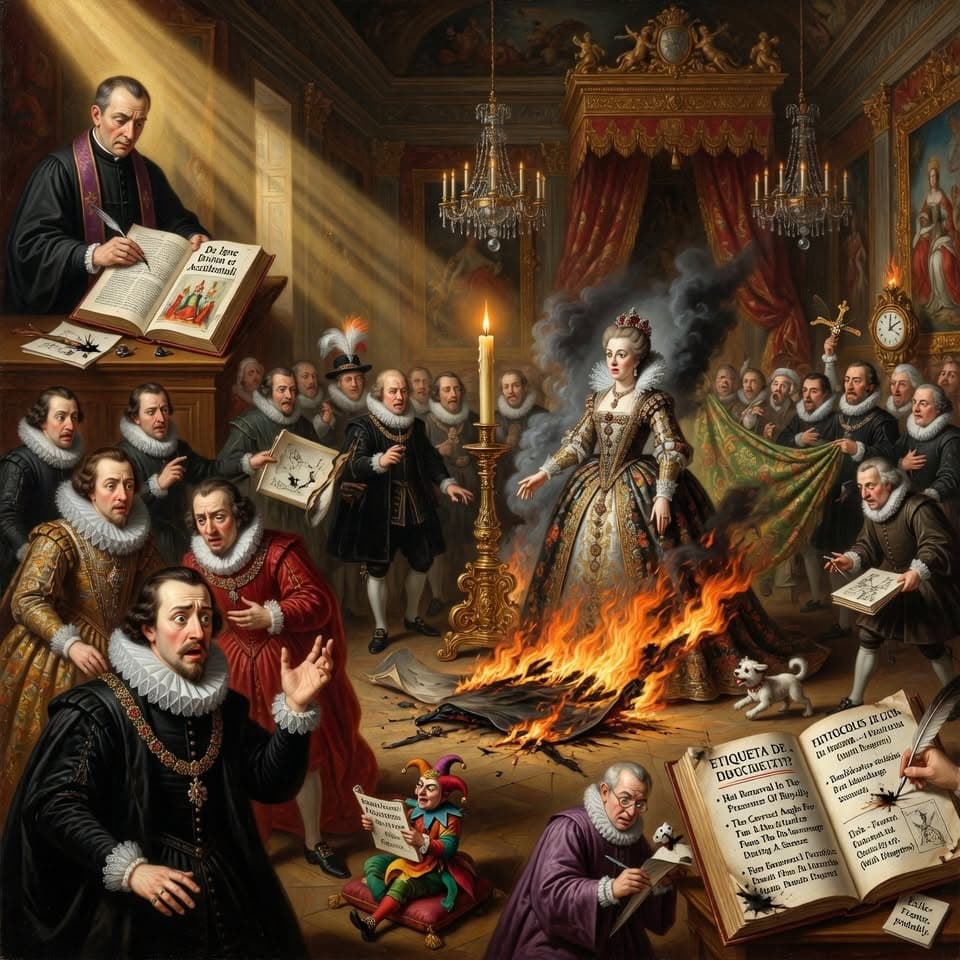
Into this system of extraordinary precision came the question of what to do when the Queen of Spain's skirt caught fire during a court ceremony, and the answer the room collectively produced was: absolutely nothing, because nobody present could establish with sufficient confidence that their rank entitled them to touch the queen's person, and the penalty for touching the queen's person without authorisation was immediate expulsion from Spain, and nobody was prepared to make that call on the basis of what was technically still an emerging situation.
The incident was not an isolated malfunction of an otherwise reasonable system. A similar paralysis occurred when a queen fell from her horse during a public procession and lay in the street while her attendants calculated the protocol implications of physical assistance. The nobleman who eventually helped her remount, concluding that the alternative was worse, subsequently left Spain as required, which Philip IV apparently considered the correct outcome and which tells you essentially everything about the priorities of the Habsburg court.
The etiquette system had been largely designed by Philip II in the previous century and was based on the Burgundian court ceremonial, which had itself been a byword for elaborate formality, imported to Spain and then refined across several decades into something that its creators would no longer have recognised and almost certainly would have found alarming. Philip II's reasoning was that an elaborate and rigid ceremonial elevated the dignity of the crown above all earthly concerns. This was correct. It elevated the dignity of the crown so far above earthly concerns that earthly concerns such as fire became temporarily irrelevant.
The courtiers of Philip IV were not stupid people. They were, many of them, highly educated, politically sophisticated and perfectly capable of independent thought in contexts where independent thought was not regulated by a leather-bound volume of court protocol. The problem was that the entire structure of their lives, their social position, their income, their family's standing across generations, rested on their correct performance of the etiquette system, and deviation from it in a moment of apparent emergency was not a simple act of helpfulness but a gamble with everything they had, based on a personal interpretation of circumstances that the protocol document did not formally address.
In this context their frozen inaction was not cowardice. It was rational. It was the system working exactly as designed, producing exactly the outcome a system that valued correct procedure over practical results will always eventually produce. The queen's skirt was eventually dealt with, by which point the smoke had made the situation significantly less ambiguous to everyone including the protocol experts.
The etiquette volume was, so far as history records, not updated to address the gap. Presumably the feeling was that it would not come up again. Presumably they were right. You only need to watch the queen catch fire once before you start standing further from the candles.