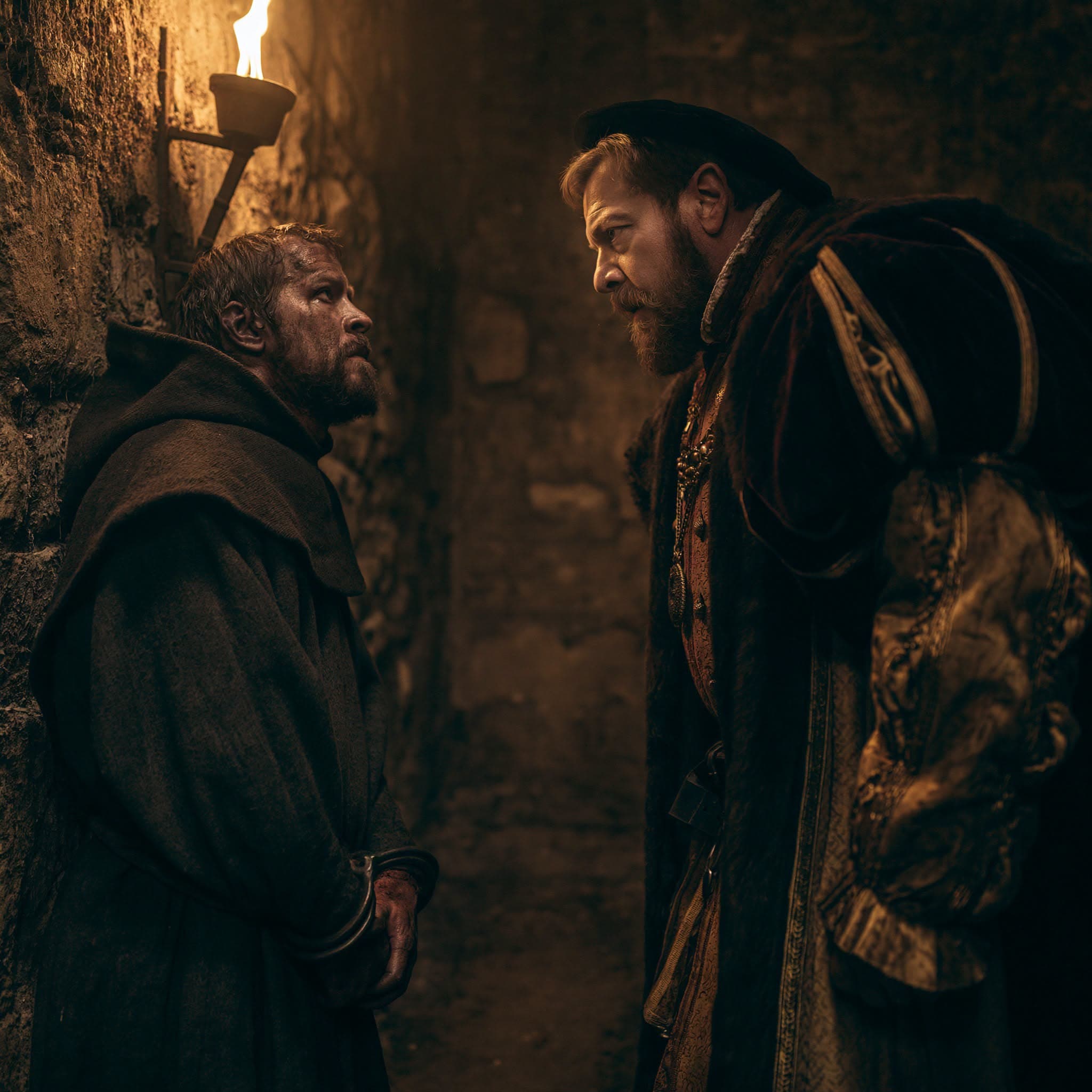
He had been one of Henry's closest companions. Henry had him chained to a pillar with iron rings at his neck, his hands, and his feet. Then he came to visit.
Sebastian Newdigate had grown up in the privy chamber, the inner rooms where Henry received the people he trusted most, a young man at the centre of things whom his own family's register would record as having become a delicate courtier. In 1524 his wife died. He entered the London Charterhouse. a Carthusian monastery, one of the strictest religious orders in England. Its monks lived in individual cells, observed long hours of silence, and withdrew almost entirely from the world outside the monastery walls.
His family was not certain the conversion would hold. A woman identified in the records as his sister visited the Prior to say she was not sure a man formed in that world had the disposition for enclosure and silence. The Prior kept him. Newdigate was ordained deacon in 1531. He had two daughters, Amphyllis and Elizabeth, who remained in the world he had left.
On the sixth of June 1534, Henry required his subjects to sign the Oath of Succession, the declaration that his marriage to Anne Boleyn was lawful and their children legitimate heirs. Newdigate signed it. He signed it, the record notes, in as far as the law of God permits, a qualification written into his own signature, a line drawn in the ink of the document itself.
He could give Henry the wife and the succession. He could not give him the Church.
The Oath of Supremacy, the declaration that the King, not the Pope, was supreme head of the Church of England, was the oath Newdigate and the Carthusian community refused. On the fourth of May 1535, the Prior of the Charterhouse, John Houghton, was hanged, drawn and quartered at Tyburn. Newdigate and two other monks, Humphrey Middlemore and William Exmew, were arrested three weeks later.
They were taken to the Marshalsea and bound to pillars standing upright, iron rings at the neck, the hands, and the feet, for fourteen days. Henry came to the Marshalsea. He is said to have come in disguise. He found his former companion in the irons and offered to load him with riches and honours if he would conform.
Newdigate refused.
He was moved to the Tower of London. Henry came again. He made the offer again. He was standing in a room with a man he had known in the privy chamber, a man his family had called a delicate courtier, and he was offering him everything he had previously possessed: position, wealth, the life that life had been before the Charterhouse, in exchange for a signature.
Newdigate refused again.
The three monks were condemned for treason on the eleventh of June 1535. They had eight days. Contemporary accounts note that they went to Tyburn as to a feast. They were dragged there on hurdles on the nineteenth of June 1535 and hanged, drawn and quartered before the crowd.
Sebastian Newdigate was thirty-four years old.
The qualification he had written into the Oath of Succession, in as far as the law of God permits, was the line he had drawn before any of this began. He had told Henry in the document what he was prepared to give and what he was not. Henry had the signature for a year before the arrest. He knew where the line was.
He came to the Marshalsea and the Tower anyway, twice, with an offer. He was refused twice by a man in iron rings who had once shared his private jests and who had made, in the Charterhouse, a different set of commitments to a different authority.
His family had doubted the conversion was permanent. It was not wrong about what kind of man he had been. It was wrong about what he had become.