
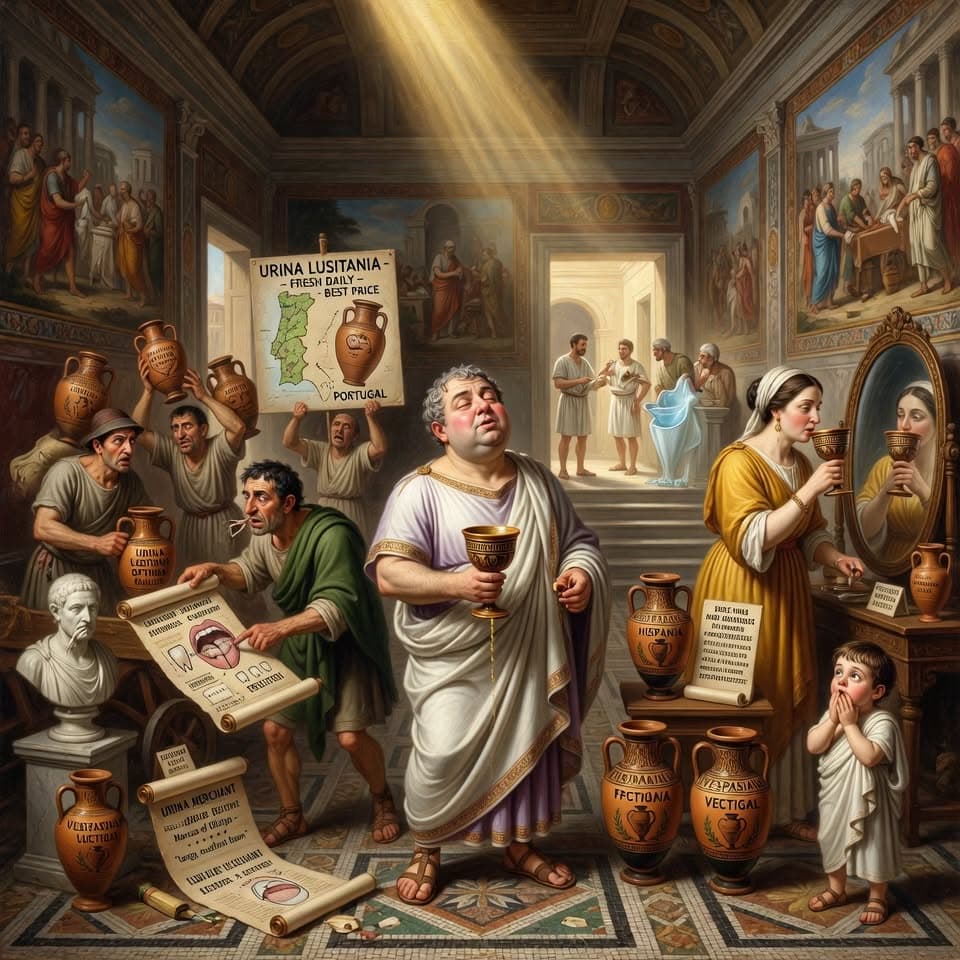
The Roman Empire invented the import/export economy, concrete, central heating, and a dental hygiene industry built entirely on human urine. Three of these things are unambiguously impressive.
The Romans were, by most measures, the most sophisticated civilisation the Western world had yet produced. They built aqueducts. They codified law. They constructed roads so well-engineered that several are still technically in use today. They looked upon the tribal peoples of northern Europe — wandering around in the mud, wearing animal skins, apparently not particularly bothered about any of this — with the quiet contempt of people who had underfloor heating and a professional class of architects.
They also gargled with other people's urine every morning before breakfast, and they considered this the height of civilised behaviour.
The science, such as it was, made a certain internal logic. Urine contains ammonia. Ammonia is a powerful cleaning agent. The Roman who first made this connection was either a medical genius operating three centuries ahead of his time, or someone who had run out of options at a particularly desperate moment and decided to commit fully to the bit. History does not record which. History, frankly, may have preferred not to know.
What the Romans had discovered — accidentally, enthusiastically, and with a thoroughness that suggests they were not people who did anything by half — was that leaving urine to ferment in an open container for several days produced a liquid with genuinely impressive whitening properties. The ammonia content intensified. The cleaning efficacy improved. The smell, one imagines, did not. This was either a minor obstacle or, given the general olfactory landscape of ancient Rome, not something anyone particularly noticed.
The practice became fashionable. Then it became standard. Then — because the Romans were nothing if not a people who understood commerce — it became an industry.
And then it became an import business, which is where things take a turn that no reasonable person could have anticipated.
The finest urine in the known world, according to Roman dental connoisseurs, came from Portugal. Specifically Celtiberian Portugal. The precise reason for this premium product designation is lost to history, though theories include diet, climate, mineral content of local water, and the possibility that whoever first made this claim had a business arrangement with someone in Iberia and was simply very committed to it. Regardless of the reason, wealthy Romans were prepared to pay accordingly, and so the ancient world's most exclusive import trade was born: bottled Portuguese urine, shipped across the Mediterranean, purchased by the Roman upper classes, and used as a daily mouth rinse to achieve the gleaming smile of someone who had just gargled with bottled Portuguese urine.
Emperor Nero, who found the concept of money leaving the imperial treasury in any direction an affront to his personal dignity, promptly taxed it. This is the point at which the Roman state officially acknowledged that its citizens were importing foreign wee as a luxury dental product and concluded that the correct response was to take a percentage. Nero's motivations in most things were questionable. His fiscal instincts, at least in this instance, were impeccable.
His successor Vespasian continued the tax. When his son Titus complained that the whole arrangement was beneath imperial dignity, Vespasian reportedly held up a gold coin produced by the urine trade, and said "pecunia non olet" — money doesn't stink.
This was either a masterclass in pragmatic governance, or a man who had simply been in Roman politics long enough that his threshold for what constituted a stink had been permanently recalibrated.
The Roman elite, meanwhile, were not merely purchasing urine in bulk and hoping for the best. They had refined the process. Pliny the Elder — a man who wrote down essentially everything anyone told him and died investigating a volcanic eruption at close range, which is the most Roman death imaginable — documented the practice in his encyclopaedia Naturalis Historia, including notes on sourcing, preparation, and optimal fermentation times. This means that the most comprehensive surviving record of Rome's dental hygiene industry was written by a man who also catalogued sea monsters, but one works with the sources one has.
The practice, it should be noted, worked. Roman teeth, by the archaeological evidence of surviving skulls, were frequently in excellent condition. The ammonia did genuinely whiten enamel. The antibacterial properties were real. A Roman citizen who committed to their morning routine was, biochemically speaking, onto something.
Whether any of this compensates for the fact that they were gargling with fermented foreign urine in the name of attractiveness is a question that each reader must answer for themselves. The Romans had made their position clear. They were smiling confidently, their teeth were magnificent, and they were not taking questions.
The practice persisted, in various forms, until the eighteenth century, when proper toothpaste was finally developed and Western civilisation collectively agreed never to discuss the previous two thousand years of dental history again.
Modern mouthwash contains chlorhexidine, cetylpyridinium chloride, and fluoride. It comes in mint flavour. It has, in every meaningful clinical measure, surpassed what the Romans were doing with Portuguese import stock.
And yet. Roman teeth were, by many accounts, better than those of the eighteenth century aristocracy who replaced urine with sugar and considered themselves to be progressing.
Progress is, as always, a matter of perspective. The Romans would have looked at modern dentistry, noted the four-hundred-pound annual bill, and suggested there was an entirely free alternative available if you were willing to think about it differently.
They would have been smiling when they said it. Magnificently, if somewhat disturbingly.