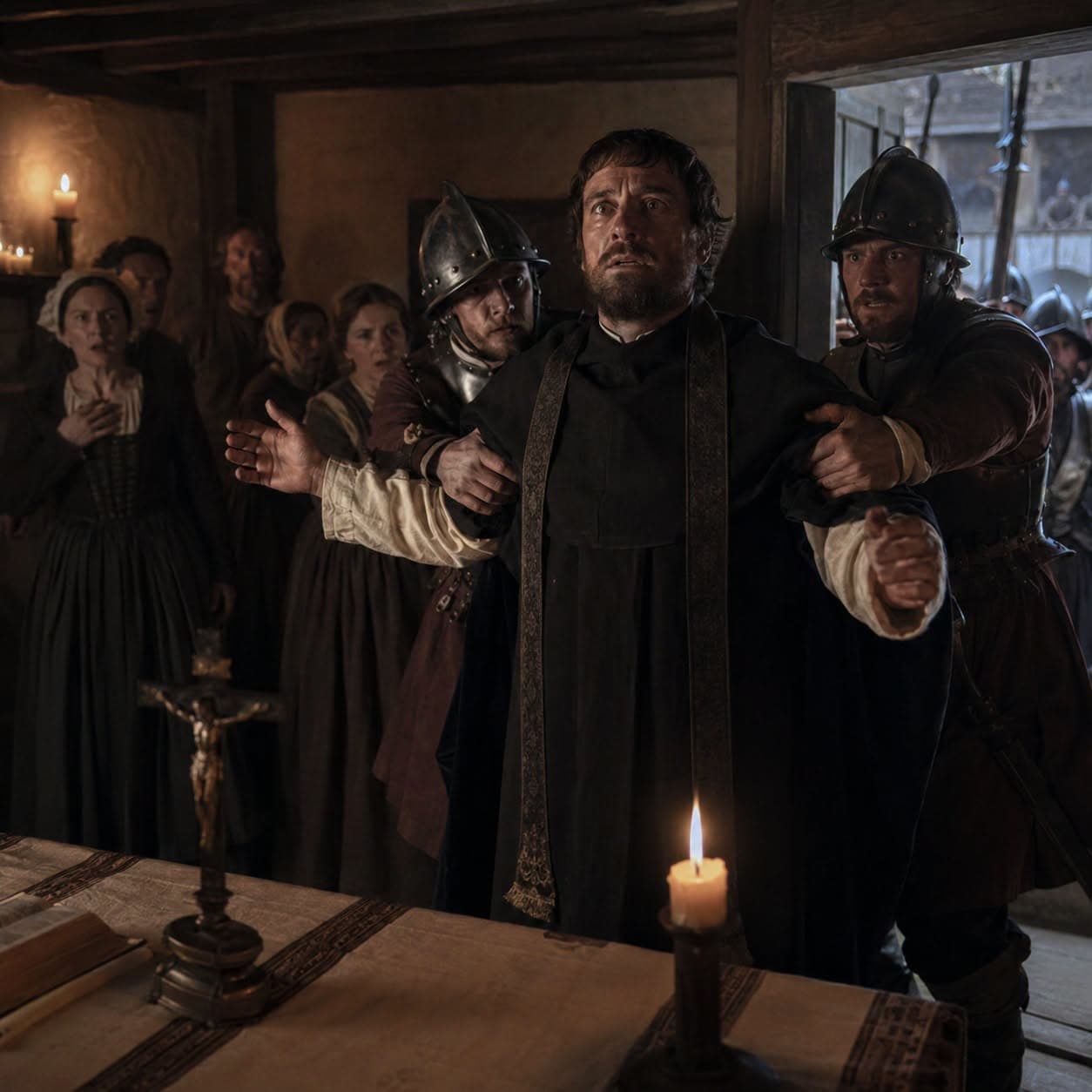
The soldiers found him mid-Mass. That was all of the evidence they needed.
Robert Sutton was born around 1543 in Burton-on-Trent, and he did not begin his career as a Catholic priest. He began it as an Anglican minister, serving as Rector of Lutterworth from 1571, delivering sermons to a congregation that had no reason to expect he would one day stand before them and tell them he had been teaching them false doctrine.
That reversal came from inside his own family. His younger brother William, who would go on to become a Jesuit, converted Robert to Catholicism, and Robert did not treat the conversion as a private matter to be kept quiet for the sake of his position. He told his own congregation plainly what he now believed, then left England for the seminary at Douai, where he was properly ordained a Catholic priest in 1578. A third brother, Abraham, was drawn into the same story, arrested and exiled alongside Robert in 1585 for their shared faith.
By the 1580s, Robert Sutton was working as an ordained Catholic priest in a country where that fact alone was enough to kill him. He was not accused of plotting against the queen, of raising arms, or of conspiring with any foreign power. Under the penal laws passed during Elizabeth I's reign, the act of having been ordained a Catholic priest abroad and returning to England to practise as one had itself been made high treason. Saying Mass was not incidental to the charge against men like Sutton. It was the charge.
He was arrested at Stafford while doing exactly that, caught in the middle of celebrating Mass, the sacrament itself serving as the moment of his exposure. There was little room for defence once the fact was established. The law did not require evidence of disloyalty beyond the priesthood itself, and a trial under those statutes was less a genuine examination of guilt than a formal confirmation of a fate that had effectively been decided the moment he was ordained.
He was convicted and sentenced to the full punishment reserved for traitors: hanging, drawing, and quartering. The execution took place on 27 July 1587 at Gallows Flat, on the outskirts of Stafford, a site used for exactly this purpose. What followed was not the clean, ritualised violence that the sentence's formal language might suggest. Accounts of his death describe him being cut down from the rope while still alive, as was standard practice at this point in the process, meant to preserve consciousness for what came next.
As Sutton attempted to rise, he was struck, not beheaded cleanly with a single deliberate blow, but hit across the mouth, the blow that ended his life arriving as something closer to a butcher's error than an execution.
His body was left on public display for a year afterward, a warning left exposed rather than buried. When Catholics eventually recovered part of his remains, they claimed to have found something that became central to how his memory survived: the thumb and forefinger of the hand that had held the consecrated host during Mass were completely uncorrupted, while the rest of his remains had decomposed as any body would. The relic passed to his brother Abraham, who had shared his exile, and was later kept at Stonyhurst College for generations before being returned to a church in Lutterworth in 1987, the same town where Sutton had once stood in an Anglican pulpit and told his own congregation he had been wrong.
Sutton was one of a great many priests who died this way across the 1580s, a decade in which the Elizabethan state pursued Catholic clergy with real, sustained organisation rather than sporadic cruelty. The law that killed him was not aimed at heresy in the abstract. It was aimed specifically at the priesthood as an institution, criminalising the training, the ordination, and the return of men who had gone abroad to seminaries on the continent and come back to serve congregations the state had already decided should not exist.
Four centuries passed before the institution he had died serving formally answered the state's verdict against him. Robert Sutton was beatified in 1987, exactly four hundred years after his death, one name among the long list of English Catholics the Church eventually recognised as martyrs for a faith that Elizabethan law had made, quite literally, a capital offence to practise.
That same year, the relic of his hand returned to Lutterworth, closing a loop that had opened in that same town more than four centuries earlier, when a rector first told his congregation that everything he had taught them needed to be unlearned.