Elizabeth was handing Robert Dudley to another queen. Halfway through the ceremony, she couldn't keep her hands off him.
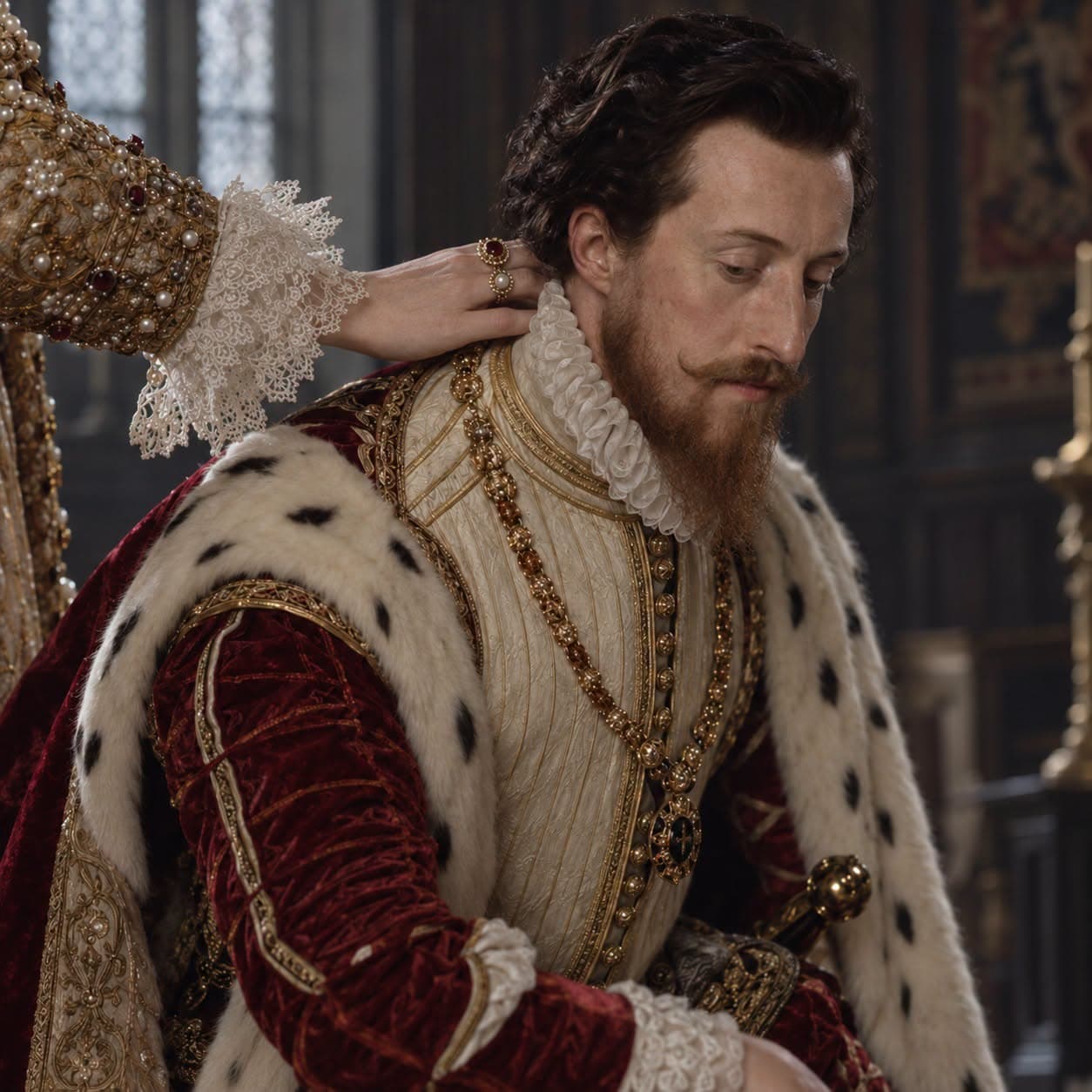
The queen had stood in Westminster and dressed Robert Dudley with her own hands on Michaelmas Day, 29 September 1564. He knelt before her in the ceremonial robes of an earldom she was about to give him, holding himself with a grave and discreet bearing, a man aware of the weight of the moment. Elizabeth helped fit the robes onto him herself, a gesture of intimacy that already said more than the formal proclamation soon would.
Watching from beside her stood two foreign ambassadors, the French envoy and the Scottish ambassador Sir James Melville. They were there because the ceremony was, at least officially, being performed for their benefit. Elizabeth was creating Dudley Earl of Leicester, having already made him Baron Denbigh, so that he might become an acceptable husband for another queen entirely: her cousin Mary, Queen of Scots.
Then, in the middle of the investiture, with Dudley still kneeling and the ambassadors still standing at her side, Elizabeth reached out and put her hand to the back of his neck, tickling him, smiling as she did it. Melville recorded the moment in his own memoir, close enough to see it happen: the queen "could not refrain from putting her hand in his neck to kittle him smilingly," with the French ambassador standing beside him.
It is hard to imagine a worse moment for the gesture. The entire purpose of the ceremony was to persuade Mary, through her ambassador, that Dudley was now a man of sufficient rank and standing to marry a reigning queen. Elizabeth needed Melville to carry home the image of a dignified new earl, someone whose blood and title could stand beside a crown.
Instead she gave him something else to report: a queen who could not keep her hands off the man she was offering away.
Elizabeth had already told Melville, in words plain enough to leave no room for misunderstanding, why she was doing this. If she had ever intended to marry, she said, she would have chosen Lord Robert himself, her brother and her best friend. But she had resolved never to marry at all, and so she wished her sister queen to have him instead. It was, on its face, an act of extraordinary generosity: giving away the one man she admitted she would have chosen for herself, so that another woman might have him as a husband.
Said aloud to a foreign ambassador, it was also a strange thing for a queen to confess. She was asking Melville to believe that her feelings for Dudley were real enough to explain the gift, yet distant enough that she could hand him to Mary without regret. The hand at his neck, in front of that same ambassador, suggested, perhaps, that she had not quite convinced herself of the second half of that claim.
When the ceremony was over, she asked Melville what he made of the new earl. He answered that Leicester was fortunate to have a mistress who appreciated his talents. Elizabeth pointed at Henry, Lord Darnley, and said, "Yet you like better of yonder long lad." She was, as it turned out, pointing at Mary's next husband.
Mary did not want Dudley either. When Randolph raised the match with her that spring, she was flabbergasted. She did not refuse outright, but demanded that if she were to marry him she must first be named Elizabeth's heir, a condition Elizabeth would never grant. Dudley's own enthusiasm seems to have been just as thin. Whatever ambitions the earldom served, they were ambitions closer to home, at the English court where Elizabeth kept him, rather than across the border in a Scottish marriage bed.
Whether Elizabeth ever intended the match to succeed is another matter. Mary marrying well would have strengthened her claim on the English succession, a prospect Elizabeth had every reason to delay. Offering Dudley, unrefusable in principle and unwanted in practice, kept the question of Mary's marriage suspended without resolving it in anyone's favour. Read that way, the tickling in front of the ambassadors becomes something closer to a confession than a slip: proof that the man on offer was never actually available to be given away.
Nothing came of it. Dudley remained Earl of Leicester and remained beside Elizabeth for the rest of his life, tied to her by a closeness that outlasted every one of her other courtships and marriage negotiations. He died in 1588, and by most accounts she grieved him as she grieved no one else.
Mary, left without the match Elizabeth had proposed, married Lord Darnley the following year instead. That marriage produced a son who would one day unite the English and Scottish crowns. It also produced Darnley's murder, Mary's disastrous marriage to Bothwell, her forced abdication, two decades of imprisonment in England, and finally her execution in 1587.
The husband Elizabeth had offered and Mary had refused was, perhaps, in the end, the safest option either woman ever had.