The letter arrived within days of the ninth of April.
It had been written in haste, which was the only honest register for what it contained. Hastings had watched Edward IV die at Westminster and he had understood before the body was cold what the death meant for the specific arrangement of men and intentions that Edward's will had attempted to fix in place. He understood it because he had spent eleven years close enough to the crown to read its geometry, and the geometry of the moment was this: the new king was at Ludlow with his Woodville escort, the coronation date was already being discussed in the rooms where Edward was still warm, and the man Edward had named Protector was two hundred and fifty miles away in Yorkshire with no knowledge yet that his brother was dead.
Hastings wrote immediately. He gave the letter to a rider and the rider covered the road north at the pace of someone who had been told what was in the packet and understood that the distance between receiving it and not receiving it was the distance between two different countries.
Richard read it at Middleham.
What the letter told him was not simply that his brother was dead. Men die. Kings die. Edward had been ill and the illness had accelerated and the death, when it came, had the quality of the inevitable arriving slightly ahead of schedule. What the letter told him, in the specific detail of the coronation timeline and the Woodville escort and the pace at which the council in London was already dividing, was that the death was not the event. The event was the twenty-five days between the ninth of April and the fourth of May, and fifteen of those days had already passed before the letter reached him.
He read it once. He read it again. He set it down on the table at Middleham.
He had been the loyal brother for twenty years. Not performing loyalty in the manner of men who calculate its return, but exercising it as the settled condition of his existence, the thing that had not required daily decision because it had been decided once and not revisited. He had never switched sides. When the ground shifted under everyone else in 1470 and 1471, he had followed Edward into exile in Burgundy and returned with him and fought at Barnet and Tewkesbury while other men recalculated their positions and George of Clarence moved between allegiances as though allegiance were a garment to be changed with the weather. Richard had not moved. He had been given Yorkshire and he had administered Yorkshire and he had asked for nothing beyond what he was given and what he was given he had earned.
The fixed point was gone. The letter told him that, and it also told him what the absence of the fixed point meant for the arrangement he had been given and the role he had been named to fill and the nephew who was currently riding toward a coronation that the men around him were managing toward a conclusion Richard had not been consulted about.
He had twenty-five days. He had probably fewer. He had enough.
He stood up from the table. He began to give orders.
Within days of receiving the letter, Richard was in York.
The city knew how to perform mourning. It had done it before, for lesser men, and it understood what was required when the dead man was a king and the living man administering the ceremony was the most powerful figure in the north of England. The black was worn. The masses were said. The northern lords came in from their estates and gathered in the city that Richard had made the centre of his authority, and they knelt and took their oaths of fealty to Edward V, and Richard administered those oaths with the gravity the moment required.
He wept for his brother. The sources do not record whether the grief was performed or genuine and the distinction may not have been available to him. Edward had been the fixed point of his entire adult life. The loyalty had not been a calculation. The loss was real in the way that the removal of something structural is real, not only as an absence but as a sudden new weight pressing through the gap where the support had been. He had twenty years of a brother and a king and a north to govern and a role that suited him, and the letter had ended all of it simultaneously, and the weeping in York may have been the one unmanaged thing he permitted himself before the management of everything else began.
Because the management had already begun.
In the same city, in the same days, his men were assembling. Not quietly, not covertly, the assembling of a northern lord's retinue for a journey south was not something that could or needed to be hidden, and Richard was not hiding it. He was the Lord Protector. He was riding to London to fulfil the role his brother's will had given him. He required men for the road and men for the arrival, and the men of the north who had served him and eaten at his table and administered his justice across Yorkshire and the borders understood without extended explanation what the moment required and what riding with him now would mean for the years ahead.
The letters to the council went south while the preparations continued. They expressed loyalty and grief in the same sentences, which was accurate, because loyalty and grief were the same thing in that moment, both of them oriented toward a dead king and a living arrangement that needed protecting. Richard wrote that he intended to fulfil his brother's will. He wrote that he was coming. He wrote with the careful precision of a man who understood that the letters would be read by people trying to calculate his intentions, and he gave them nothing to calculate. He was the Protector. He was coming south. The mourning was sincere and so was the departure and there was no contradiction between them.
He wore the motto Loyaulte me Lie. Loyalty binds me. He had worn it his entire adult life and it had described him accurately for twenty years and he was still wearing it now, riding out of York and south through the Midlands, and whether it still described him accurately was not a question the motto asked.
He had finished the letters. He had assembled his men. He had wept for his brother in the city his brother had given him.
He rode.
At Brecknock Castle in Brecon, Henry Stafford, Duke of Buckingham, had also received the news.
He was twenty-eight years old and he had spent his adult life wearing an arrangement he had not chosen. The crown had made him a ward at ten years old and married him inside that wardship to Catherine Woodville, the queen's sister, and the marriage had been the condition of his position at court for the entirety of his adult life. He was one of the greatest magnates in England. He was related by marriage to the most powerful family in the new reign. He had resented both facts every day since the arrangement was made, and the resentment had nowhere to go in the years when Edward IV was alive and the Woodville position was secure and the court ran on the geometry Edward had established and maintained by the specific force of his personality.
Edward was no longer alive.
Buckingham left Brecknock on approximately the twenty-fourth of April. He took three hundred men. Before he cleared the Welsh border he sent a servant ahead to find Richard on the road and make contact. He did not write to request permission. He did not wait for an invitation. He assembled what he had and rode north to find the one man positioned to meet this moment, and he sent a man ahead of him so that Richard would know he was coming before he arrived.
The servant found Richard somewhere north of Northampton. What passed between them, what the message contained, what Richard sent back, what terms if any were discussed on the road in the last week of April 1483, is not in any record that survives. That the contact was made is confirmed. That Buckingham covered one hundred and thirty miles in five days with three hundred men and arrived not as a suppliant but as a partner is confirmed. On the twenty-ninth of April, Richard and Buckingham rode into Northampton together.
Anthony Rivers was waiting for them.
He had managed the young king's journey from Ludlow with the precision his position required, keeping the pace correct and the household in order and the political implications of every stopping point carefully considered. He was the queen's brother and the king's governor and the most accomplished figure the Woodville family had produced, a tournament champion and a scholar, a man who had translated Christine de Pizan and corresponded with Caxton and moved through the courts of Europe with an ease that most English magnates could not approximate. He had also spent the three weeks since Edward's death calculating what the Protectorship meant for the position he and his family held, and the calculation had told him that the Protectorship was the problem and that the distance between Ludlow and London needed to be closed before Richard could close it first.
He had come within fourteen miles of closing it.
He had sent the young king ahead to Stony Stratford, since the accommodation at Northampton was insufficient for a party of that size, the logistics required the separation, there were reasonable explanations available and Rivers had provided them, and remained himself at Northampton to receive the Protector. It was the correct thing for a governor to do. It was also the thing that placed Richard's nephew fourteen miles further south, fourteen miles closer to London, fourteen miles closer to a coronation on the fourth of May, on the eve of the first meeting between the boy's governor and the boy's Protector.
That evening the three men dined together.
The sources describe the meal as cordial and there is no reason to doubt it. Rivers was a man who could conduct a dinner at the end of the world and have the guests feeling that the wine had been well chosen. The conversation moved where it moved, touching on the road south, the arrangements for London, and the business of a new reign settling into its shape, and the candles burned and the plates were cleared and the evening drew itself toward its close with all the surface comfort of three powerful men who had temporarily set aside the geometry of what they each represented.
Richard said goodnight. Buckingham said goodnight. Rivers retired to his rooms. He had no reason to believe the morning would be different from the evening.
Across the table that same night, Richard had spent dinner in the company of a man who had sent the king fourteen miles away from the meeting, in the direction of London, on the eve of their first encounter. He had watched Rivers across the candlelight and said the correct things and filled his glass and said goodnight, and everything about the evening had been exactly as a cordial dinner between powerful men should be, and Rivers had read it correctly as cordiality and gone to bed satisfied.
He was arrested at dawn.
Richard's men moved through Northampton in the early morning before the city had properly woken, before Rivers had risen, before the night's satisfaction had finished converting itself into the confidence of a new day. Rivers was taken. Richard Grey was taken at the same hour. There was no resistance because there was no time for resistance and no warning from which resistance could have been organised, and the arrests were complete and the men were under guard before the sun was fully up.
Richard did not wait to see what Northampton made of it. Rivers and Grey rode north under armed guard. Their destination was Pontefract Castle.
Richard rode south for Stony Stratford at the pace of a man with fourteen miles to cover before the king's party broke camp and continued toward London without him.
He arrived before the king's party had cleared the road.
Edward V was twelve years old. He had ridden from Ludlow over two weeks in the company of men he knew, his governor Rivers, his half-brother Grey, the household that had formed the texture of his daily life since he was old enough to have a daily life. He had conducted himself across that journey with the composed gravity the records of his short life consistently note, the particular quality of bearing that settles in children who have been raised understanding what they will one day be required to carry. He was his father's son in his colouring and in the stillness behind his eyes and in the way he held himself in the saddle.
He was eating, or preparing to ride, or standing in the early morning light of Stony Stratford doing whatever a twelve-year-old king does in the hour before the day begins, when his uncle Richard of Gloucester rode in from the north with Buckingham at his shoulder and an armed retinue behind them.
Richard dismissed the boy's household. The men who had ridden from Ludlow, who had managed the journey, who had formed the familiar perimeter of faces and voices around the young king for two weeks on the road, were removed. Stood aside. The space they had occupied was filled by different men, Richard's men, who arranged themselves around the boy with the quiet efficiency of people who had been told what their positions would be before they arrived.
Richard placed himself at his nephew's side. The king asked where his uncle Rivers had gone.
He was told that Rivers had been engaged in activity against the Protectorate. He was told that the men who had surrounded him on the road from Ludlow had not had his interests at their centre. He was told these things by the man who had arrested Rivers four hours earlier and ridden fourteen miles through the early morning to reach him before anyone else could carry a different version of events.
Edward wept.
He was twelve years old and the men he had trusted were gone and the man now at his side was his father's brother wearing his father's authority and his father's commission, and there was no one present to tell him a different story and no version of the morning available to him except the one Richard had ridden fourteen miles to deliver.
Richard turned south.
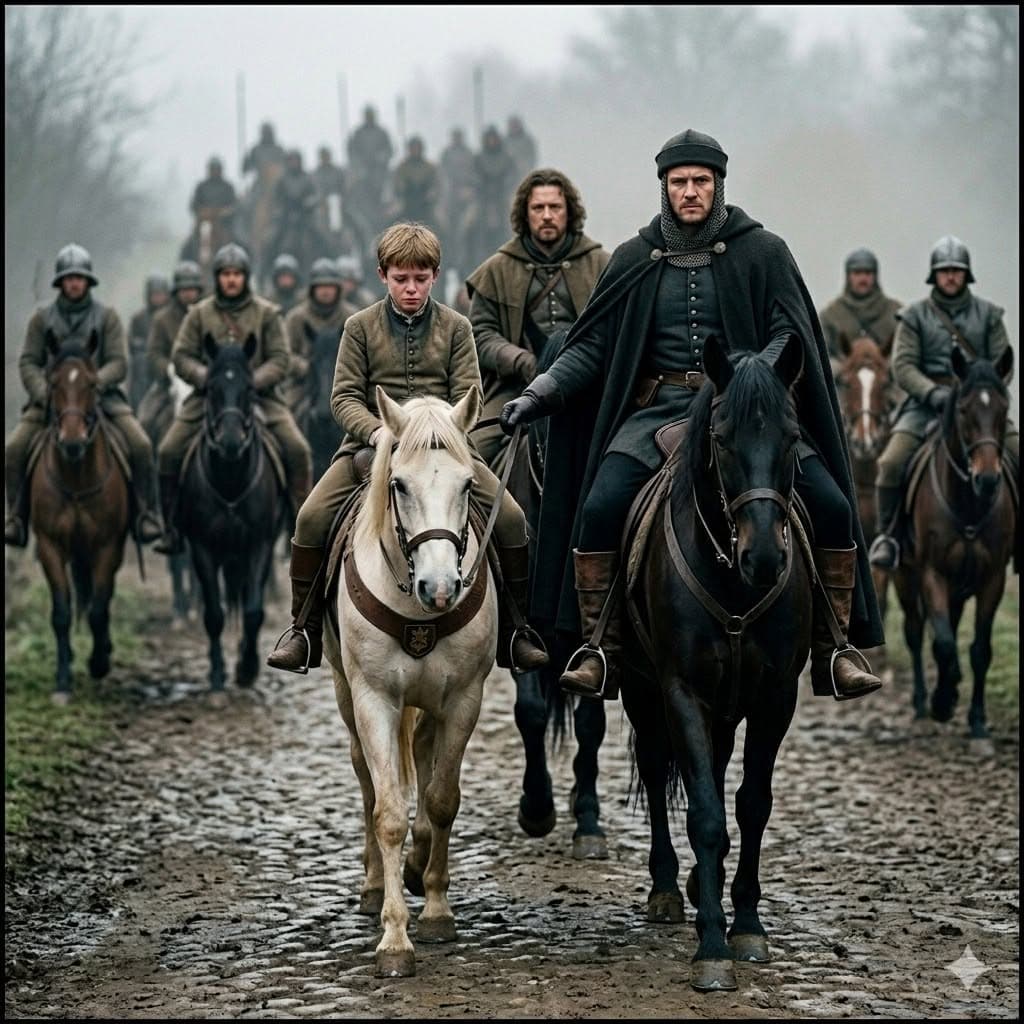
He rode with the young king beside him and Buckingham at his shoulder, at the pace of a procession through the late April countryside, formal and orderly and correct in every outward particular. The Protector and the king. The word Protector means one who protects. The arrangement his father's will had specified. The boy who had wept at Stony Stratford rode in silence or did not ride in silence, asked questions or did not ask questions, understood what had happened to him or was still in the process of understanding it, and the record gives none of it. The road south is the one part of those eleven days that the sources decline to inhabit.
What passed between them on that road is not recorded. It is quite possible that neither the word Protector nor the word prisoner was ever spoken aloud. They simply rode.
On the fourth of May, Richard of Gloucester entered London with Edward V. The council acknowledged the Protectorship. The young king was lodged in the Tower of London, which was the traditional royal residence before a coronation, which it was, which it had always been. The word traditional carried what it needed to carry and asked nothing further of anyone present.
Twenty-five days had passed since Edward IV died. Eleven had passed between the letter at Middleham and the arrest at dawn at Northampton.
The record notes only the speed. It does not say what the speed meant.