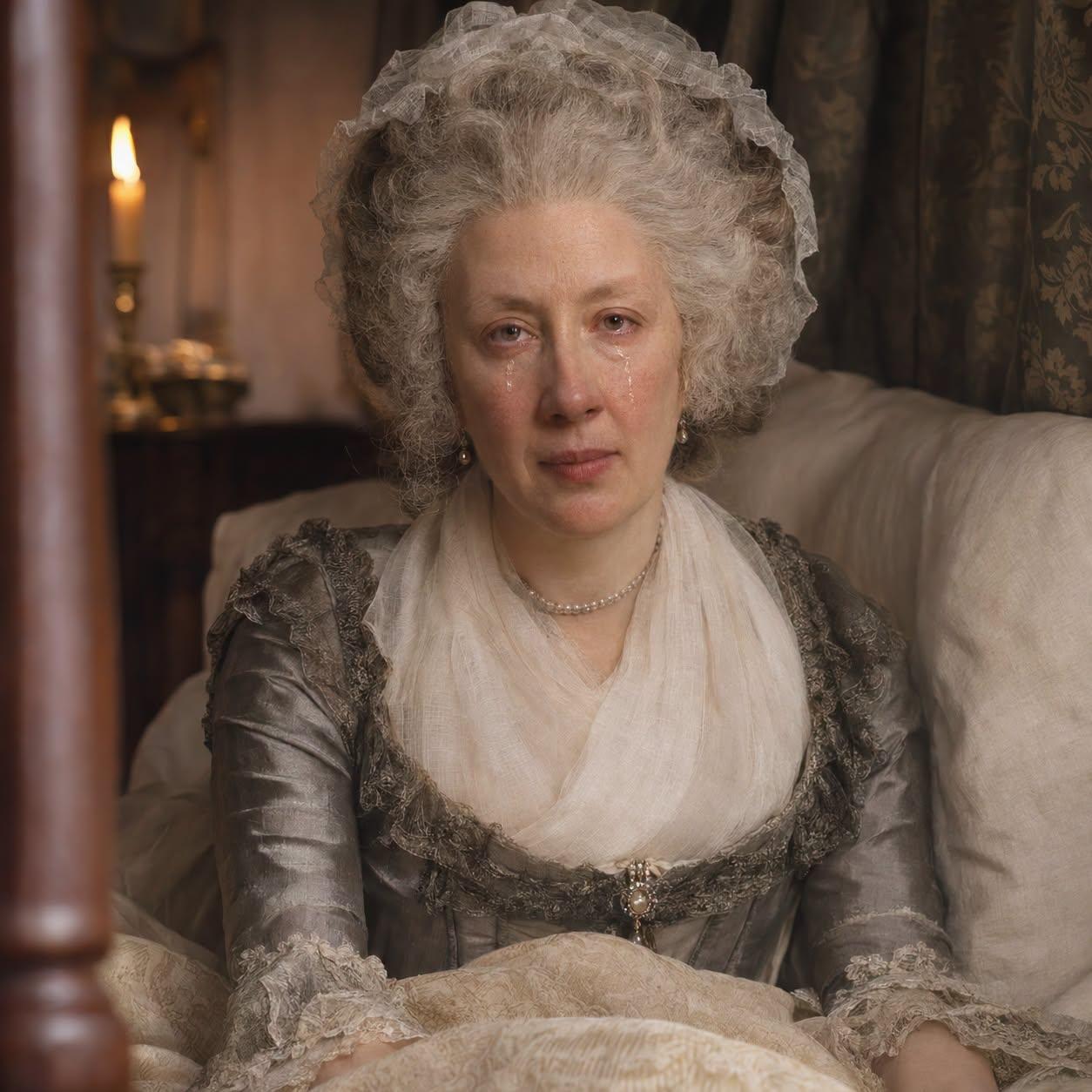
Charlotte’s hand was so cold that the woman beside her compared it to marble. Three women were helping her undress. Her husband had agreed to sleep in the next room because she was ill.
The crisis had come at Windsor on 5 November 1788. George III, already unwell, had become delirious at dinner, and Queen Charlotte had broken down. During the night that followed, a little after one on the morning of 6 November, Fanny Burney was summoned to help attend her. The queen was forty-four. She had been married to George for twenty-seven years.
They had married in September 1761, when Charlotte was seventeen, and she had borne fifteen children. Music was a shared pleasure, and even now, as the king’s health deteriorated, a concert had been expected. Their family life had its familiar arrangements, its hours and duties, its people waiting in the appropriate rooms. That evening, even those inside the household struggled to discover what was happening.
Fanny, a novelist employed in the queen’s wardrobe, had watched Charlotte grow more distressed that day. The king had gone out for a carriage ride with their eldest daughter. Charlotte had taken offence at a newspaper paragraph about his illness and ordered Fanny to burn the paper. The printer, she said, should be called to account. Even inside the royal household, a husband’s illness was already something strangers were discussing.
At seven that evening, Fanny learned that the music had been cancelled and the musicians sent away. The house had grown strangely quiet. Men came and went, their faces and brief answers giving her very little comfort. Eventually Mr Fairly, one of the royal attendants, told her what had happened at dinner. The king’s condition had alarmed everyone. Charlotte had been overcome, the princesses were distressed, and the Prince of Wales had burst into tears.
At ten, Fanny went to her room to wait until she was needed. Midnight passed. She opened her door and listened, but heard nothing. She wanted to find someone who could tell her more, yet dared not miss a summons. Another hour went by before a page came for her.
Lady Elizabeth Waldegrave and Miss Goldsworthy were already with Charlotte. The queen sat pale and quiet while they helped her undress. Fanny’s own hands shook so badly, and her eyes were so full of tears, that she could scarcely make herself useful. The women who had been there longer were steadier.
Fanny gave her the camphor julep prescribed by Sir George Baker.
“How cold I am!” Charlotte cried, putting her hand on Fanny’s.
At Sir George’s urging, the king had consented to sleep separately because the queen was ill. He would go no further than her adjoining dressing room, where a bed was put up for him. He also directed that Miss Goldsworthy should sit with Charlotte. Ill as he was, George was still giving instructions about his wife’s care.
Charlotte, too, was still giving orders. Fanny wanted to remain nearby, and Lady Elizabeth offered to stay, but the queen sent them to their rooms. Another wardrobe attendant was to sit in the little dressing room. Fanny obeyed and went to bed, hoping to preserve her strength for whatever came next. She could not sleep.
At six on the morning of 6 November, she rose and dressed again. Pages and attendants had kept watch through the night. When Fanny reached Charlotte, the queen was sitting up in bed, with Miss Goldsworthy beside her. Charlotte asked how she was. Fanny tried to answer and burst into tears.
Then Charlotte cried too.
She thanked Fanny for it. Weeping had brought relief after a night in which she had been unable to cry. During that night, George had entered her bedroom to satisfy himself that she had not been taken away. He had stayed for half an hour. Charlotte was now frightened that he would come in again.
Later that morning she kept Fanny with her, sending her to listen to the king in the next room and report what he was saying. His voice was hoarse from continual talking. Fanny brought back what reassurance she could, leaving some things unsaid.
Beyond those rooms, the illness would become a struggle over who should exercise the king’s powers. During the winter of 1788–89, plans for a regency strained Charlotte’s relationship with her eldest son. The Prince of Wales was the expected regent; proposals to restrict his authority and entrust the king’s care and household to his mother brought accusations that she was meddling in politics. Arrangements for her husband’s care had become inseparable from a dispute over the government of the country.
George recovered in 1789 before the proposed regency took effect. In September that year, Charlotte sat for the young painter Thomas Lawrence at Windsor. She was reluctant to sit, and the portrait shows her wearing pearl bracelets with elaborate clasps, one containing her husband’s miniature, the other his royal monogram. The hand Fanny had felt, cold as marble, was painted wearing the king’s likeness. The bracelets had been his wedding present.