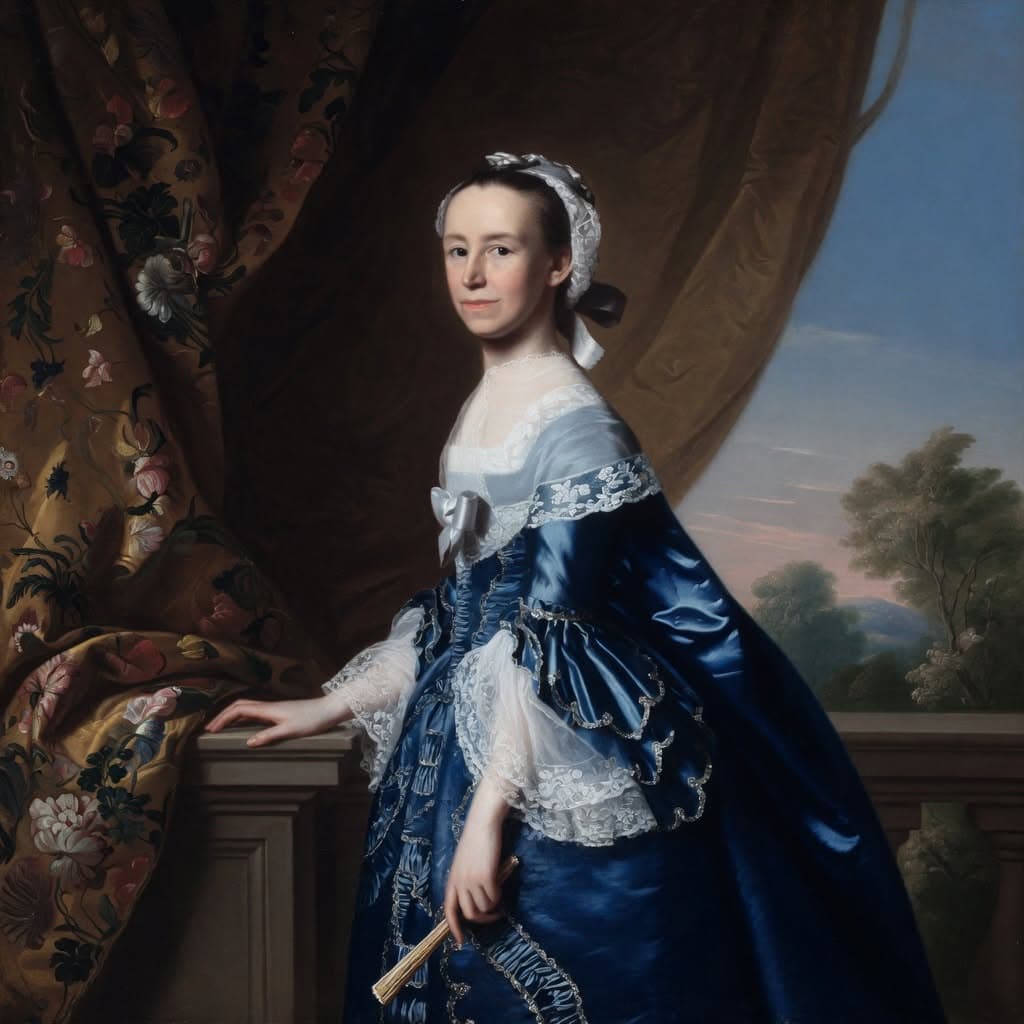
She wrote the words that helped start a revolution. She wrote them without her name on them, because the era did not permit a woman to write politics under her own name, and she had things to say that could not wait for the era to change.
Mercy Otis was born on the fourteenth of September 1728 in Barnstable, Massachusetts, the daughter of a prosperous Cape Cod family with strong opinions about British taxation and the specific good fortune, for Mercy, of a father who believed his daughter's mind was worth developing. She was not formally educated — girls of her class and period were not — but she sat in on the lessons given to her brother James by their uncle, a minister and Harvard man, and she read everything the house contained, and she emerged from that childhood in Barnstable with a political intelligence that had no official outlet and no intention of staying quiet.
James Otis became one of the most prominent voices against British taxation in Massachusetts. His sister watched, absorbed, understood, and waited. In 1754 she married James Warren, a Plymouth merchant and politician who moved in the same circles as Samuel Adams and John Hancock, and she moved with him into the centre of the revolutionary conversation, the woman at the table who was not supposed to be at the table and was there anyway. They had five children. She wrote between the children and the housekeeping and the management of the household, which is the only time women of her period were given to write, and she used every hour of it.
In 1772 a Boston newspaper published a political play called The Adulateur. It was a savage satirical portrait of the royal governor of Massachusetts, Thomas Hutchinson, reimagined as a tyrannical villain called Rapatio, corrupt and imperious and contemptuous of the colonists he ruled. It was precisely the kind of political writing that was igniting Massachusetts opinion toward rebellion, exactly the kind of public work that shaped the revolutionary conversation, the kind of thing that appeared under a man's name or no name at all. It appeared under no name at all. It was Mercy's.
Two more plays followed — The Defeat in 1773 and The Group in 1775, each one sharper than the last, each one published in newspapers and passed hand to hand through the committees and drawing rooms of Massachusetts while their author stayed in Plymouth and wrote letters to Abigail Adams and corresponded with George Washington and Thomas Jefferson and Samuel Adams and kept her name off the title pages because that was the price of being read. The plays could not be staged — Puritan Boston had prohibited theatrical performance — but they were printed and circulated and read aloud and they did the work she intended them to do. She ignited the revolution with words nobody was supposed to know were hers.
She met Abigail Adams in the spring of 1773, when Abigail accompanied John to Plymouth for a court session, and what followed was the most important intellectual friendship between women in the history of the early republic. Abigail was fifteen years younger. Mercy was already writing the plays that were shaping Massachusetts.
They corresponded for decades, two women who had arrived at the same political conclusions by the same route of self-education and careful observation and the specific frustration of minds that had no official channel, and who were doing completely different things with the conclusions. Abigail wrote private letters to her husband. Mercy published. Both of them knew the other was doing something the century had not designed for women and neither of them could do the other's thing.
The revolution succeeded. The men whose names are on the documents built the republic. And Mercy looked at what they had built and said it was not enough.
In 1788, as the states debated ratification of the Constitution, she published a pamphlet called Observations on the New Constitution under the pseudonym A Columbian Patriot. She argued that the document was dangerous, that it lacked a bill of rights, that it concentrated power in ways that made tyranny too easy, that the men who had fought a revolution against arbitrary authority were building structures that would permit exactly that authority to flourish under American colours.
She was a Jeffersonian Republican in a world where John Adams was becoming a Federalist, and the political distance between them was growing into something that would eventually cost them both. Her pamphlet is credited by historians as one of the voices that pushed for the Bill of Rights, which was added three years later. She was right. The record proves it. She published it without her name.
She spent twenty-five years writing the history.
She had been taking notes since before the revolution, corresponding with the men who made it, watching from Plymouth and from the rooms her husband's position gave her access to, and in 1805 she published three volumes called History of the Rise, Progress and Termination of the American Revolution, the only comprehensive history of the revolution written by a woman who had lived through it, who had known its architects personally, who had in some cases helped to build it. She put her name on it. She was seventy-six years old. It was the first major work she had ever published under her own name.
John Adams read it and the letters began arriving in the summer of 1807, two years after publication, ten of them, sent in rapid succession without waiting for her replies between them. Mercy herself described them as ten long letters of accusation and reproach. He told her she had been malevolent. He told her she had fabricated. He told her she should have known more of the law of nations, the policy of governments, and the etiquette of courts before she attempted to write history. She wrote back without apology.
They did not speak for years. Their mutual friend Elbridge Gerry eventually brought them back to correspondence, and they reconciled in 1812. She was eighty-three years old. He was seventy-six. They had built the same republic and disagreed about what it was, which is either the inevitable ending for two people of strong political conviction or simply what happens when the thing you have given your life to turns out to be a compromise, and you cannot agree on which compromises were necessary and which were betrayals.
She died on the nineteenth of October 1814, eighty-six years old, in Plymouth, Massachusetts, the town where she had written the plays and the pamphlets and the history and the letters, where she had sat in rooms full of the men who were building the republic and she had watched and remembered and written it all down, while they built the republic they wanted and were now surprised to find that the woman who had watched them do it had written down what she saw.
She had published her first political play at forty-three without her name on it. She had published her pamphlet opposing the Constitution at fifty-nine as A Columbian Patriot. She put her name on the history at seventy-six, having spent fifty years writing without it, and the men whose republic she had helped to build told her she should have known more about courts and governments before she tried.
She had been in those courts and governments longer than most of them. She had written everything down. The republic she helped build gave women the vote one hundred and six years after she died. History was not, in the end, their province to withhold.